Last updated: October 6, 2026 | By Richard Hale
Yoga is one of the few forms of movement backed by real clinical research for arthritis and joint pain, not just tradition or word of mouth. In an 8-week Hatha yoga trial, older women with knee osteoarthritis reported a 38 percent reduction in pain and a 35 percent reduction in stiffness. This guide breaks down what the evidence actually shows, how yoga differs from ordinary stretching, which styles are appropriate for sensitive joints, specific poses for the knees, hips, and shoulders, and how to start without aggravating an already painful joint.
This content is for educational purposes only and is not medical advice. If you have inflammatory arthritis during a flare, recent joint replacement, significant balance impairment, or spinal disc issues, talk with your healthcare provider or a physical therapist before starting yoga so any needed modifications are clear from day one.
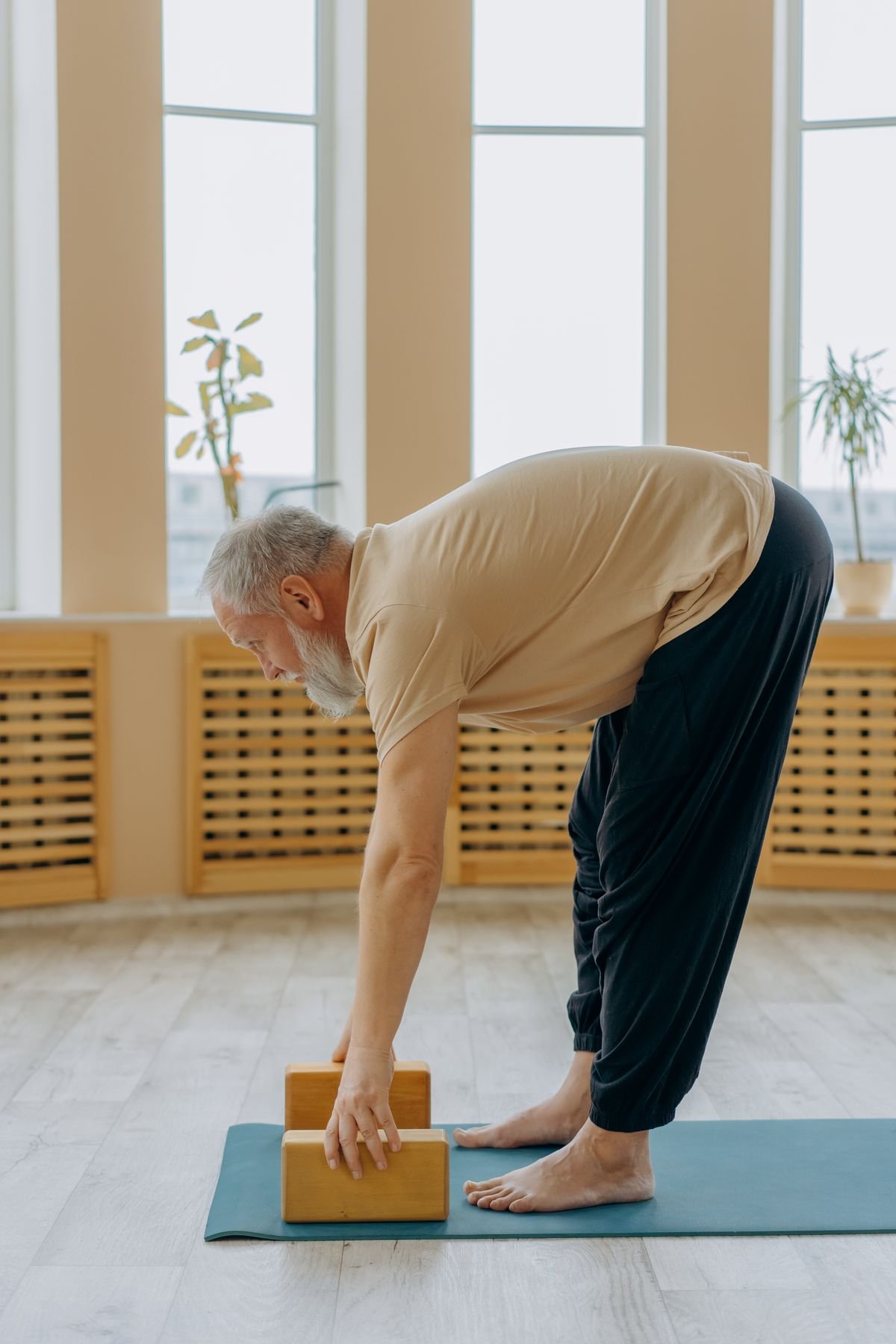
Table of Contents
- What the Evidence Actually Shows
- How Yoga Differs From Ordinary Stretching
- Best Types of Yoga for Sensitive Joints
- Poses and Practices for Knees, Hips, and Shoulders
- Precautions and Modifications for Arthritis
- How to Start Safely
- The Bottom Line
- Frequently Asked Questions
What the Evidence Actually Shows
Clinical trials in older adults with osteoarthritis and rheumatoid arthritis show that yoga measurably reduces pain and stiffness, and that most of the gains hold up months after the program ends. This is not a single small study. It is a pattern that shows up across trials run at different institutions, on different arthritis types, using different yoga formats.
The most specific numbers come from a pilot randomized controlled trial published in BMC Complementary and Alternative Medicine (Cheung et al., 2014). Thirty-six community-dwelling women with knee osteoarthritis, average age 72, were assigned to either an 8-week Hatha yoga program (weekly group class plus home practice) or a wait-list control group. At 8 weeks, the yoga group’s WOMAC pain scores dropped from 9.3 to 5.8, a reduction of roughly 38 percent. Stiffness scores dropped from 5.2 to 3.4, a reduction of roughly 35 percent. The program was rated safe and acceptable, with a 95 percent retention rate, which matters for a population often assumed to be too frail or too sedentary for a new exercise habit.
A larger trial from the Johns Hopkins Arthritis Center (Moonaz, Bingham, Wissow, and Bartlett, Journal of Rheumatology, 2015) enrolled 75 sedentary adults with either rheumatoid arthritis or knee osteoarthritis in an 8-week Integral-based Hatha yoga program, with poses modified individually. Compared to a wait-list group, participants who did yoga showed significantly better physical health scores, walking capacity, and mood. The detail that matters most for anyone deciding whether yoga is worth the time: when researchers checked back in at 9 months, most of the physical and psychological gains were still present. This was not a short-lived placebo bump. It looks like a durable change in function.
The Arthritis Foundation and the Johns Hopkins Arthritis Center both summarize the broader research the same way: regular yoga practice in people with arthritis is associated with less joint pain, better flexibility and joint function, more muscle strength around affected joints, improved balance, and lower stress and anxiety. Serious injury from yoga is rare when practiced under qualified instruction and without forcing extreme positions. These findings sit alongside the broader picture of joint health after 40, where consistent low-impact movement tends to outperform any single “miracle” exercise.
How Yoga Differs From Ordinary Stretching
Yoga is not just stretching with a nicer name. The difference that matters clinically is the breath and nervous system component layered on top of the joint movement, which stretching alone does not provide.
A static stretching routine moves a joint through its range and holds it there. Yoga does something additional: it pairs sustained, controlled breathing (pranayama) with the held positions, and many sessions end with a period of stillness or guided relaxation. This breathing component is not decorative. Slow, deliberate breathing activates the parasympathetic nervous system, the body’s “rest and digest” branch, which lowers the sympathetic “fight or flight” activation that keeps chronic pain wound up. For someone whose knee or shoulder pain has become chronic, this nervous system effect is often as relevant as the physical range-of-motion gain, because chronic pain is rarely just a tissue problem. It is also a nervous system that has learned to stay on alert.
This is also where yoga’s angle is genuinely different from two other low-impact practices covered on this site. Tai chi is built around continuous, flowing weight shifts between the legs, and its strongest evidence is for balance and fall prevention through proprioceptive training. Pilates is a neuromuscular control system built around spinal stability and precise core activation, with its strongest evidence in chronic low back pain. Yoga’s core mechanism is different from both: it combines held, joint-specific stretching with a breath and nervous system component aimed at down-regulating pain sensitivity. If tai chi trains balance through movement and Pilates trains stability through control, yoga trains range of motion and nervous system calm through breath and stillness. Many people benefit from combining more than one of these rather than treating them as competing options.
The breathing and relaxation component also explains why yoga shows up so consistently in the research for psychological outcomes, not just physical ones. Reduced anxiety, better mood, and better sleep were reported across the trials cited above, alongside the pain and stiffness reductions. Ordinary static stretching, done without any breath practice, has not been studied for these effects, and there is no clear mechanism for why it would produce them.
Best Types of Yoga for Sensitive Joints
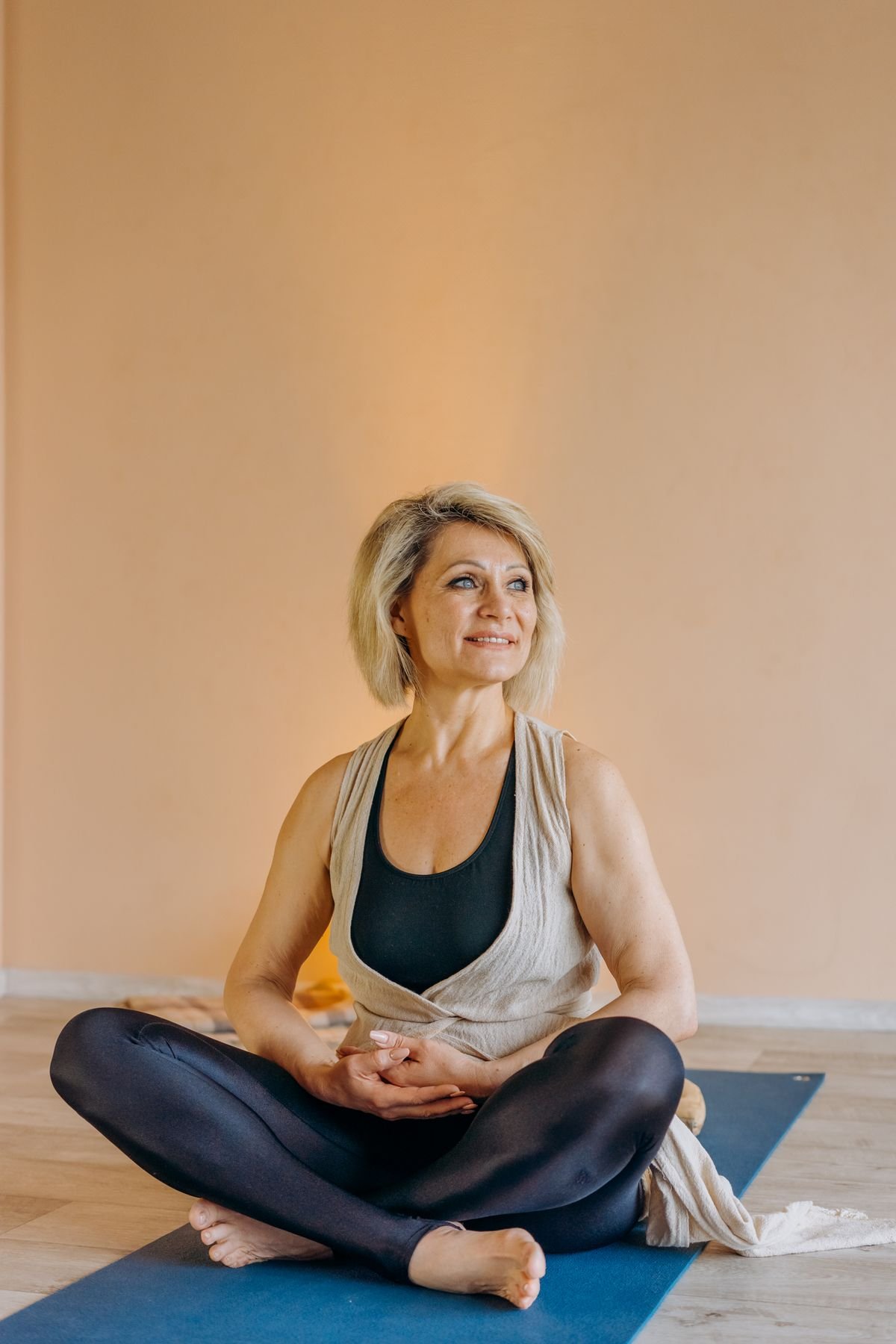
For arthritis or general joint sensitivity after 40, the styles worth starting with are the slow, prop-supported ones. Vigorous, fast-paced styles are the ones to approach with caution or skip entirely while joints are sensitive.
Iyengar yoga: the style most often recommended by the Arthritis Foundation specifically because of its heavy use of props (blocks, straps, bolsters, chairs) to support the body in each position. This makes poses accessible even with significant range-of-motion limits, and it emphasizes precise alignment over depth of stretch, which reduces the risk of overstretching an unstable joint.
Restorative yoga: almost entirely passive. Poses are supported by props and held for several minutes at a time, with the goal of deep relaxation rather than strength or flexibility gains. This is a reasonable entry point for someone in a flare or recovering from a joint procedure, since the nervous system benefit is present with minimal physical demand.
Yin yoga: also slow and held-position based, but targets the connective tissue (ligaments, joint capsules, fascia) rather than muscle, using longer holds (often 2 to 5 minutes) at a gentle depth. Because the holds are long and the intensity is meant to stay mild, yin yoga rewards patience over effort, which suits sensitive joints well.
Gentle or “slow flow” Hatha yoga: the format used in both clinical trials cited above. Poses are held briefly, transitions are unhurried, and instruction typically includes modifications by default rather than as an afterthought. This is a good middle option between the stillness of restorative/yin and a more active practice.
Styles to approach with more caution: Vinyasa (fast-paced, flowing between poses with less alignment cueing), Ashtanga (a fixed, physically demanding sequence), and Bikram or other “hot yoga” formats (heated rooms that increase the risk of overstretching because tissue feels more flexible than it structurally is). None of these are off-limits forever. They are simply not the place to start while a joint is actively painful or unstable, and the Johns Hopkins Arthritis Center specifically advises caution with vigorous styles for this reason.
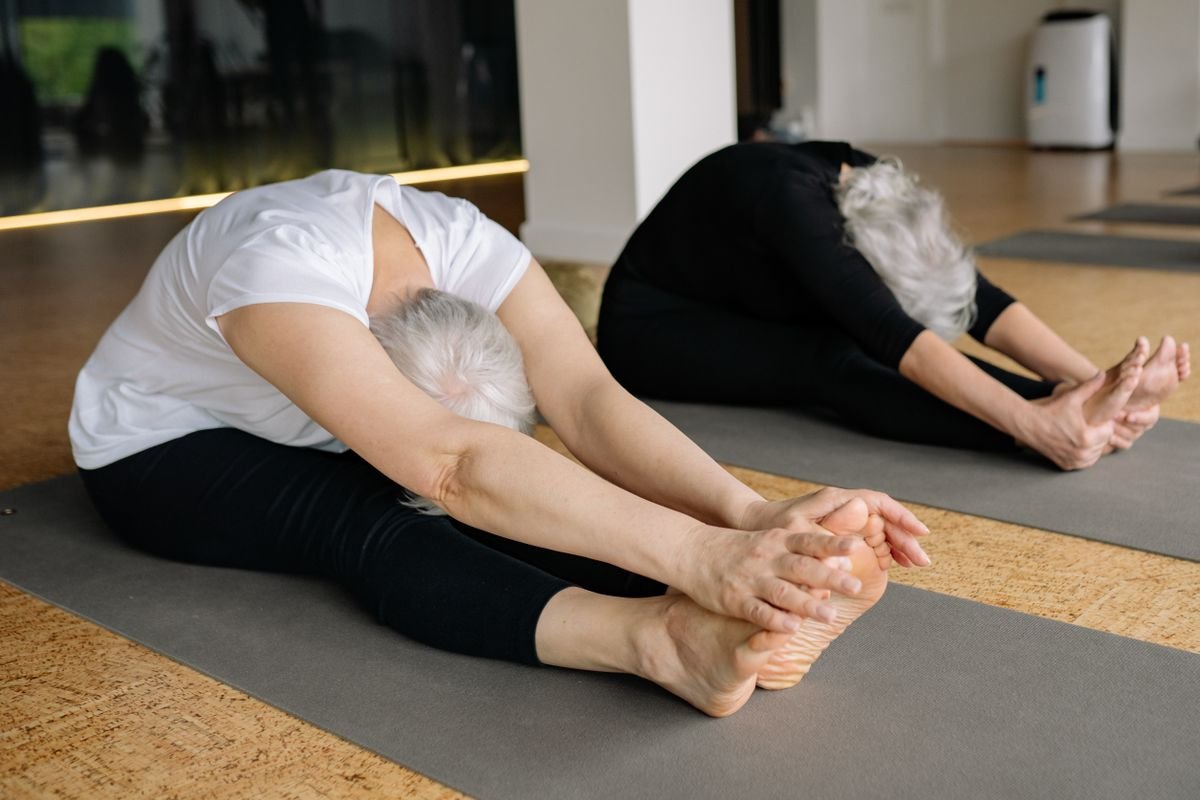
Poses and Practices for Knees, Hips, and Shoulders
These are commonly used poses for the joints that tend to be most affected after 40, along with the modification that makes each one appropriate for a sensitive joint rather than a risk to it.
For the knees:
- Supported bridge pose: lying on your back with knees bent, feet flat, lift the hips slightly and rest them on a block rather than holding an unsupported lift. This strengthens the muscles around the knee and hip without deep knee flexion under load.
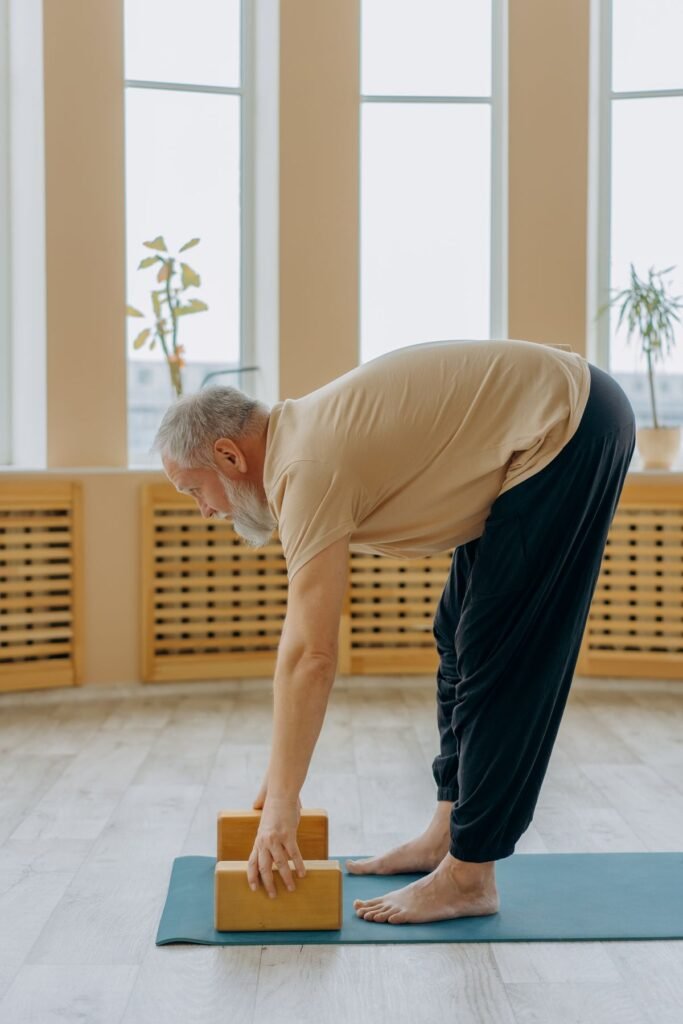
- Chair-assisted forward fold: instead of a standing forward fold that loads the knees in a deep hinge, rest the hands on the back of a sturdy chair and hinge only as far as is comfortable, keeping a soft bend in the knees throughout.
- Reclined leg stretch with a strap: lying on your back, loop a strap around the ball of one foot and extend the leg toward the ceiling, using the strap to control the stretch rather than pulling the knee toward the chest by hand.
For the hips:
- Supported reclined bound angle: lying on your back with the soles of the feet together and knees falling open, place blocks or cushions under each knee so the hips open only to a comfortable range rather than the floor pulling them further than the joint is ready for.
- Seated or chair pigeon: seated in a chair, cross one ankle over the opposite knee and gently hinge forward from the hips. This targets the same hip rotators as full pigeon pose without the deep knee flexion the floor version requires.
- Supported low lunge: using a block under the back knee and a chair or wall for hand support, this opens the front of the hip without asking the front knee to bear full body weight in a deep bend.
For the shoulders:
- Wall-supported shoulder stretch: standing facing a wall with one hand placed on it at shoulder height, gently rotate the body away to stretch the shoulder and chest, controlling the range with your stance rather than momentum.
- Cow face arms with a strap: instead of clasping the hands behind the back (often not possible with a stiff shoulder), hold a strap between the hands so the gap can be as wide as needed while still working the same range of motion.
- Supported child’s pose: kneeling with a bolster or stacked cushions under the torso and arms extended forward, this gently stretches the shoulders and upper back without weight-bearing through the wrists or shoulders.
A qualified instructor should demonstrate each of these with the props available in the room, and it is reasonable to ask directly for the modified version rather than attempting the full-range pose first and backing off if it hurts.
Precautions and Modifications for Arthritis
The Johns Hopkins Arthritis Center frames the core safety principle simply: if it hurts, stop. Yoga should not reproduce or worsen joint pain during or after a session, and a “no pain, no gain” mindset is the wrong one for arthritic joints.
A few specific cautions worth knowing before a first class. Deep backbends should stay small, and the neck should never be forced into hyperextension, which is a common technique error in poses like cobra or camel. Poses that require extreme external rotation of the hip, such as full lotus or unmodified pigeon, warrant real caution with hip osteoarthritis and should be approached only with an instructor’s guidance or skipped in favor of the seated modifications above. Pain can also show up with a delay, meaning a pose that felt fine during class can produce soreness the next day, so it is worth tracking how a joint feels 24 hours after a new practice, not just during it.
During an active flare of rheumatoid arthritis or an inflammatory arthritis flare of any kind, gentle breathing practice and restorative poses are reasonable, but poses that load or stretch the actively inflamed joint should wait until the flare settles. This is a case where checking with a rheumatologist or physical therapist about timing is worth the conversation. If shoulder or hip pain rather than knee pain is the main concern, the modification principles are the same ones covered in more depth in our guides to shoulder pain after 40 and hip flexor pain after 40.
Beginner-level pranayama (breathing practice) is considered safe for almost everyone, including people with asthma or COPD, according to the Johns Hopkins Arthritis Center. More advanced breath-holding techniques taught in some yoga traditions are a different matter and should only be attempted under qualified instruction.
How to Start Safely
A practical way to begin for someone over 40 with joint sensitivity:
- Weeks 1 to 2: attend a beginner or “gentle yoga” class labeled specifically for that level, ideally one where the instructor has experience with older adults or arthritis. Tell the instructor about any affected joints before class starts so modifications are offered proactively rather than after something hurts.
- Weeks 3 to 4: add a short home practice on non-class days, 10 to 15 minutes of the poses already learned, focusing on the breath as much as the stretch. This is the phase where the pranayama component becomes a habit rather than something only done in class.
- Weeks 5 to 8: this is the window both clinical trials used to measure results. Two class sessions plus one home practice per week is a realistic target that mirrors the Johns Hopkins protocol, and it is a reasonable point to expect some reduction in pain and stiffness if the practice has been consistent.
Look for an instructor with experience teaching arthritis or older adult populations specifically, not just general yoga certification. The Arthritis Foundation and many YMCAs and senior centers maintain lists of instructors trained in arthritis-appropriate modifications. Chair yoga classes are a legitimate and often underrated starting point for anyone with significant joint limitations, and they use the same breath and gentle range-of-motion principles as mat-based classes.
For joint pain that is more about strength and stability than flexibility, pairing yoga with other low-impact exercises for joints rounds out a well-balanced routine, and targeted knee-strengthening exercises can complement the range-of-motion work yoga provides.
The Bottom Line
Yoga will not replace strength training or reverse joint damage, but the evidence for pain, stiffness, and stress reduction in arthritis is real and specific, not just anecdotal. The breath and nervous system component is what sets it apart from plain stretching, and the range of styles available (from fully supported restorative practice to a more active gentle Hatha class) means there is an appropriate entry point for almost any joint condition.
For a well-rounded joint health routine, yoga pairs naturally with other approaches covered on this site. If balance and fall prevention are the bigger priority, start with tai chi for joint health and balance. If core stability and back pain are the main concern, Pilates for back pain after 40 targets that more directly. And for a broader menu of joint-friendly movement options to rotate through the week, see our guide to low-impact exercises for joints.
Frequently Asked Questions
Is yoga good for arthritis or joint pain?
Yes. Clinical trials in people with knee osteoarthritis and rheumatoid arthritis show measurable reductions in pain and stiffness after 8-week yoga programs, along with improvements in flexibility, walking capacity, and mood. The Arthritis Foundation and Johns Hopkins Arthritis Center both recommend yoga as a safe, evidence-supported activity for arthritis when practiced with appropriate modifications.
What type of yoga is best for people with arthritis?
Iyengar yoga is the style most often recommended specifically for arthritis because of its heavy use of props for support and its emphasis on alignment over depth of stretch. Restorative and yin yoga are gentler starting points, and gentle Hatha yoga is the format used in the clinical trials with documented arthritis benefits. Fast-paced styles like Vinyasa, Ashtanga, and hot yoga are generally better approached later, once joints are more resilient.
Can yoga make joint pain worse?
It can if poses are forced past a comfortable range, particularly deep backbends, extreme hip rotation, or holding weight through a painful joint. With appropriate modifications and an instructor who understands arthritis, yoga is considered safe, and the core rule to follow is simple: if a pose hurts, stop or modify it rather than pushing through.
How often should I do yoga for joint pain?
The clinical trials with documented benefits used roughly two class sessions plus one home practice session per week over 8 weeks. That frequency is a reasonable target once the basic poses and modifications are familiar, though even one weekly session with consistent home practice can produce benefit over time.
Is yoga better than stretching for joint pain?
Yoga includes stretching but adds a breath and nervous system component that ordinary stretching does not. This pranayama and relaxation element activates the parasympathetic nervous system, which helps calm the central pain sensitization that keeps chronic joint pain going. That combination, not the stretching alone, is what the clinical research has measured.
Can yoga help with knee osteoarthritis specifically?
Yes. A pilot randomized controlled trial in older women with knee osteoarthritis found a 38 percent reduction in WOMAC pain scores and a 35 percent reduction in stiffness scores after 8 weeks of Hatha yoga, with a 95 percent study retention rate showing the program was well tolerated in this population.
Is chair yoga effective for joint pain?
Chair yoga applies the same breathing and gentle range-of-motion principles as mat-based yoga while removing the demands of getting up and down from the floor and bearing weight through the wrists and knees. It is a legitimate option for anyone with significant joint limitations and is often a practical starting point before progressing to a mat-based class.
How long does it take to feel yoga’s benefits for arthritis?
Most of the clinical evidence is built around 8-week programs, and that is a reasonable timeframe to expect a noticeable change in pain and stiffness with consistent practice. In the Johns Hopkins trial, most of the physical and psychological gains measured at 8 weeks were still present at a 9-month follow-up, suggesting the benefits are not just short-lived.
About the author: Richard Hale is an independent health writer focused on mobility, joint health, and active aging research. He is not a licensed medical professional. All content on VitalMove40 is for educational purposes only and is not a substitute for advice from a qualified healthcare provider.