Disclosure: VitalMove40 earns a commission if you buy through links on our site, at no extra cost to you. See our full affiliate disclosure.
Last updated: October 12, 2026 | By Richard Hale
This content is for educational purposes only and is not medical advice. Talk to your doctor before starting a new exercise routine, especially if you have a heart, joint or balance condition.
The Hume Band 2.0 has no screen, so the first thing most people ask is simple: does it still count my steps? It is a fair doubt. Hume sells the band on recovery, sleep and blood pressure trends, and the product page talks far more about longevity than about walking. If your daily walk is the habit you care about, you want to know it is being counted before you pay.
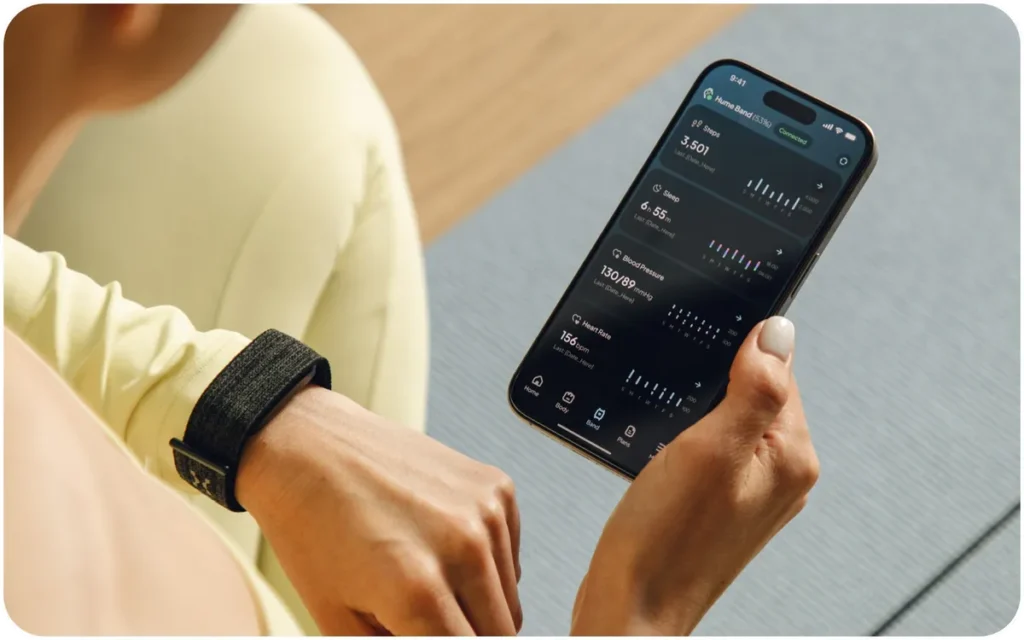
Short answer: yes, the Hume Band 2.0 tracks steps. Hume lists heart rate, steps, active zone minutes, distance and calories as tracked automatically, 24 hours a day. There is no screen, so you read your step count in the free Hume Health app, not on your wrist. Hume does not list built-in GPS.
Good fit if: you want steps counted in the background while the band looks after sleep, recovery and blood pressure trends. Know before you buy: you cannot glance at your wrist to see the number.
Table of Contents
- Does the Hume Band Track Steps?
- Where Do You See Your Step Count?
- Does the Hume Band Track Workouts?
- Does the Hume Band Have GPS?
- How Many Steps Are Enough After 40?
- Price and Subscription
- Frequently Asked Questions
Does the Hume Band Track Steps?
Yes. The Hume Band 2.0 counts your steps all day without you starting anything. On its product page Hume describes it this way: heart rate, steps, active zone minutes, distance and calories, tracked automatically, 24/7. Its metrics catalog also lists “total steps taken throughout the day” under Activity and Strain.
Steps are not an extra here. Hume uses them to set up the band. Its calibration guide for the first week asks new users for 3,000 or more steps a day, because daily movement teaches the band how your heart rate responds to light and moderate effort. Without that, it cannot separate your resting state from your active state as well.
So the band does two things with your walking. It gives you the plain number, and it uses that number to make the rest of your data (active calories, strain, recovery) more accurate.
Where Do You See Your Step Count?
In the Hume Health app on your phone. The band is screenless by design, so there is no step number on your wrist and nothing lights up when you hit a goal. You open the app, and the count is there with your other daily numbers.
The app is free. Hume states that no subscription is required to use the band or to access your raw data, and steps are part of that. The band works with iPhone 8 and newer on iOS 14 or above, and with Android 8.0 and above.
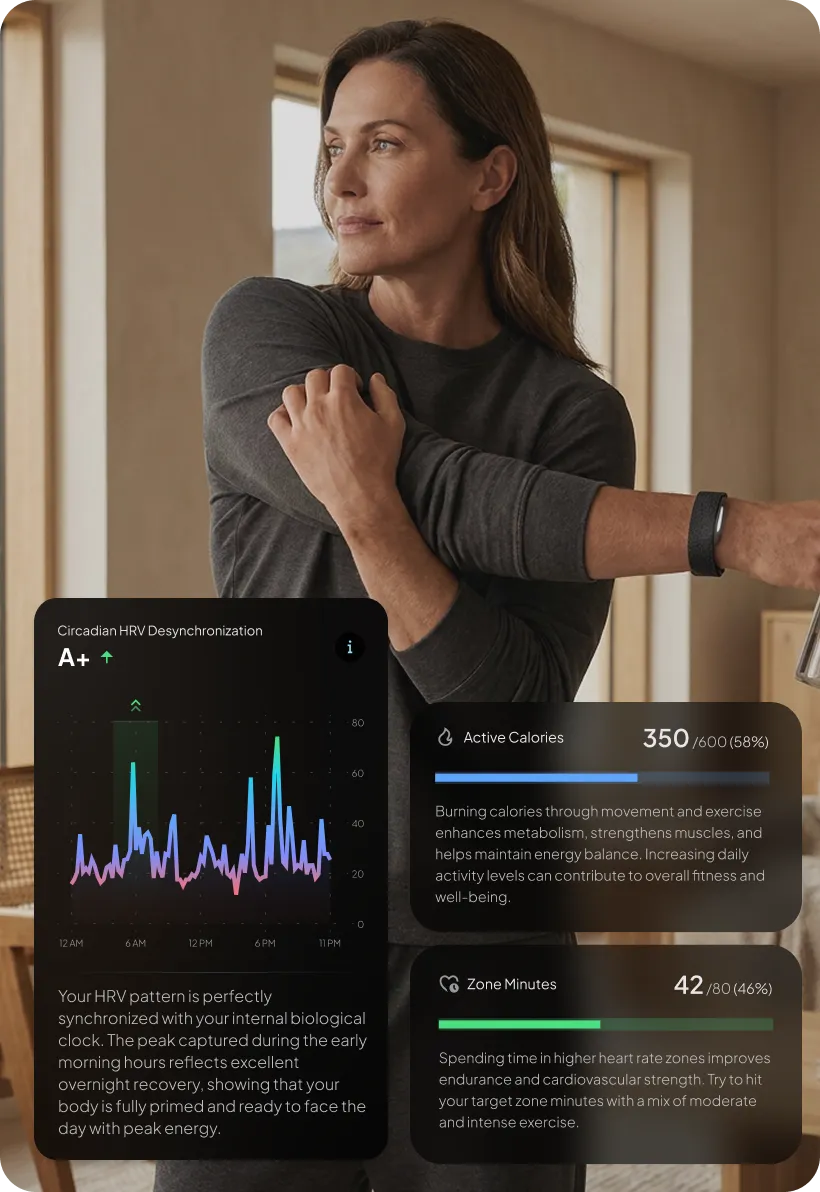
Each morning the app also turns your current state into daily targets. Hume describes these as steps, active calories, heart rate zone minutes and sleep timing, adjusted to your goal and how recovered you are. For a lot of people over 40 that is more useful than a fixed 10,000: on a day when your recovery is low, the target is not the same as on a day when you are fresh.
Want the full picture before you buy? Our Hume Band 2.0 review has the complete breakdown, the $249 price and the link to the official Hume store, where the 45-day refund applies.
Does the Hume Band Track Workouts?
Yes, automatically. You do not press start, because there is nothing to press. The band reads your heart rate around the clock, and when it rises during a walk, a gym session or a bike ride, that effort shows up in three places:
- Active zone minutes: the time you spent with your heart rate in the higher zones.
- Active calories: the energy you burned through movement, above what your body uses at rest.
- Strain: the total stress on your body for the day. Hume separates positive strain, which is training that builds fitness when you recover from it, from negative strain such as stress, illness or overtraining.
Then comes the part that matters most after 40: recovery. The next morning the band shows how your body handled yesterday’s effort through your heart rate variability, resting heart rate and sleep. That tells you whether today is a day to push or a day to walk and stretch.
The Hume Health app also connects to Apple Health and Google Health Connect, and Hume says you can import workouts, step count and sleep from them. If you already log runs or rides in another app, they can sit next to your band data.

Does the Hume Band Have GPS?
Hume does not list built-in GPS among the Band 2.0’s features. The band tracks distance along with steps, but it has no screen and no route map on the wrist.
For most walkers this changes very little. Your steps, distance, heart rate zones and calories are still recorded. If you want a map of your route with pace per mile, carry your phone and record the walk in a phone app that connects to Apple Health or Google Health Connect. The band keeps covering what a phone cannot: your heart, your sleep and your recovery, day and night.
The same goes for telling time. The band has no display, so it does not show the time, messages or calls. That is deliberate. Hume built it as a quiet band that stays on for up to 14 days per charge, including in bed, where a bright screen is the last thing you want.
How Many Steps Are Enough After 40?
Fewer than the famous 10,000, according to the best data we have. A 2022 meta-analysis in The Lancet Public Health pooled 15 studies and 47,471 adults. The risk of death from any cause kept falling as daily steps went up, until about 6,000 to 8,000 steps a day for adults aged 60 and older, and until about 8,000 to 10,000 for adults under 60 (Paluch et al., 2022).
Two practical points come out of that study:
- The biggest gain is at the bottom. People in the second-lowest group, with a median of about 5,800 steps a day, already had a clearly lower risk than the least active group, with about 3,500.
- Consistency beats one big day. A band you never take off counts every day, including the ones you would rather forget. That honest weekly average is the number worth watching.
If your knees or hips complain on longer walks, split the total into two or three shorter ones. Our guide to low-impact exercises for joints has options that add steps without adding pain.
Price and Subscription
The Hume Band 2.0 is a one-time purchase, currently $249. The app is free, and step counting does not sit behind a paywall. Hume Premium, which adds AI coaching and deeper analysis, is optional and starts at $8.99 a month.
Hume accepts returns within 45 days for a full refund, including opened and used products, so you can wear the band for a few weeks and see whether background step tracking with no screen suits you.
A note on price: prices change, and Hume runs promotions from time to time, so the amount you see today may be different from the one above. Check the current price before you order.
Ready to let your steps count themselves? Read our full Hume Band 2.0 review. It is also where you will find the link to buy from the official Hume store: $249 once, no yearly bill, 45 days to try it.
Buying it mainly for heart health? See does the Hume Band track blood pressure for what that feature can and cannot do.
Frequently Asked Questions
Does the Hume Band track steps?
Yes. The Hume Band 2.0 counts steps automatically all day, along with heart rate, active zone minutes, distance and calories. You see the count in the free Hume Health app, because the band has no screen.
Does the Hume Band have GPS?
Hume does not list built-in GPS among the Band 2.0’s features. The band records steps and distance. For a route map, record the walk with a phone app that connects to Apple Health or Google Health Connect.
Does the Hume Band track workouts?
Yes, automatically. It reads heart rate around the clock and turns exercise into active zone minutes, active calories and a daily strain score, then shows your recovery the next morning. There is no start button to press.
Does the Hume Band tell time?
No. The Hume Band 2.0 is screenless, so it does not show the time, steps or notifications on the wrist. Everything is read in the Hume Health app on your phone.
Do I need a subscription to see my steps on the Hume Band?
No. Hume states that no subscription is required to use the band or to access your raw data, and the app is free. Hume Premium, from $8.99 a month, is an optional upgrade for AI coaching and deeper analysis.
Does the Hume Band track sleep?
Yes. It tracks sleep stages (light, deep, REM and awake) along with sleep quality and efficiency. With up to 14 days of battery, it can stay on your wrist at night instead of on the charger.
About the Author
Richard Hale writes about mobility, recovery, and evidence-based wellness strategies for adults over 40 at VitalMove40. His focus is on practical tools and habits that support joint health, sleep quality, and long-term physical independence. Content is educational and not a substitute for advice from a qualified healthcare provider.