Last updated: July 14, 2026 | By Richard Hale
Swimming is one of the few exercises that provides full-body cardiovascular conditioning, resistance training, and significant reduction in joint loading simultaneously. For adults over 40 with joint pain, arthritis, or limited tolerance for weight-bearing activity, it is among the most evidence-supported options available.
You do not have to be a competent swimmer to benefit. Water walking, aquatic exercise classes, and pool-based movement all produce meaningful outcomes, sometimes better outcomes than lap swimming for adults with significant joint limitations.
This content is for educational purposes only and is not medical advice. If you have open wounds, active skin infections, or uncontrolled incontinence, pool exercise is contraindicated until these are resolved. Check with your physician before starting aquatic exercise if you have significant cardiovascular or respiratory conditions.
Table of Contents
- Why Water Exercise Is Different
- What the Research Shows
- Aquatic Exercise Options (Not Just Swimming Laps)
- Which Strokes Are Best for Joint Health
- Getting Started After 40
- Pool Temperature Matters
- Frequently Asked Questions
Why Water Exercise Is Different
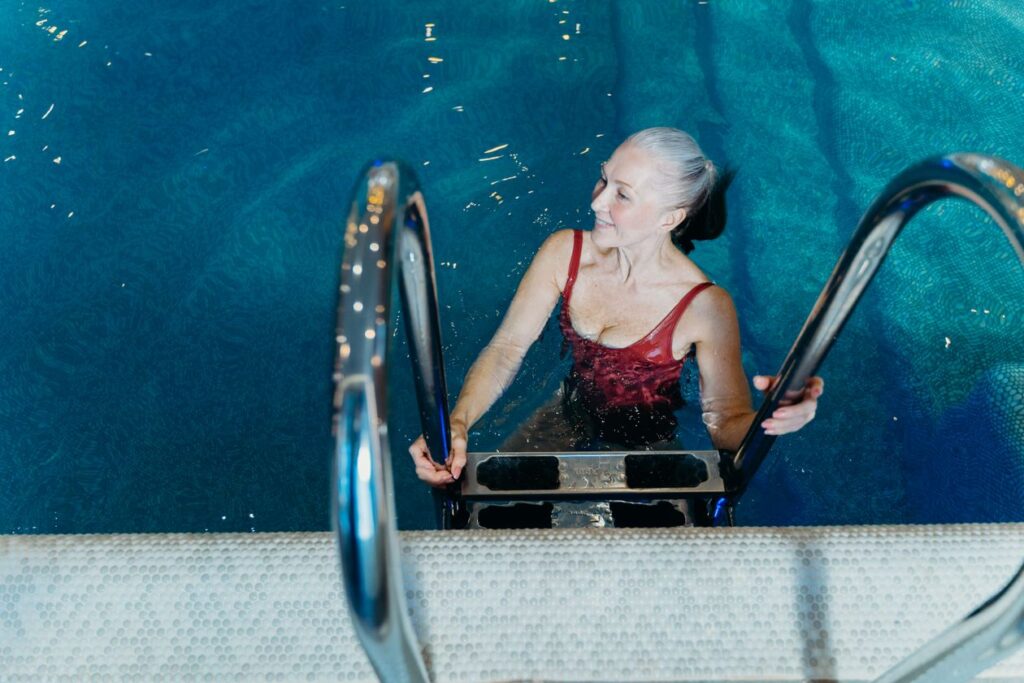
The key property of water for joint-friendly exercise is buoyancy. When you are submerged to shoulder depth, buoyancy supports approximately 90% of your body weight, meaning the joints of the lower body experience only 10% of the ground-reaction forces they absorb during walking on land. At waist depth, the offloading is approximately 50%.
This load reduction does not mean exercise in water is easy, water provides viscous resistance to movement in all directions, proportional to the speed of movement. Moving your arms and legs through water at exercise intensity requires significant muscular effort while the joints experience a fraction of the compressive loading they would on land. The combination is unique: you can work hard without hammering your joints.
Additionally, water provides a constant, gentle pressure (hydrostatic pressure) on all submerged tissue. This pressure reduces edema (swelling) in arthritic joints and may contribute to the disproportionate pain relief that aquatic exercise produces compared to land exercise in some populations.
What the Research Shows
The evidence base for aquatic exercise in joint conditions is substantial:
- Knee osteoarthritis: a 2016 Cochrane systematic review found moderate-quality evidence that aquatic exercise reduces pain and improves physical function in knee and hip OA, with effects comparable to land-based exercise on function and somewhat better on pain
- Rheumatoid arthritis: multiple RCTs find aquatic exercise reduces disease activity scores, improves functional capacity, and reduces fatigue in RA patients, with less risk of provoking flares compared to equivalent land exercise
- Fibromyalgia: among the strongest evidence bases for aquatic exercise, multiple Cochrane-reviewed RCTs show significant improvements in pain, fatigue, depression, and quality of life with regular warm-water aquatic exercise
- Cardiovascular outcomes: regular swimming (3x/week, 30-45 min) produces VO2max and resting heart rate improvements comparable to land-based aerobic exercise in middle-aged adults, and is associated in epidemiological studies with lower cardiovascular mortality
Aquatic Exercise Options (Not Just Swimming Laps)
Many adults over 40 with joint pain avoid pool exercise because they assume it requires swimming competence. It does not. The most accessible options:
Water walking: walking back and forth in waist-to-chest-deep water. The resistance of water makes this significantly more demanding than it sounds, at a brisk pace, water walking produces heart rate responses comparable to moderate-intensity walking on land, with a fraction of the joint loading. This is the most accessible starting point for people with no swimming background.
Aqua aerobics / hydrotherapy classes: structured group classes in shallow or deep water, led by instructors trained in aquatic exercise. The social component is a significant adherence advantage. Many community pools and rehabilitation centers offer these classes specifically for adults with arthritis or joint conditions.
Deep water running / deep water jogging: using a flotation belt, running or jogging motions in deep water where the feet do not touch the bottom. This is essentially zero-impact cardiovascular exercise at any intensity you choose, without any technical swimming skill required. Used by injured athletes for maintenance training.
Lap swimming: for those with swimming competence, lap swimming is the most time-efficient form of aquatic exercise for cardiovascular conditioning and full-body muscular development. See the stroke guidance below.
Which Strokes Are Best for Joint Health
Not all swimming strokes are equal from a joint health perspective:
- Freestyle (front crawl): the most joint-friendly stroke for the lower body, the flutter kick is low-impact. The main caution is shoulder rotation technique; poor freestyle technique can aggravate shoulder impingement in susceptible adults. Focus on body rotation rather than arm-only pulling.
- Backstroke: also joint-friendly and an excellent option for people with shoulder sensitivity, as the stroke mechanics involve less internal rotation than freestyle.
- Breaststroke: the frog kick places the knee in a position of external rotation under load and can stress the medial (inner) knee ligaments. Adults with medial knee OA or medial ligament laxity should either use a modified breaststroke kick or switch to freestyle.
- Butterfly: technically demanding and physically intense; places significant load on the lumbar spine and shoulders. Not recommended as a starting point for adults with back or shoulder issues.
Getting Started After 40
A practical starting point for adults with joint pain:
- Week 1-2: 20-30 minutes of water walking at a comfortable pace, 2-3 times per week. Focus on getting comfortable in the water and establishing the habit before adding intensity.
- Week 3-4: add arms during water walking (pushing through the water with straight arms), or add some standing aquatic exercises (leg raises, side steps, arm circles). Extend sessions to 30-40 minutes.
- Week 5-8: transition to 40-60 minute sessions. Consider adding lap swimming or deep-water running intervals if comfortable. Join an aqua aerobics class if available, the structure and social component significantly improve adherence.
The dose showing consistent benefit in OA trials: 3 sessions per week, 45-60 minutes per session, over at least 8-12 weeks. The early weeks feel less physically demanding than land exercise, this is expected. The joint offloading is doing less damaging work, but the cardiovascular and muscular stimulus is real and will accumulate.
Pool Temperature Matters
For adults with arthritis, fibromyalgia, or significant joint stiffness, warmer water (88-94°F / 31-34°C) produces better outcomes than standard pool temperatures (78-82°F / 26-28°C). Warm water reduces muscle guarding, increases tissue extensibility, and allows greater range of motion during exercise. Some research finds that hydrotherapy in heated pools produces larger pain reductions than aquatic exercise in standard-temperature pools for arthritis populations.
Standard competition pools are typically maintained at 78-82°F, too cool for comfortable arthritis exercise for many people. Look for community pools, rehabilitation centers, or warm-water classes that maintain higher temperatures. Many JCC facilities, hospital rehabilitation pools, and community aquatic centers maintain warmer therapeutic pools specifically for this population.
Frequently Asked Questions
Is swimming good for knee arthritis?
Yes, with the stroke caveat noted above. Multiple systematic reviews and RCTs confirm that regular aquatic exercise reduces knee OA pain and improves walking ability and quality of life. The combination of joint offloading, gentle range-of-motion through exercise, and hydrostatic pressure makes pool exercise uniquely suited to knee OA management. Freestyle kick and water walking are the most appropriate modalities; breaststroke kick should be avoided or modified for medial compartment OA.
Can I swim if I have back pain?
Generally yes, with some modifications. Freestyle and backstroke are typically well-tolerated with back pain. Breaststroke causes lumbar hyperextension during the recovery phase, which can worsen facet joint or disc-related back pain, avoid it if back pain is significant. Water walking is the safest starting point for back pain, as it allows posture monitoring and pain-guided intensity adjustment. Several trials show aquatic exercise superior to land exercise for chronic low back pain specifically.
How often should I swim for joint health?
The most consistent outcome data in the research comes from 3 sessions per week, 45-60 minutes each. Two sessions per week produce maintenance-level benefits; one session per week is insufficient for meaningful adaptation. Starting with 2 sessions per week and progressing to 3 as the habit is established is a reasonable approach.
Which swimming stroke is easiest on joints?
Freestyle and backstroke are generally the most joint-friendly strokes for adults with joint pain. Both allow natural shoulder rotation without the impingement risk of breaststroke’s frog kick on the inner knee, or the overhead stress that butterfly creates on the rotator cuff. Breaststroke can aggravate medial knee and inner hip structures due to the frog kick mechanics and should be modified or avoided in adults with medial compartment knee osteoarthritis or hip labral issues. For adults with shoulder problems, a pull-buoy between the legs removes the kick and allows a controlled upper body focus with significantly reduced shoulder demand.
Can swimming help with arthritis?
Yes, swimming is among the most evidence-supported exercise modalities for osteoarthritis management. Water buoyancy reduces joint loading to approximately 10 to 20 percent of bodyweight, allowing movement through full ranges of motion that may be painful on land. Aquatic exercise programmes show consistent reductions in joint pain and improvements in physical function in knee and hip OA in multiple systematic reviews. The main limitation is that swimming does not provide the mechanical loading that bone and cartilage health require, complementing swimming with some weight-bearing activity is preferable to swimming alone over the long term.
About the author: Richard Hale is an independent health writer focused on mobility, joint health, and active aging research. He is not a licensed medical professional. All content on VitalMove40 is for educational purposes only and is not a substitute for advice from a qualified healthcare provider.