Affiliate Disclosure: VitalMove40 earns a commission from purchases made through affiliate links on this page, at no extra cost to you. See our full Affiliate Disclosure Policy.
Last updated: September 10, 2026 | By Richard Hale
Kinzeno is sold as a “triple-action” massage gel that treats the cause of joint and muscle pain rather than masking it. That is a big promise for a drug-free topical. This Kinzeno review looks at what is actually in the gel, how a menthol-and-botanical formula like this can and cannot work, how it stacks up against Biofreeze and Voltaren, what the 60-day guarantee covers, and who the Kinzeno massage gel genuinely suits after 40.
This content is for educational purposes only and is not medical advice. Kinzeno is a topical cosmetic gel, not a medicine, and it is not intended to diagnose, treat, cure or prevent any disease. Talk to a healthcare provider or pharmacist about persistent joint pain, and before using a new topical product if you are pregnant, breastfeeding, or have sensitive skin or a known allergy.
VitalMove40 Verdict on Kinzeno Massage Gel: 4.3 / 5
Best for: Adults 40+ who want one drug-free, non-greasy gel to work into sore knees, lower back, neck, shoulders and hands during a daily self-massage, and who value a 60-day money-back guarantee to test it
✓ Drug-free: no diclofenac, no lidocaine, so it suits people who cannot or prefer not to use NSAID gels
✓ Cooling, fast-drying and non-greasy, with no strong medicine smell and no residue on clothing or bedding
✓ One gel for several body areas, which makes the per-use cost reasonable
✓ 60-day money-back guarantee on the official site, longer than most drugstore rubs offer
✓ Generally well tolerated on intact skin
✗ Ingredient amounts are not disclosed, so there is no way to check the actives against researched doses
✗ The “reaches deep tissue and treats the root cause” language runs ahead of what a topical gel is shown to do
✗ Relief from a menthol-led gel is temporary, so this is a comfort routine, not a fix for the underlying joint
Quick verdict: is Kinzeno worth it?
Kinzeno is a reasonable buy if you want a drug-free, non-greasy massage gel to use on several sore areas and you treat it as a comfort aid rather than a treatment. The menthol gives a genuine cooling, distracting effect within minutes, and the act of massaging it in helps loosen tense muscles. What it will not do, on the current evidence, is repair a joint or replace a diagnosed treatment. The 60-day guarantee makes a personal test low-risk, which is the main reason it earns a 4.3 rather than a mid-3 score.
Table of Contents
- What is Kinzeno massage gel?
- How Kinzeno works, honestly
- Kinzeno ingredients, one by one
- How to use Kinzeno
- Kinzeno vs Biofreeze vs Voltaren
- Does Kinzeno actually work?
- Kinzeno side effects and safety
- Kinzeno price: how much does it cost?
- How the 60-day guarantee works
- Where to buy Kinzeno, including Australia, the UK and Canada
- Who should buy Kinzeno and who should skip it
- Final verdict: is Kinzeno legit and worth buying?
- Frequently asked questions
What is Kinzeno massage gel?
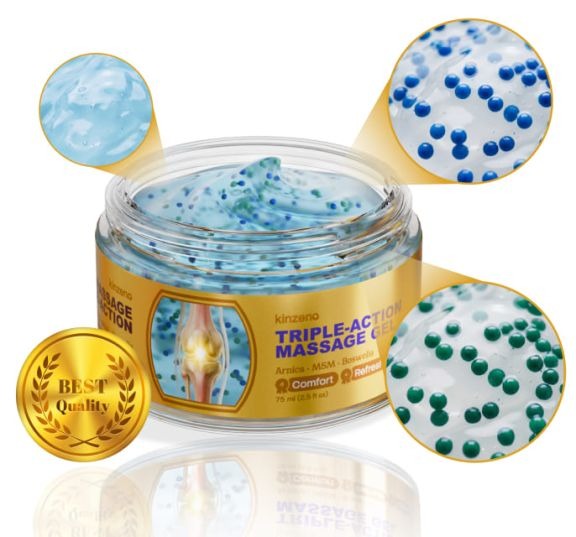
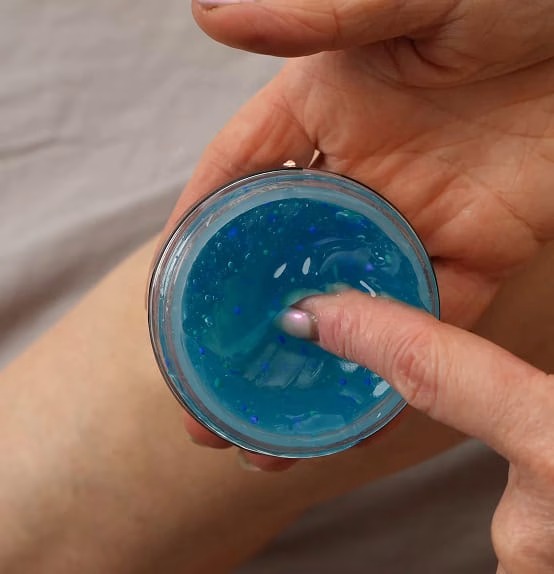
Kinzeno, sold in full as Kinzeno Triple Action Massage Gel, is a massage gel for joint and muscle pain that you rub into sore areas a few times a day. It comes in a 75 ml (2.5 fl oz) jar. The gel is blue, holds small coloured beads that break down as you massage, and is marketed as drug-free, non-GMO and gluten-free. On the label the “triple action” is described as relieve, repair and revitalise.
The brand frames Kinzeno as different from a normal rub because of a “microbubble technology” that works on contact and, through massage, targets the source of the pain. In plain terms, Kinzeno is a cosmetic massage gel built around menthol for the cooling sensation plus a list of botanical and skin-conditioning ingredients. It is not a registered medicine, and under the rules for this product category it cannot legally claim to treat arthritis or any other diagnosed condition. The company’s own disclaimer positions it as a complement to treatments prescribed by a professional, not a replacement.
People search for this product as “Kinzeno”, “Kinzeno gel” and “Kinzeno massage gel”, and the maker also sells a roller version. This review covers the jar of gel.
How Kinzeno works, honestly
Three things are plausibly going on when you use Kinzeno, and it helps to separate them.
The menthol. Menthol is a counterirritant. It triggers cold-sensing receptors in the skin and produces a cooling feeling that competes with the pain signal for your attention. This is real, it happens within minutes, and it is the same mechanism behind Biofreeze and most drugstore cooling gels. It is also temporary, usually lasting from half an hour to a few hours, and it does not change what is happening inside the joint.
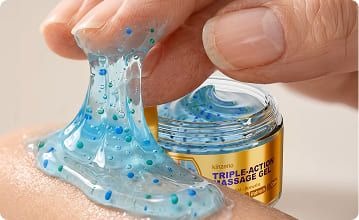
The massage. Rubbing any gel into a stiff area increases local blood flow, warms the tissue slightly and can ease muscle guarding around a sore joint. Kinzeno leans into this by asking you to massage until the beads dissolve. A few minutes of deliberate self-massage is genuinely useful for day-to-day aches, with or without a special gel.
The botanicals. Arnica, boswellia, MSM, magnesium and the plant extracts have anti-inflammatory data, but most of that evidence comes from oral doses, not from a gel on the skin. How much of each active is in Kinzeno is not disclosed, and how well ingredients like MSM and magnesium cross intact skin in useful amounts is still debated. It is fair to treat the botanical list as a supporting cast rather than the main event.
What Kinzeno is not is a product shown to reach deep tissue and correct the cause of joint pain. That phrasing is marketing. Independent write-ups of the gel reach the same conclusion: use it as a topical that changes how an area feels for a while, not as a repair. For context on where topical products fit in a broader plan, see our guide to topical joint creams and gels.
Kinzeno ingredients, one by one
Kinzeno’s official store highlights eight ingredients, and the longer sales page adds a botanical blend on top. None of the amounts are published, so the notes below are about what each ingredient is generally used for, not about whether the dose in Kinzeno is enough.
- Menthol. The cooling agent and the ingredient most responsible for what you feel in the first minute. Counterirritant, temporary, well established for short-term symptom relief.
- Arnica montana. A traditional topical for bruises and muscle soreness. Some trials suggest a modest benefit for soreness and hand osteoarthritis, others find it no better than placebo. Well tolerated on unbroken skin. Should not be swallowed.
- MSM (methylsulfonylmethane). A sulfur compound with modest anti-inflammatory data when taken by mouth at 1.5 to 3 grams a day. Evidence that a topical dose does the same is limited. Our MSM for joint pain guide covers the oral research.
- Magnesium (sulfate and chloride). Popular in topical form for muscle relaxation. Whether meaningful amounts cross the skin is genuinely contested, with only small pilot data behind it. More on this in our magnesium for muscle recovery article.
- Boswellia serrata. Also called Indian frankincense. Boswellic acids act on an enzyme in the inflammatory pathway, and oral extracts have a reasonable record for knee osteoarthritis. Topical delivery is less studied. Background in our boswellia guide.
- Horse chestnut (aescin). Used topically for swelling and a feeling of heaviness in the legs. Can give a mild decongestant, firming sensation.
- Allantoin. A skin conditioner that soothes and softens. It is why the gel feels calming on contact rather than harsh.
- Vitamin E (tocopherol). Antioxidant and skin-conditioning agent, common in creams and gels.
- Vitamin B5 (panthenol). Supports skin hydration and the skin barrier.
- Inositol. Included for cell-membrane and skin support. A minor role here.
- Botanical blend (white turmeric, turmeric, ginger, ginseng, moringa). Traditional anti-inflammatory plants from Ayurvedic and East Asian medicine. Amounts are not listed, so treat these as supporting ingredients.
- Glycols (propylene and butylene glycol). Carriers that help the gel spread, absorb into the upper skin layers and dry without grease.
So the honest summary of the Kinzeno ingredients: a menthol-led cooling gel with a broad botanical and skin-care supporting list, no disclosed amounts, and most of the actives backed by oral rather than topical studies. If you specifically want an arnica, boswellia and MSM gel or a magnesium massage gel, Kinzeno qualifies, but you are buying on the ingredient names, not on published potency.
How to use Kinzeno
- Apply a small amount. A coin-sized blob is enough for one area such as a knee, the lower back, a shoulder or both hands. Use it on clean, dry, unbroken skin.
- Massage it in. Work it in with firm circular pressure for a minute or two, until the beads dissolve and the gel disappears. The massage is part of the point, not an afterthought.
- Repeat as needed. The maker suggests two to four times a day. Wash your hands afterwards, and keep it away from your eyes and any broken skin.
Do not wrap the area tightly or put a heating pad over it straight after applying, since menthol plus trapped heat can irritate skin. If you like using heat or ice as well, our article on heat or ice for joint pain explains how to combine them sensibly.
Kinzeno vs Biofreeze vs Voltaren
These three come up together constantly, so here is how they actually differ. The short version: Biofreeze and Kinzeno work the same basic way, while Voltaren works differently and has the strongest evidence for arthritis.
| Kinzeno | Biofreeze | Voltaren (diclofenac gel) | |
|---|---|---|---|
| How it works | Menthol counterirritant plus botanicals, worked in by massage | Menthol counterirritant | NSAID that reduces inflammation in the tissue under the skin |
| Drug-free | Yes | Yes | No |
| Evidence for knee or hand osteoarthritis | Limited, ingredient-level, mostly from oral studies | Limited, temporary symptom relief | Strong, randomised trials show pain and function benefit |
| Onset and duration | Cooling in minutes, fades over a few hours | Cooling in minutes, fades over a few hours | Builds over days to weeks of regular use |
| Feel | Non-greasy, light scent, dissolving beads | Non-greasy, stronger menthol smell | Low odour, comes with a dosing card |
| Best for | Daily self-massage across several areas, drug-free preference | Quick cooling before or after activity | Diagnosed inflammatory joint pain in the knees or hands |
| Guarantee | 60-day money-back on the official site | Standard retail return | Standard retail return |
If you searched for a natural alternative to Voltaren gel, be clear-eyed about the trade. You gain the drug-free profile and lose the ingredient with the best arthritis evidence. Many people use a menthol gel like Kinzeno for everyday aches and keep topical diclofenac for flare-ups in a specific joint, on a pharmacist’s advice. For self-care during a flare, see how to manage an arthritis flare at home.
Does Kinzeno actually work?
It depends on what you are asking it to do. As a way to make a sore knee, a stiff lower back or aching hands feel better for a while, a menthol massage gel like Kinzeno can help, and the customer feedback on the brand’s Trustpilot page, which sits around four stars across roughly 130 reviews at the time of writing, mostly describes that kind of short-term comfort. The people who are happiest tend to be using it as a daily ritual on several areas, not expecting a single application to solve a long-standing problem.
As a treatment for the joint itself, there is no good evidence that Kinzeno changes the course of arthritis or “repairs” anything. Reviews of topical menthol products describe temporary relief through sensory distraction rather than a lasting effect, and the Mayo Clinic’s overview of arthritis treatments absorbed through the skin puts counterirritants like menthol well below topical NSAIDs for measurable benefit. The realistic expectation for Kinzeno is same-day comfort that you top up through the day, working best alongside movement, strengthening and, where relevant, weight management. Our piece on knee pain when climbing stairs covers the load side of that equation.
Kinzeno side effects and safety
Applied to intact skin, a gel like this has a good tolerability record. The issues that do come up are local:
- Skin reactions. Redness, itching, a burning feeling, or cooling that is simply too intense, most likely if you are sensitive to menthol, fragrance or botanical extracts. Patch test on a small area first.
- Eyes and broken skin. Keep it away from your eyes, lips and any cut, rash or broken skin. Do not swallow it.
- Heat and wraps. Avoid tight bandaging or a heating pad over a freshly applied area.
On medication questions, a topical gel used in normal amounts on unbroken skin has minimal absorption into the bloodstream. The interaction concern people have seen for arnica applies to arnica taken by mouth, not to a gel, so the practical rule is simply not to ingest Kinzeno. If you take blood thinners or blood pressure medication and plan to use large amounts over big areas several times a day, mention it to your pharmacist. Kinzeno is an adult product and is not intended for use during pregnancy or breastfeeding without medical advice.
Kinzeno price: how much does it cost?
Kinzeno is a 75 ml (2.5 fl oz) jar. On the official site it is sold in tiers, priced in US dollars, and the per-jar price drops sharply as you buy more:
- 1 jar: $44.99
- 2 jars: $29.99 each, $59.98 total
- 3 jars: $21.99 each, $65.97 total
- 4 jars: $17.99 each, $71.96 total
Your final price and any shipping cost show at the checkout once you select your country, and some regions are offered a pay-on-delivery option. The crossed-out “regular” prices and the large discount percentages on the sales page are set by the brand and are not independently verifiable, so judge Kinzeno on the figure you are actually charged. Buying from the official site is what keeps you inside the 60-day guarantee.
For comparison, a single jar is also listed on Amazon in the US, UK and Canada for around $29.99, which undercuts the official site’s single-jar price. The trade-off is that the 60-day money-back guarantee applies to official-site orders, and the brand notes that some third-party marketplace sellers are not authorised.
Check the current Kinzeno price for your country →
How the 60-day guarantee works
Kinzeno’s official store lists a 60-day return policy. Based on the brand’s own wording:
- The 60 days run from when your order arrives, not from the order date.
- It covers a change of mind, not only damaged, defective or incorrect orders.
- You contact the support team within the window to request a refund, exchange or store credit.
- Keep your order confirmation and the packaging until you are sure you are keeping it.
As with any direct-to-consumer offer, confirm the current terms, including who pays return shipping, with customer support before you order.
Where to buy Kinzeno, including Australia, the UK and Canada
Kinzeno sells through its official website and ships to the United States, Canada, the United Kingdom, Ireland, Australia, New Zealand and much of Europe, including Germany, France, Belgium, the Netherlands, Finland, Sweden, Norway and Denmark. Searches like “Kinzeno Australia” or “Kinzeno UK” land on the same product, with the price shown in local terms at checkout.
It is also on Amazon in the US, UK and Canada. The brand notes that some third-party marketplace sellers are not authorised, and that counterfeit or diluted jars have turned up, so the official store is the safer source and the only one that keeps the 60-day guarantee in play. Wherever you buy, check that the seller is the brand itself.
Who should buy Kinzeno and who should skip it
Consider Kinzeno if you:
- Want a drug-free gel because you cannot use, or would rather avoid, NSAID rubs
- Have aches in several places, knees, lower back, neck, shoulders, hands, and want one jar for all of them
- Like the routine of a few minutes of self-massage and a cooling, non-greasy finish
- Want a money-back guarantee so a personal test costs you nothing if it does not suit you
Skip Kinzeno if you:
- Want the topical with the strongest evidence for knee or hand arthritis, which is diclofenac gel, and should speak to a pharmacist
- Expect it to rebuild cartilage, remove inflammation for good, or stand in for a diagnosed treatment
- React badly to menthol or fragrance, or need to treat broken or irritated skin
- Are pregnant or breastfeeding and have not cleared a botanical topical with your provider
- Just want the cheapest option and are happy with a plain drugstore menthol gel, which costs less than Kinzeno
Final verdict: is Kinzeno legit and worth buying?
Rating: 4.3 / 5
Kinzeno is a legitimate product. It is a real topical gel from a company with an official store, a 60-day return policy, and listings on Amazon in several countries. “Legitimate” is not the same as “will fix your joints”, and Kinzeno is best understood as a well-made comfort gel rather than a treatment.
What it does well: it is drug-free, it dries clean with no medicine smell, it works on many areas from one jar, it is easy on the skin, and the cooling from the menthol is real and quick. The massage step it builds in is genuinely helpful for day-to-day stiffness. The guarantee removes most of the risk of trying it.
What holds it back from a higher score: the amounts of arnica, MSM, magnesium, boswellia and the plant extracts are not disclosed, so you cannot check them against the doses used in research, and most of those ingredients have their evidence in oral form. The claim that it reaches deep tissue and treats the root cause is more than a topical gel is shown to do, and any relief from a menthol-led product is temporary by nature.
For an adult over 40 who wants exactly what Kinzeno is, a drug-free, versatile, guarantee-backed massage gel for daily aches, it is a solid choice and the 60-day guarantee makes it easy to find out. Anyone looking for evidence-first arthritis relief, or the lowest price on a menthol gel, should look elsewhere.
Check Current Price for Kinzeno →
Frequently asked questions
Does Kinzeno massage gel actually work?
Kinzeno can work as a temporary comfort aid. The menthol produces a cooling, distracting sensation within minutes, and massaging the gel in helps loosen tense muscles around a sore joint. It is not shown to repair joints or reduce inflammation for the long term, so the realistic result is same-day relief that you top up through the day, used alongside movement and strengthening.
What are the ingredients in Kinzeno?
The official store highlights menthol, arnica, MSM, magnesium, boswellia, horse chestnut, allantoin, vitamin E, vitamin B5 and inositol, and the sales page adds a botanical blend of white turmeric, turmeric, ginger, ginseng and moringa. The gel is drug-free, non-GMO and gluten-free. Individual ingredient amounts are not published.
Is Kinzeno a legitimate product?
Yes. Kinzeno is a real topical gel sold through an official website with a 60-day return policy, and it is also listed on Amazon in the US, UK and Canada. Set expectations at temporary comfort rather than a cure, since it is a cosmetic massage gel and not a medicine.
Is Kinzeno the same as Kinzeno Triple Action Massage Gel?
Yes. “Kinzeno Triple Action Massage Gel” is the full name printed on the jar. “Kinzeno”, “Kinzeno gel” and “Kinzeno massage gel” are the short forms people use for the same product. The brand also sells a roller applicator version; this review is of the jar of gel.
Kinzeno vs Voltaren: which is better?
They are different tools. Voltaren is a diclofenac NSAID gel with strong trial evidence for knee and hand osteoarthritis, but it is a drug. Kinzeno is drug-free and menthol-led, aimed at daily self-massage across several areas. If you want the option with the best arthritis evidence, that is Voltaren, on a pharmacist’s advice. If you want a drug-free gel and a massage routine, that is Kinzeno.
Does Kinzeno have side effects?
The common ones are local: redness, itching, a burning feeling, or cooling that is too strong, mainly in people sensitive to menthol or fragrance. Keep it away from eyes and broken skin, do not swallow it, and do not put a heating pad over a freshly applied area. Patch test first.
Can I use Kinzeno with blood pressure or blood-thinner medication?
A topical gel used in normal amounts on intact skin has minimal absorption into the bloodstream. The interaction concern with arnica applies to arnica taken by mouth, so the practical rule is not to ingest Kinzeno. If you take blood thinners or blood pressure medication and plan to use large amounts over big areas several times a day, run it past your pharmacist.
How long does Kinzeno take to work?
The cooling sensation starts within a few minutes. Any easing of stiffness from the massage is same-day. There is no evidence that Kinzeno produces a lasting structural change in a joint, so judge it as a comfort routine you repeat rather than a course of treatment.
Where can I buy Kinzeno and how much does it cost?
On the official site Kinzeno is priced in US dollars by tier: $44.99 for one jar, $29.99 each for two, $21.99 each for three and $17.99 each for four, with your final price shown at checkout by country. A single jar is also on Amazon in the US, UK and Canada for around $29.99. Buy from the official site if you want the 60-day money-back guarantee.
Is Kinzeno available in Australia, the UK and Canada?
Yes. The official site ships to Australia, the UK, Canada, Ireland, New Zealand and much of Europe, as well as the United States. The price appears in local terms at checkout, and some regions are offered a pay-on-delivery option.
How we assessed this: This Kinzeno review is based on the product’s official store and sales pages, its published ingredient highlights and return policy, its Amazon listings and pricing at the time of writing, third-party customer ratings, and the general evidence for topical menthol counterirritants and topical NSAIDs. Individual ingredient amounts are not disclosed by the brand, and we did not receive the product from the maker. Prices and terms change, so confirm the current details before buying.
About the author: Richard Hale is an independent health writer focused on mobility, joint health, and active aging research. He is not a licensed medical professional. All content on VitalMove40 is for educational purposes only and is not a substitute for advice from a qualified healthcare provider.