
Last updated: September 16, 2026 | By Richard Hale
Disclosure: This post contains affiliate links. If you purchase through our links, we may earn a commission at no extra cost to you. We only review products we believe are worth your consideration. Full disclosure here.
Grounding mats bring the principle of earthing (direct electrical contact between the body and the earth’s surface charge) into a desk or indoor setting. The Bareflowmat is a desk and floor mat designed for barefoot use during sedentary work periods, connecting through a standard outlet’s ground port to replicate the conductive contact that outdoor barefoot activity provides. This review covers how grounding mats work, what the evidence shows for inflammation and sleep, the specific design of the Bareflowmat, and who is most likely to benefit from this category.
Quick answer
- Does it work? The proposed mechanism (neutralizing free radicals through ground contact) is a hypothesis, not a proven medical effect.
- Evidence: one 2015 review and one small 2013 pilot study (10 people) show early, preliminary signals, not large-scale proof.
- What it is: a conductive mat that connects to your outlet’s ground port, for barefoot use under a desk during the workday.
- Guarantee: 30 days money-back, which may be short given that any effect is described as gradual rather than immediate.
- Bottom line: a low-risk way to test a biologically plausible but unproven practice during work hours, not a validated treatment for any specific condition.
Bottom line: if you’ve already decided grounding is worth testing and want a practical way to do it during the workday, the Bareflowmat is a straightforward, low-risk option. Check Bareflowmat’s current price and guarantee →

Table of Contents
- Quick Answer
- What Grounding Is and Why It Applies Indoors
- What the Evidence Shows for Grounding
- Bareflowmat Design and Materials
- Pricing and Guarantee
- Who It’s For (and Who Should Pass)
- Pros and Cons
- Frequently Asked Questions
What Is Grounding, and Why Would It Apply Indoors?
Grounding, also called earthing, is direct physical contact between the human body and the earth’s surface, specifically the free electrons in the ground’s conductive layer. When standing barefoot on soil, grass, sand, or concrete, the body equilibrates electrically with the earth, allowing electrons to flow from the ground into the body. Modern footwear (rubber and synthetic soles) insulates the body from this connection at virtually all times.
The theoretical mechanism for grounding’s health effects centres on free radical neutralisation. Reactive oxygen species (free radicals) are produced during normal cellular metabolism and inflammatory processes. They carry a positive charge and seek electrons. Earth electrons, being freely available and negatively charged, can neutralise these reactive species when the body has direct ground contact. The hypothesis is that chronic electrical isolation from the earth, which essentially all modern adults experience, contributes to sustained low-grade inflammation over time.
Important context: this is a proposed mechanism, not a confirmed medical effect. Treat it as a working theory that current research is still testing, not an established fact.
Grounding mats replicate the electrical connection indoors. They use a conductive surface (typically carbon-infused or silver-thread fabric) connected via a grounding cord to the ground port of a standard electrical outlet, not the live or neutral lines, only the ground. The outlet’s ground connects back to the building’s earth stake, completing the connection to actual earth ground. The mat’s conductive surface then transfers the earth’s electron potential to bare skin in contact with it.
For context on the broader earthing research and its relationship to inflammation and sleep quality, see our guide on earthing, grounding, inflammation, and sleep, and our overview of joint health after 40.
What Does the Evidence Actually Show for Grounding?
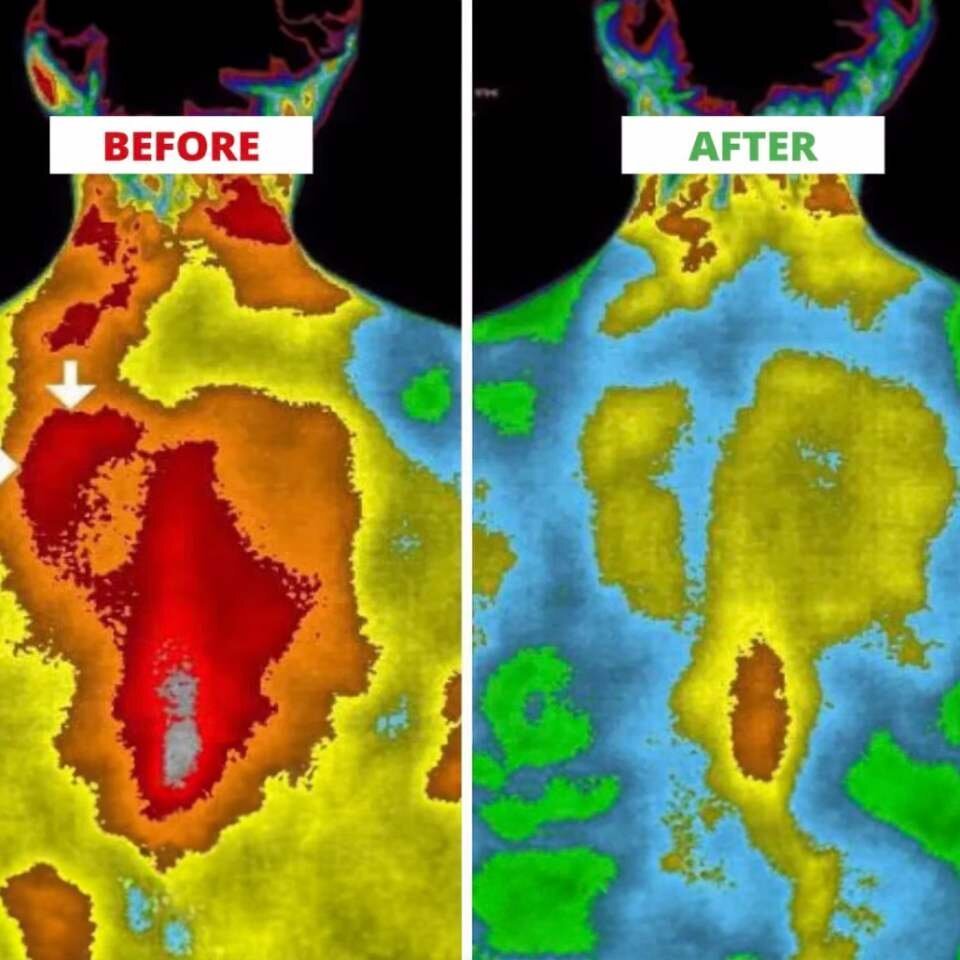
Two published studies support grounding’s potential effects: a 2015 review in the Journal of Inflammation Research and a 2013 open-label pilot study of 10 people in the Journal of Alternative and Complementary Medicine. Both point in a favourable direction, but both are small or preliminary, so the evidence is suggestive rather than conclusive.
| Study | Year | Type / Sample | Journal | Reported Finding |
|---|---|---|---|---|
| Oschman, Chevalier & Brown | 2015 | Review | Journal of Inflammation Research | Reduced markers of exercise-induced muscle soreness, normalised cortisol circadian rhythm, and inflammatory cytokine shifts consistent with reduced systemic inflammation |
| Chevalier, Sinatra, Oschman & Delany | 2013 | Open-label pilot, 10 people | Journal of Alternative and Complementary Medicine | Reduced blood viscosity (a cardiovascular risk marker) after two hours of grounding via patches; not sleep-specific, not double-blind |
The lead researchers behind this work are Dr. James Oschman, an independent biophysicist affiliated with Nature’s Own Research Association, and Dr. Gaétan Chevalier, affiliated with the Developmental and Cell Biology Department at UC Irvine, publishing together in peer-reviewed journals from 2010 onward. It’s worth noting that much of the peer-reviewed grounding research comes from this same small, overlapping group of investigators, some of whom are industry-adjacent. That doesn’t invalidate the findings, but it does call for extra caution when weighing them, and it’s part of why we describe this evidence as preliminary rather than settled.
The other limitations are real too: the studies are small, not yet consistently replicated in large independent trials, and difficult to double-blind convincingly. That said, the mechanism is biologically plausible, the risk profile is essentially zero (the ground port carries no current, so there is no electrical shock risk from a grounding mat used correctly), and the practical cost is low. For adults over 40 with ongoing inflammatory conditions, joint pain, or disrupted sleep, the evidence is sufficient to make it a reasonable addition to a broader recovery routine: not a replacement for well-evidenced interventions, but a low-risk complement.
Bareflowmat Design and Materials
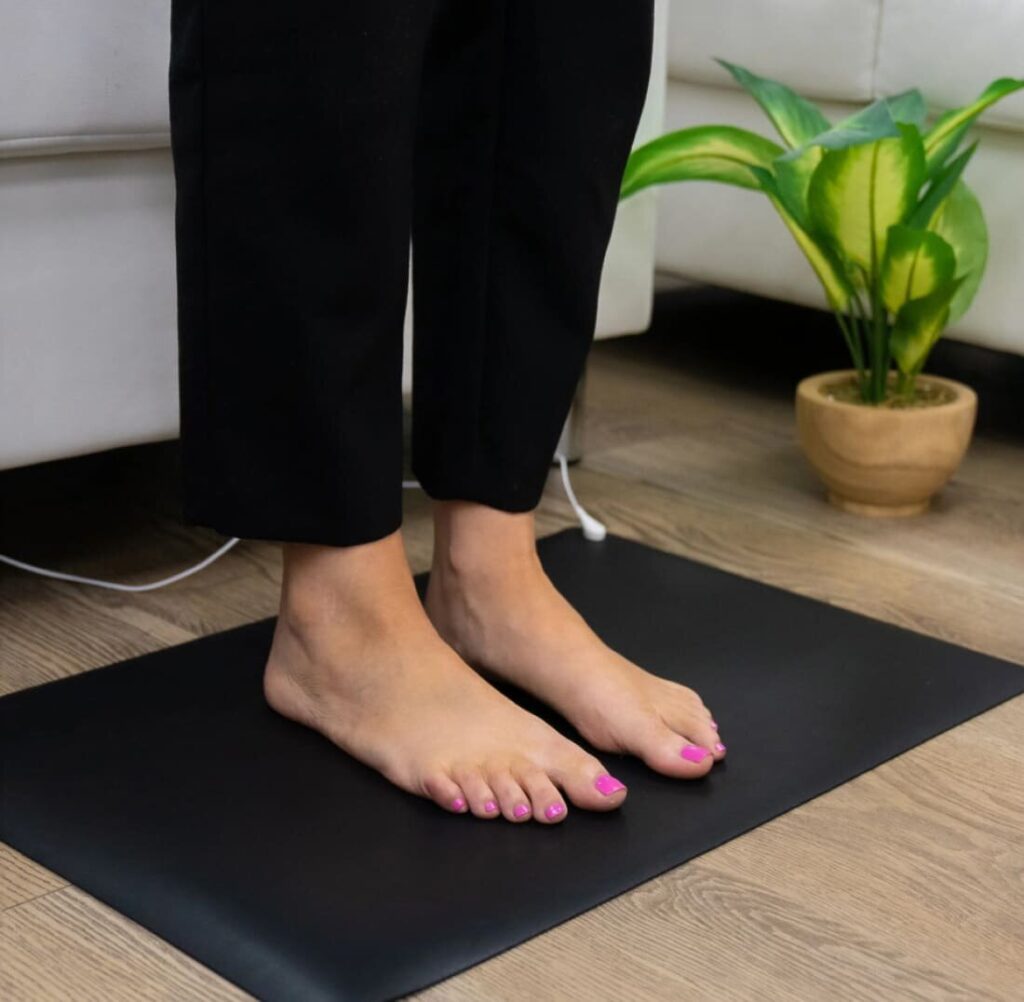
The Bareflowmat is a conductive floor and desk mat that connects to a standard outlet’s ground port, so you can stay barefoot and grounded while working at your desk. It comes with a 30-day money-back guarantee. Full specifications appear in the table below.
| Specification | Detail |
|---|---|
| Primary use | Floor/desk mat for barefoot grounding during seated work |
| Conductive material | Carbon-infused or conductive-fibre surface |
| Connection method | Grounding cord to outlet ground port |
| Use case | Daytime, seated desk use, barefoot contact while working |
| Complementary product | Grounding sheets (nighttime sleep use, different product category) |
| Guarantee | 30-day money-back |
The Bareflowmat’s primary design distinction is the desk mat / floor mat format for daytime use. This differentiates it from grounding sheets, which are used during sleep, and from outdoor barefoot activity. The desk setting targets the category of adults who spend extended hours seated, have little opportunity for outdoor barefoot activity, and want passive grounding contact during working hours without changing their routine significantly. The mat sits under the desk; bare feet rest on it while working.
The connection to the ground port of a standard outlet is the critical element. A grounding cord tester (typically included or available inexpensively) should be used to confirm the outlet’s ground port is functioning before use, since not all older outlets are correctly grounded, and an ungrounded outlet provides no earthing benefit. This is the most common practical issue with indoor grounding products in general.
Pricing and Guarantee
The Bareflowmat comes with a 30-day money-back guarantee, but that window may be tight for judging results, since any grounding effect is described in the research above as building gradually rather than appearing right away. Pricing itself is displayed at checkout.
If you do decide to try it, our practical advice is to use the full 30-day window rather than testing it for a few days and giving up: start using it the day it arrives, keep it under your desk consistently, and judge it at the end of the guarantee period rather than the end of the first week. That gives the gradual-effect theory an honest chance to show itself, one way or the other, before the return window closes.
See current pricing and availability →
Who It’s For (and Who Should Pass)
Use these two lists as an honest checkpoint before you buy:
Good fit for:
- Adults over 40 who spend extended hours at a desk and have essentially no barefoot outdoor time, the core use case for grounding mats as a passive substitute for direct earth contact
- Adults with chronic low-grade inflammation, joint pain, or poor sleep quality who want a low-risk, low-effort addition to a broader recovery routine
- Adults who have already read the grounding evidence and want to trial it systematically. The Bareflowmat is the practical format for doing this during working hours
- Adults who use or are considering grounding sheets for sleep and want daytime grounding coverage as well: the Bareflowmat and grounding sheets address different time windows and complement each other without redundancy
Who should pass:
- Adults expecting a primary intervention for pain or inflammation: the evidence does not support grounding as a standalone treatment for any specific condition. It is a low-effort adjunct, not a first-line therapy
- Adults in buildings with older electrical systems where outlets may not be correctly grounded, since the product provides no benefit and the grounding cannot be assumed without testing the outlet first
- Adults looking for immediate, measurable results: grounding effects are gradual and subtle; they do not produce the type of acute response that, for example, heat therapy or compression does
Pros and Cons
| Pros | Cons |
|---|---|
| Passive daytime grounding, no routine change required beyond removing footwear at the desk | Requires outlet with functioning ground port, not all older outlets qualify |
| Low-risk profile, ground port carries no current, no electrical shock risk | Evidence base is growing but smaller and less replicated than mainstream interventions |
| Complements grounding sheets (nighttime) without overlap, covers daytime hours | Effects are gradual and subtle, not appropriate for adults wanting acute relief |
| Practical format for desk workers with no outdoor barefoot access | 30-day guarantee short for a gradual-effect intervention |
| Biologically plausible mechanism with supporting pilot evidence | None noted |
Frequently Asked Questions
Does the Bareflowmat actually work?
There’s no definitive proof either way. A 2015 review (Oschman, Chevalier & Brown) and a small 2013 pilot study of 10 people reported physiological changes consistent with reduced inflammation and improved cardiovascular markers, but both come from a small, overlapping research group and haven’t been replicated in large independent trials. The proposed mechanism, neutralising free radicals through ground contact, remains a hypothesis, not a confirmed medical effect. The Bareflowmat itself simply delivers that ground contact; whether the underlying theory holds up at scale is a separate, still-open question.
Is grounding pseudoscience?
Not entirely, but it isn’t settled science either. Grounding rests on a biologically plausible mechanism (electron transfer through skin contact) and has been studied in peer-reviewed journals, which puts it in a different category from claims with no research behind them at all. At the same time, the existing studies are small, come largely from one overlapping group of researchers, and haven’t been replicated at scale, so treating grounding as proven would overstate the evidence. A fair, honest position is: biologically plausible, preliminarily studied, not yet confirmed.
Is a grounding mat safe to use?
Yes. Grounding mats connect only to the ground port of an electrical outlet, not to the live or neutral wires. The ground port carries no current under normal conditions. There is no electrical shock risk from using a grounding mat correctly. The one precaution is to verify the outlet’s ground is functional using a simple outlet tester before first use. Adults with implanted electronic devices (pacemakers, neurostimulators) should consult their physician before using any electrical grounding product.
How long should I use the grounding mat each day?
Studies supporting grounding effects have used exposure periods ranging from 30 minutes to continuous overnight use. For a desk mat, 2–4 hours of daily barefoot contact during seated work is a practical target. Consistency over weeks matters more than duration in any single session. The proposed mechanism involves gradual equilibration of the body’s electrical state, not an acute dose response.
What is the difference between the Bareflowmat and grounding sheets?
Grounding sheets are fitted or half-sheets placed on a bed, providing earthing contact during sleep, typically 6–8 hours per night. The Bareflowmat is a floor/desk mat providing contact during waking, seated hours, typically 2–4 hours of barefoot desk use. They target different time windows and can be used together without redundancy. For adults primarily concerned with sleep quality, sheets address the longer passive contact window. For adults primarily concerned with daytime inflammation or circulation, a desk mat is more directly applicable.
Will it work through socks?
Not through standard synthetic or wool socks. Electrical conductivity requires direct skin contact with the conductive mat surface. Some manufacturers sell conductive socks with silver-thread construction that maintain the electrical connection, but these are separate products. For the Bareflowmat to work as designed, bare feet (or conductive footwear) directly contacting the mat surface are required.
If you’ve read this far wondering whether a grounding mat is worth adding to your desk setup, here is the honest summary: the science behind grounding is promising but not settled, the Bareflowmat’s job is simple (deliver a stable connection to your outlet’s ground port while you work), and the risk is low because no live current is involved. It is not a substitute for treating a specific inflammatory condition or sleep disorder, and if you are expecting an overnight, dramatic effect, this isn’t the product for that. But for adults over 40 who have already decided grounding is worth testing systematically during the workday, the Bareflowmat is a straightforward, low-risk way to do it.
Check today’s price and 30-day guarantee →
About the author: Richard Hale is an independent health writer focused on mobility, joint health, and active aging research. He is not a licensed medical professional. All content on VitalMove40 is for educational purposes only and is not a substitute for advice from a qualified healthcare provider.