Last updated: July 18, 2026 | By Richard Hale
This content is for educational purposes only and is not medical advice. Consult a qualified healthcare provider for guidance specific to your health situation.
Hiking is one of the most effective forms of exercise for adults over 40, it combines cardiovascular effort with resistance loading through varied terrain, reduces sedentary time, and has documented benefits for mood, bone density, and metabolic health. But knees take more stress on trails than they do on flat ground, particularly on descents. After 40, when cartilage thickness declines and recovery between sessions takes longer, the knees become the limiting factor that determines whether hiking remains sustainable. This guide covers the biomechanics of trail stress on the knee, practical protective strategies, and the gear and habits that allow adults to hike longer and harder without paying for it the following week.
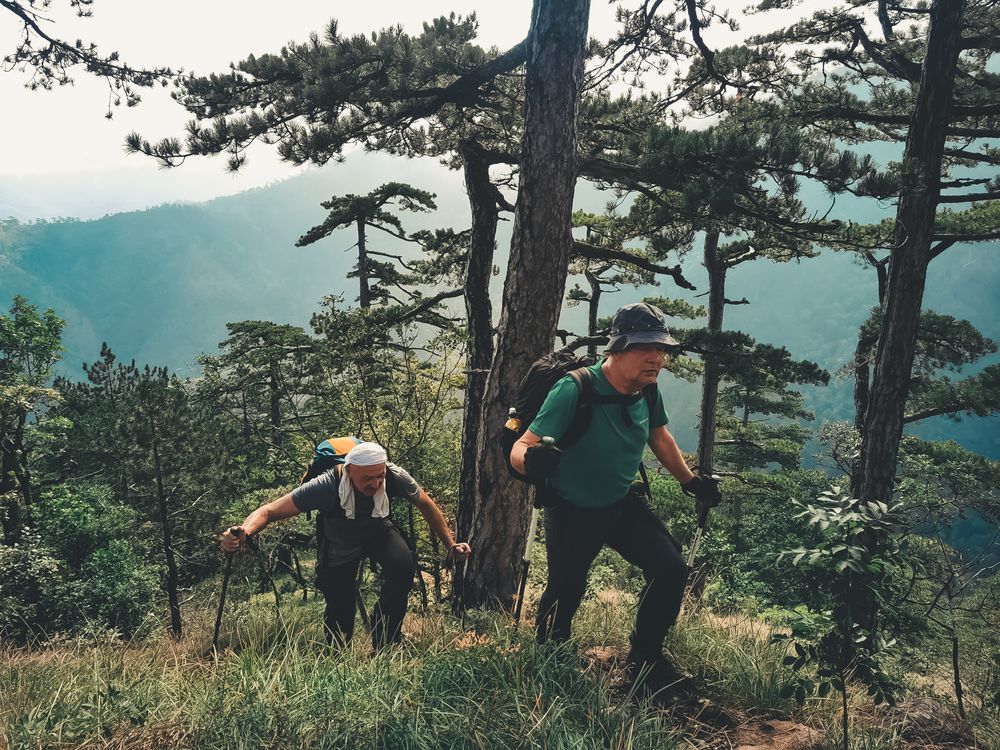
Table of Contents
- Why Knees Take More Stress on Trails
- The Descent Problem
- Trekking Poles: The Most Underused Tool
- Footwear and Ankle Support
- Trail-Specific Training for Knee Durability
- Recovery Protocols for After the Hike
- Knee Support: Braces and Sleeves on Trail
- Frequently Asked Questions
Why Knees Take More Stress on Trails
On flat ground, the knee joint handles a load of approximately 1.5–2× body weight during walking. On uneven terrain, the patellofemoral joint (kneecap against the femur) and the tibiofemoral joint (shin against thigh bone) experience substantially higher peak loads due to the ankle and foot having less ability to absorb impact through a consistent, predictable gait cycle.
Three specific trail conditions drive elevated knee stress:
- Step-down landings: stepping down from a rock or root requires the leading knee to decelerate the body’s downward momentum, producing loads of 3–4× body weight across the knee joint
- Lateral stability demands: roots, rocks, and uneven surfaces require constant micro-corrections from hip, thigh, and knee stabiliser muscles. When these muscles fatigue mid-hike, the mechanical load shifts to passive structures, cartilage, ligament, meniscus
- Sustained downhill walking: the classic knee aggravator in hiking. On sustained descents, the quadriceps work eccentrically (under load while lengthening) to control knee flexion angle and pace of descent. This is the highest muscular demand pattern for the knee, and the one that produces the most post-hike soreness
The Descent Problem
Most adults who experience knee pain after hiking report it on descents rather than ascents. The reason is eccentric quadriceps loading: on a descent, the quadriceps must absorb the body’s downward momentum by contracting while lengthening, a fundamentally more damaging contraction pattern than the concentric (shortening) contractions used on ascents.
Patellofemoral pain (pain behind or around the kneecap) is the most common hiking-related knee complaint and is directly associated with sustained steep descents. The patellofemoral joint experiences compression forces of 4–7× body weight on steep downhill steps, well above what most everyday activities produce.
Practical descent strategies that reduce patellofemoral loading:
- Step sideways on steep sections: descending a steep trail in a lateral crabwalk significantly reduces knee flexion angle, which reduces patellofemoral compression. Adopt this for sections steeper than 25–30 degrees
- Shorter steps: longer strides on a descent increase the knee’s flexion angle at footfall, shorter steps keep the angle smaller and reduce peak compression
- Pace reduction: the faster the descent, the higher the impact load. Slow down on steep terrain, it may feel less efficient but it dramatically reduces joint loading
- Switch-backing: on very steep terrain without a maintained trail, zigzagging reduces the effective gradient angle and distributes the descent over more lateral distance
Trekking Poles: The Most Underused Tool
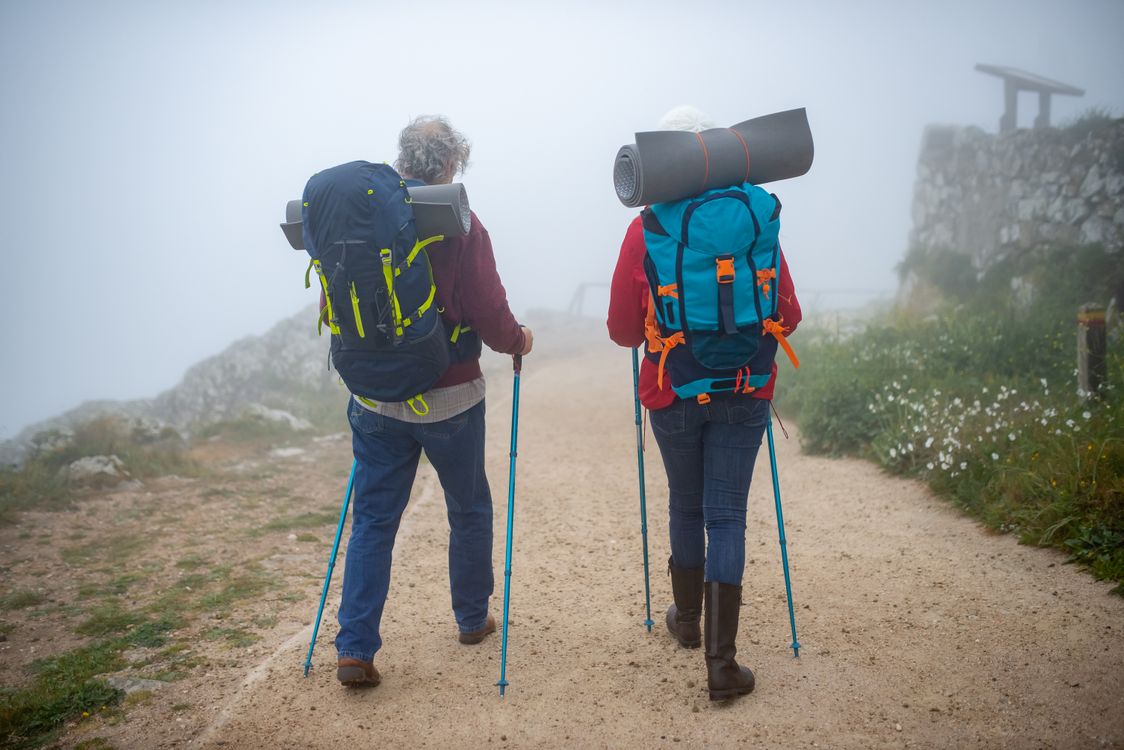
Among the practical interventions for reducing knee stress in hiking, trekking poles have the strongest evidence and the most underestimated benefit among recreational hikers who haven’t used them before.
A 2017 study in the Journal of Electromyography and Kinesiology measured muscle activation patterns and knee joint load in hikers with and without poles on simulated trail conditions. Pole users showed 22% lower peak knee joint forces on downhill sections and 15% lower peak forces on uphill sections. The mechanism: poles engage the triceps, shoulder, and upper back musculature in absorbing impact energy that would otherwise be borne entirely by the lower limb joints.
Correct pole use matters: many hikers use poles too long or plant them in front rather than to the side, which reduces the load-sharing benefit. For downhill use, poles should be lengthened 5–10cm beyond the uphill setting, this places the pole contact point ahead of and beside the foot, distributing the load transfer effectively. Planting the pole at foot contact (not mid-stride) maximises force absorption during the heel-strike phase when knee load is highest.
Footwear and Ankle Support
Knee biomechanics on trail are significantly affected by ankle function. The ankle and subtalar joint absorb and distribute impact load before it reaches the knee, when ankle mobility is limited or the foot overpronates or supinates excessively on uneven terrain, compensatory knee mechanics develop that increase stress on the medial (inner) compartment or patellofemoral joint.
Trail shoes vs hiking boots: the choice depends on terrain and personal mechanics. For light to moderate trails with no significant technical scrambling:
- Trail running shoes with moderate cushioning and a sticky rubber outsole provide proprioceptive feedback from the terrain, which supports the micro-corrections that protect joint stability. Their lighter weight also reduces the energy cost of leg swings over long distances
- Mid-cut hiking boots with ankle support are appropriate for technical terrain, heavy pack loads, or individuals with a history of ankle instability, they limit ankle range of motion, which reduces the demand on lateral ankle stabilisers when crossing roots and rocks
Insoles: custom or semi-custom orthotics that address pronation or supination can meaningfully change knee biomechanics in adults with structural foot variations. If knee pain consistently develops from a specific valgus or varus load pattern, a sports podiatry assessment for footwear and insole guidance is a worthwhile investment before trying to address knee pain through other means.
Trail-Specific Training for Knee Durability
Knee durability on trail is primarily determined by the strength and endurance of three muscle groups: quadriceps, glutes (particularly gluteus medius), and calf. Most recreational hikers over 40 have a relative weakness in one or more of these groups that becomes the limiting factor when trail demands exceed muscle capacity.
Single-leg eccentric squats (step-downs): stand on a step with one foot, lower the opposite heel slowly toward the floor over 3-4 seconds, return. This directly trains the descent demand pattern, eccentric quadriceps loading under the body’s weight. 3 sets of 8-12 reps per leg, 3×/week for 6–8 weeks before a demanding hiking trip.
Glute medius lateral band walks: place a resistance band around both ankles, step laterally across the floor maintaining a slight knee bend and level pelvis. The gluteus medius controls hip abduction and prevents the knee from collapsing inward (valgus) during single-leg loading, its weakness is a primary driver of patellofemoral pain on descents.
Calf raise progression: strong plantarflexion allows the ankle to absorb more impact on each step, reducing transmission to the knee. Eccentric calf raises (heel drop off a step edge) directly load the soleus and gastrocnemius in the range where they are most needed for trail impact absorption.
Load progression: total daily elevation gain is the key variable for knee durability on trail. Increasing trail day elevation by more than 10-15% per week exceeds the adaptive capacity of connective tissue and increases injury risk. Plan a 6–8 week loading progression before any demanding hiking trip rather than jumping from flat walks to a mountain route directly.
Recovery Protocols for After the Hike
What happens in the 24-48 hours after a demanding trail day determines how quickly the knee recovers and how much inflammation persists into the next session.
Immediate (within 2 hours): elevate legs for 15–20 minutes; cold compression if the knee is warm or swollen (15 minutes on, 15 off, twice); avoid prolonged standing or walking that prolongs mechanical loading in the fatigued state.
The following day: light movement (gentle walk, cycling, swimming) is superior to complete rest for reducing delayed-onset muscle soreness and stiffness. The increased circulation and gentle loading encourages repair without additional tissue stress.
Compression sleeves: wearing a knee compression sleeve for the hours after a demanding trail day reduces periarticular swelling and provides mild proprioceptive support during recovery. A basic neoprene or knitted sleeve with consistent compression is adequate, complex hinged braces are not necessary for recovery use. See our guide to the Comprex ankle sleeves for the ankle equivalent when ankle swelling is also a factor.
Supplementation for recovery: collagen peptides with vitamin C taken within 60 minutes post-hike support connective tissue repair synthesis. Magnesium (glycinate or malate form, 200-400mg) addresses the magnesium depletion that occurs through sustained aerobic exertion and supports muscle relaxation and sleep quality overnight. Tart cherry juice concentrate (30ml) has evidence for reducing delayed-onset muscle soreness and inflammatory markers after high-load exercise sessions.
Knee Support: Braces and Sleeves on Trail
Knee braces and sleeves serve different functions on trail:
Compression sleeves (neoprene or knitted, no hinges) provide warmth, proprioceptive feedback, and mild compression that reduces reactive swelling during and after a hike. Appropriate for adults with mild arthritis, chronic patellofemoral irritation, or who simply find the feedback from compression reduces discomfort on long descents.
Hinged knee braces (with lateral and medial hinge mechanisms) provide collateral ligament support and limit excessive valgus/varus movement. Appropriate for adults with a history of ligament injuries, documented instability, or post-surgical knees where mechanical support genuinely reduces risk. Heavy on a hike, reserve for technical terrain or high-instability situations rather than routine trail use.
Patellar tracking braces (with a cut-out or buttress around the kneecap) reduce patellofemoral pain on descents by constraining lateral patellar tracking. These are the most relevant category for adults whose knee pain is specifically behind or around the kneecap during descents. Dr Flexa is a patella-support brace reviewed on this site that covers this use case.
Frequently Asked Questions
Is hiking bad for arthritic knees?
Not categorically, and the evidence generally supports that moderate hiking is beneficial for mild-to-moderate knee OA rather than harmful. A 2019 study in Arthritis Care and Research found that regular walking on varied terrain reduced pain and functional limitation in adults with knee OA compared to sedentary controls. The key variables are terrain intensity (avoid steep, technically demanding trails in active flares), pole use (mandatory for reducing peak load), and load management (gradual progression, not sudden increases in distance or elevation). Adults with severe OA or post-surgical knees should confirm with their orthopaedic team before beginning a trail programme.
How do I stop my knees from hurting when going downhill?
The three most effective strategies are: (1) use trekking poles, they reduce knee load by 15–22% on descents; (2) shorten your stride and slow down on steep descents; (3) strengthen the quadriceps and glute medius through eccentric training (step-downs, lateral band walks) before the hike season. If knee pain on descents is chronic or progressive, a patellofemoral support brace and a physiotherapy assessment are appropriate next steps.
What knee brace is best for hiking?
For patellofemoral pain (pain behind/around the kneecap) on descents: a patellar tracking brace with a lateral buttress. For general arthritis and swelling: a simple compression sleeve provides warmth and proprioceptive feedback without excessive restriction. For instability or ligament history: a hinged brace. The best brace is the one that matches your specific presentation, if you’re unsure which applies, a physiotherapist assessment of your knee pain pattern is worth the investment.
How much water should I drink while hiking?
A practical guideline is 0.5 litres per hour of moderate-intensity hiking, adjusting upward in heat (add 0.25–0.5L/hour above 25°C) and for body weight (larger individuals need proportionally more). Dehydration reduces synovial fluid viscosity (the joint lubricant) which increases friction and discomfort in already-compromised joints. Consistent hydration throughout the hike, rather than large volumes at rest stops, maintains synovial fluid quality and delays fatigue-related neuromuscular breakdown in stabiliser muscles.
About the author: Richard Hale is an independent health writer focused on mobility, joint health, and active aging research. He is not a licensed medical professional. All content on VitalMove40 is for educational purposes only and is not a substitute for advice from a qualified healthcare provider.