Last updated: September 10, 2026 | By Richard Hale
Disclosure: This post contains affiliate links. If you purchase through our links, we may earn a commission at no extra cost to you. We only review products we believe are worth your consideration. Full disclosure here.
Available in: United States, Australia, Germany and Austria.
Foot and ankle swelling is one of the more overlooked consequences of sitting for extended periods, reduced activity, or impaired venous return, and it affects adults over 40 disproportionately. Graduated compression sleeves address this directly by applying calibrated pressure from the foot upward, supporting the venous pump that drives blood back toward the heart. Comprex ankle sleeves use that principle in a toeless, breathable format designed for all-day wear.
This review covers the compression mechanism, what the evidence supports, the practical experience of wearing them, pricing, and who is most likely to benefit.
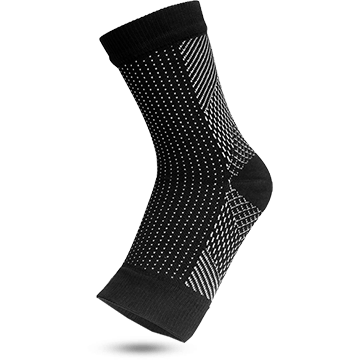
Table of Contents
- What Comprex Ankle Sleeves Do
- How Graduated Compression Works
- What the Evidence Shows
- Specs and Materials
- Pricing and Guarantee
- Who They’re For, and Who Should Look Elsewhere
- Pros and Cons
- Frequently Asked Questions
What Comprex Ankle Sleeves Do
Comprex ankle sleeves are graduated compression garments designed to reduce foot and ankle swelling, improve local circulation, and reduce the aching and fatigue that comes with prolonged standing or sitting. The toeless design allows normal footwear use while keeping the foot cool, and the 4-way stretch fabric accommodates natural foot movement without bunching or slipping.
The sleeves are not ankle braces, they do not provide structural joint stabilisation in the way a rigid or semi-rigid brace does. Their mechanism is vascular: compression applied from the foot upward creates a pressure gradient that assists venous return. For adults whose ankle swelling or discomfort has a circulation component, which is the most common cause in adults without a specific injury, this is the relevant mechanism.
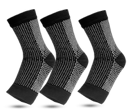
Rating: 3.6 / 5, Solid graduated compression design in a practical all-day format. Good materials and breathable construction. The 30-day guarantee is short for what is typically a habit-building product, and the small 3-pack image quality is limited, but the core product delivers what compression sleeves are supposed to deliver.
How Graduated Compression Works
Graduated compression means the sleeve applies greatest pressure at the foot and progressively less pressure moving up the ankle. This gradient is the mechanically important feature, it creates a directional assist for venous blood flow, pushing blood upward against gravity rather than allowing it to pool in the lower extremities.
In healthy adults at rest, the calf muscle pump (contractions during walking) handles most of this work. During prolonged sitting or standing, or in adults with reduced calf muscle activity or mild venous insufficiency, the pump underperforms and blood pools in the feet and ankles. Graduated compression provides a passive substitute for the pump’s pressure gradient, maintaining circulation without requiring active muscle contraction. For more on how muscle recovery supports circulation after 40, see our guide on muscle recovery after 40.
The effect is most pronounced during the wearing period. Unlike some interventions, compression does not produce lasting structural change, it works while worn and its benefits diminish after removal. This makes consistent, daily wear the key usage pattern for adults managing chronic swelling or circulation-related discomfort. For more on ankle health and mobility, see our guide on ankle mobility after 40.

What the Evidence Shows
Graduated compression for lower-limb venous circulation is among the best-evidenced interventions in preventive and rehabilitative medicine. A meta-analysis of randomised controlled trials on compression therapy for venous disorders (Amsler & Blättler, European Journal of Vascular and Endovascular Surgery) found compression consistently effective at reducing oedema and discomfort in adults with chronic venous insufficiency. The physiological mechanism is well-established and uncontroversial.
For the specific use case of sitting-related foot swelling in otherwise healthy adults, several RCTs have confirmed compression reduces ankle circumference and subjective discomfort during prolonged sedentary periods, relevant for remote workers, frequent travellers, and adults with reduced mobility.
The evidence is less strong for pain relief in adults with structural ankle pathology (tendon injuries, ligament instability). Compression can reduce swelling around an injured joint, but the pain reduction in these cases is secondary to the swelling reduction rather than a direct analgesic effect. For structural ankle and foot pain, targeted approaches discussed in our ankle mobility guide are more directly relevant.
Specs and Materials
| Specification | Detail |
|---|---|
| Material | 93% nylon, 7% spandex |
| Construction | 4-way stretch, toeless, anti-slip |
| Sizes | L and XL |
| Dimensions | 100 x 180 mm |
| Weight | 80g per sleeve |
| Colour | Black |
| Care | Machine washable |
| Guarantee | 30-day money-back |
| Markets | United States, Australia, Germany, Austria |
The 93% nylon / 7% spandex ratio is standard for compression hosiery, nylon provides the structural compression support and durability, spandex provides stretch recovery so the sleeve maintains its compression profile over repeated wears and washes. Machine washability is practical for daily use garments.
Two sizes (L and XL) covers most adults, though sizing is relatively broad, users at the boundary between sizes should consider their dominant ankle circumference when choosing.
Pricing and Guarantee
| Package | Per pair (USD) | Total | Saving |
|---|---|---|---|
| 1 pair | $34.95 | $34.95 | 50% off |
| Buy 2, Get 1 Free (3 pairs) | $17.24 | $34.48 | ~75% off |
| Buy 3, Get 2 Free (5 pairs) | $12.58 | $37.74 | ~82% off |
| Buy 4, Get 3 Free (7 pairs) | $9.99 | $39.96 | ~86% off |
Pricing for Australia, Germany, and Austria is displayed in local currency at checkout. The bundle deals represent significant per-unit savings, for daily wear garments that will be rotated through the wash cycle, having multiple pairs is practical rather than excessive. The B2G1 (3 pairs) is the most balanced value point for most users.
The 30-day guarantee is the main structural limitation. Compression garments take time to integrate into daily routine, wearing them consistently enough to assess their benefit to chronic swelling may take longer than 30 days for some users.
US: See current US pricing →
Australia: See current AU pricing →
Germany / Austria: See current DE/AT pricing →
Who They’re For, and Who Should Look Elsewhere
Good fit for:
- Adults with ankle or foot swelling related to prolonged sitting, standing, or reduced activity, the primary evidence-backed use case for graduated compression
- Adults over 40 with mild venous insufficiency or circulation-related lower-limb discomfort, compression assists venous return without medication or invasive intervention
- Remote workers, frequent travellers, or adults in jobs requiring extended standing who experience end-of-day foot fatigue and swelling
- Post-exercise recovery: wearing compression sleeves after activity reduces delayed-onset swelling and speeds clearance of metabolic waste from working tissue, a useful complement to low-impact recovery activities like swimming for joint health after 40
- Australia, Germany, and Austria users, these markets are often underserved by US-centric recovery product ranges
Who should look elsewhere:
- Adults with acute ankle injuries (sprains, fractures), a graduated compression sleeve is not a substitute for clinical assessment and structured rehabilitation for acute injury
- Adults with peripheral arterial disease, compression is contraindicated in arterial insufficiency (where the problem is arterial inflow, not venous return). Consult a physician before use if you have diagnosed arterial conditions
- Adults looking for structural ankle stabilisation, Comprex sleeves provide venous compression but not the mechanical joint stabilisation that a semi-rigid brace provides for instability or tendon issues
- Adults with diabetes and peripheral neuropathy, reduced sensation means pressure damage may occur without the user being aware. Consult a physician before using compression garments in this population
Pros and Cons
| Pros | Cons |
|---|---|
| Well-evidenced mechanism: graduated compression for venous return is backed by RCT meta-analyses | 30-day guarantee short for a daily habit product |
| Toeless design, wearable with normal footwear all day | Only two sizes (L and XL), limited precision for boundary cases |
| Machine washable, practical for daily rotation | No structural joint support, not for instability or acute injury |
| Strong bundle value (B2G1 brings cost to $17/pair) | Benefits require consistent wear, do not persist after removal |
| Available in US, AU, DE, AT | N/A |
Frequently Asked Questions
How long should I wear Comprex ankle sleeves each day?
Most adults get the best results wearing compression sleeves throughout the working day, from morning until the end of the main sitting or standing period. Overnight use is not typically recommended for compression garments unless specifically advised by a physician. Start with 4–6 hours of wear and adjust based on comfort. If you experience numbness, tingling, or skin colour changes, remove the sleeves and consult a physician.
Can I wear these while exercising?
Yes, the 4-way stretch construction accommodates a full range of foot and ankle motion. Many adults use compression sleeves during walking, light running, or standing workouts. For high-intensity sport or activities requiring precise foot feel, personal preference will determine comfort level.
Will compression sleeves help with plantar fasciitis?
Indirectly. Compression reduces swelling and can improve circulation to the plantar tissue, which may support healing. However, the primary causes of plantar fasciitis, excessive tension on the plantar fascia, inadequate arch support, tight calf muscles, are not directly addressed by compression alone. For a comprehensive approach to plantar fasciitis, see our guide on plantar fasciitis after 40.
Are these the same as compression socks?
Similar mechanism, different coverage. Compression socks extend up the calf; Comprex sleeves focus on the ankle and foot with a toeless format. The sleeve format is more compatible with standard footwear and lighter to wear in warmer conditions. If calf swelling or deep vein return support is the primary concern, full compression socks covering the calf provide more complete coverage. If knee swelling or discomfort is the primary concern rather than the ankle, see our review of the KneeHero Knee Compression Sleeve.
About the author: Richard Hale is an independent health writer focused on mobility, joint health, and active aging research. He is not a licensed medical professional. All content on VitalMove40 is for educational purposes only and is not a substitute for advice from a qualified healthcare provider.