Last updated: July 14, 2026 | By Richard Hale
This content is for educational purposes only and is not medical advice. Consult a qualified healthcare provider for guidance specific to your health situation.
Most adults over 40 track their health through a single number: weight. But weight is a poor proxy for health after 40. Two people can weigh exactly the same and have completely different body compositions, one with 35% body fat and low muscle mass, the other with 20% body fat and high lean mass. Only one of those profiles predicts good physical function, metabolic health, and mobility into later decades. The other is a risk factor for all of them.
This guide explains what body composition is, why it becomes more important to track after 40, how it is measured, and what the evidence says about its relationship to mobility, metabolic health, and physical independence.
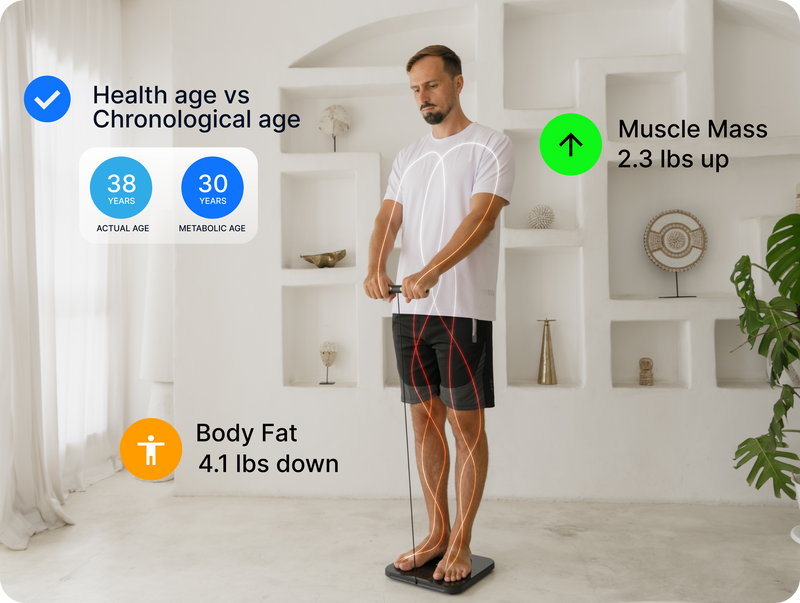
Table of Contents
- Why Weight Alone Misleads After 40
- Sarcopenia: The Muscle Loss Problem Most Adults Don’t Know About
- Body Fat, Visceral Fat, and What Actually Matters
- How Body Composition Is Measured
- What Body Composition Numbers to Aim For
- What You Can Do About It
- Frequently Asked Questions
Why Weight Alone Misleads After 40
Weight measures total mass, bone, water, muscle, fat, organ tissue, everything. BMI (body mass index) adjusts weight for height, but it still cannot distinguish between muscle and fat. A 60-year-old man who weighs 85kg could have excellent body composition with high lean mass and moderate fat, or he could have the metabolic profile of someone at serious cardiovascular and metabolic risk, the scale shows the same number in both cases.
The problem becomes more acute after 40 for a specific reason: body composition changes in a predictable direction. Adults lose muscle mass and tend to gain body fat simultaneously, even when total weight stays the same. This quiet shift is called body recomposition, and it happens passively without any change in diet or activity. The result is a body that weighs the same but functions differently: less strength, less metabolic rate, more fat storage, and a greater proportion of that fat stored in the metabolically dangerous visceral (around the organs) location.
Tracking weight alone misses this shift entirely. Body composition measurement catches it.
Sarcopenia: The Muscle Loss Problem Most Adults Don’t Know About
Sarcopenia is the progressive loss of skeletal muscle mass with age. It begins in the fourth decade, most adults lose between 3% and 8% of muscle mass per decade after 40, with the rate accelerating significantly after 60. The European Working Group on Sarcopenia in Older People (EWGSOP2) defines sarcopenia as low muscle strength combined with low muscle quantity or quality, and classifies severe sarcopenia when physical performance is also impaired.
The mobility consequences are direct: less muscle mass means less strength to perform daily tasks, less joint stability (the muscles around joints provide dynamic stability that passive structures cannot replicate), and slower recovery from both activity and illness. The metabolic consequences are also significant: skeletal muscle is the primary site of glucose uptake, less muscle means less capacity to clear blood glucose, which contributes to insulin resistance over time.
Sarcopenia is not inevitable. It is strongly modifiable by resistance training. The intervention effect is consistent across the research literature: progressive resistance training in adults over 40, 60, and even 80 increases muscle mass, strength, and function, at any starting point. But it requires regular stimulus. The muscle loss continues passively in its absence.
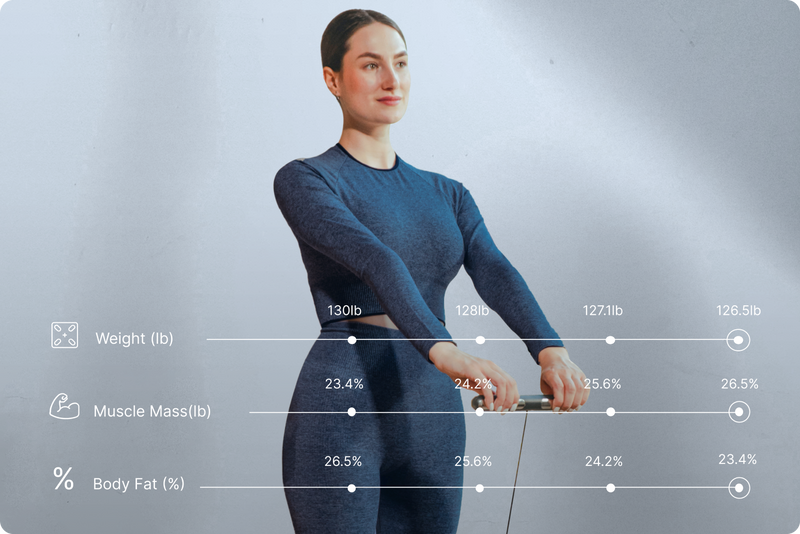
The practical implication: tracking muscle mass directly (not just weight) gives meaningful feedback on whether an exercise and nutrition approach is working. Body weight can remain stable while muscle mass increases and fat decreases, a change the scale misses entirely.
Body Fat, Visceral Fat, and What Actually Matters
Total body fat percentage is a useful metric, but not the most important one. Visceral fat, the fat stored around the abdominal organs rather than under the skin, is the metabolically active fraction that drives risk. Visceral fat produces inflammatory cytokines, disrupts insulin signalling, and is independently associated with cardiovascular disease, type 2 diabetes, and all-cause mortality, regardless of total body weight.
Subcutaneous fat (under the skin, visible as soft tissue) is less metabolically active and less directly harmful. The distinction matters because two adults with the same total body fat percentage can have very different visceral fat loads, and very different metabolic risk profiles. Adults who carry more of their fat centrally (abdominal/visceral) are at substantially greater risk than those with the same total fat distributed peripherally.
Advanced body composition measurement can estimate visceral fat directly, something that weight or waist circumference can only approximate. This makes body composition tracking a more precise risk indicator than conventional anthropometric measurements.
How Body Composition Is Measured
DEXA (Dual-Energy X-ray Absorptiometry)
DEXA is the clinical reference standard for body composition measurement. It distinguishes bone mineral content, lean tissue, and fat tissue across body segments with high precision. It requires a clinical facility, typically costs $50–150 per scan, and involves a small amount of radiation. It is the benchmark against which other methods are validated.
Bioelectrical Impedance Analysis (BIA)
BIA sends a low-level electrical current through the body and measures the resistance, different tissue types (muscle, fat, water, bone) impede the current differently. From the impedance measurements, body composition metrics are calculated using validated equations. Modern multi-frequency BIA devices with segmental analysis (measuring arms, torso, and legs separately) achieve accuracy within 2–3% of DEXA in research settings, making them a clinically meaningful home measurement tool. At-home BIA devices like the Hume Body Pod use 8-frequency sensors and segmental handles to approach this accuracy level.
Waist Circumference and Waist-to-Hip Ratio
Simple anthropometric measures that approximate central adiposity (visceral fat accumulation). A waist circumference above 88cm (35 inches) for women and 102cm (40 inches) for men is associated with elevated metabolic risk. Waist-to-hip ratio above 0.85 (women) or 0.90 (men) similarly flags central fat distribution. These are accessible and evidence-based but less precise than BIA or DEXA for distinguishing fat type and location.
Skinfold Calipers
A trained practitioner measures subcutaneous fat thickness at multiple sites and uses validated equations to estimate total body fat. Technique-dependent and cannot measure visceral fat, generally less useful for the visceral fat concern that is most relevant after 40.
What Body Composition Numbers to Aim For
Evidence-based targets vary by age and sex, and are best discussed with a physician or sports medicine professional in the context of individual health. General reference ranges from the American College of Sports Medicine:
| Category | Men 40–59 | Women 40–59 |
|---|---|---|
| Excellent body fat % | 11–17% | 18–25% |
| Good body fat % | 17–22% | 25–30% |
| Fair | 22–27% | 30–35% |
| Poor | >27% | >35% |
For muscle mass, skeletal muscle index (SMI) (skeletal muscle mass divided by height squared) is the clinical measure used to diagnose sarcopenia. Normal SMI thresholds are approximately 7.0 kg/m² for men and 5.5 kg/m² for women; below these levels, sarcopenia is suspected. Advanced BIA devices can estimate SMI directly from their measurements.
These numbers are reference points, not targets to pursue rigidly. The more actionable framework: tracking your own composition over time and watching the trajectory, is muscle mass stable or declining? Is visceral fat increasing?, is more useful than comparing to a population average at a single time point.
What You Can Do About It
The evidence on body composition modification after 40 is consistent on several key interventions:
Resistance training: The most powerful single intervention for preserving and increasing muscle mass. Two to three sessions per week of progressive resistance exercise (where load increases over time) produces meaningful muscle mass gains at any age. Compound movements targeting large muscle groups (squat, hinge, press, pull patterns) are most effective per unit of time invested.
Protein intake: Muscle protein synthesis requires adequate dietary protein, and protein requirements increase with age as anabolic efficiency declines. Current evidence supports 1.2–1.6g of protein per kilogram of body weight per day for adults over 40 who are training, higher than standard population guidelines. Distribution matters: spreading protein across meals produces better muscle synthesis than concentrated intake in one or two meals.
Sleep: Growth hormone, the primary hormonal driver of muscle protein synthesis and fat mobilisation, is secreted predominantly during deep sleep. Chronic sleep restriction impairs body composition independently of diet and exercise.
Regular tracking: Measuring body composition at consistent intervals (monthly or quarterly) provides objective feedback on whether interventions are working. Without measurement, changes in muscle and fat are invisible until they become clinically significant, which by then often represents years of missed opportunity to intervene.
Frequently Asked Questions
Is BMI useful after 40?
BMI is useful as a population-level screening tool but is a poor individual predictor of metabolic health after 40. It does not account for muscle mass, which means muscular adults are often classified as overweight, and adults with low muscle and high fat can be classified as normal weight. Body composition measurement is a more informative individual metric.
How often should I measure body composition?
Monthly tracking is a reasonable frequency for adults actively working on body composition change. Weekly measurement introduces noise, day-to-day hydration variation alone can shift BIA readings by 1–2%, which is larger than most weekly changes in actual tissue composition. Quarterly measurement is sufficient for adults in maintenance mode who want to confirm their composition is stable.
Can I build muscle after 50?
Yes, unambiguously. Multiple RCTs have demonstrated muscle mass gains and strength improvements from resistance training in adults aged 60, 70, and 80+. The rate of gain is somewhat slower than younger adults, and recovery time between sessions may be longer, but the fundamental response to progressive resistance training does not disappear with age. Protein intake adequacy becomes more important as anabolic efficiency declines.
Does cardio help with body composition?
Cardiovascular exercise burns calories and supports overall metabolic health, but it is less effective than resistance training for preserving muscle mass. A combination approach, resistance training 2–3x/week plus moderate cardiovascular activity, produces the best outcomes for body composition management after 40. Pure cardio without resistance training will improve cardiovascular fitness but will not prevent sarcopenia.
Is cardio or strength training better for body composition after 40?
Strength training has a stronger direct effect on body composition after 40 than cardio alone. It builds and maintains lean muscle mass, raises resting metabolic rate, and improves insulin sensitivity, all of which determine where the body preferentially stores energy. Cardio improves cardiovascular health and burns calories during activity, but without resistance training, the muscle loss that drives body composition changes after 40 continues regardless of cardio volume. The most effective combination is progressive resistance training 2 to 3 times per week alongside moderate cardiovascular activity, which produces better results than either approach alone.
About the author: Richard Hale is an independent health writer focused on mobility, joint health, and active aging research. He is not a licensed medical professional. All content on VitalMove40 is for educational purposes only and is not a substitute for advice from a qualified healthcare provider.