Last updated: September 5, 2026 | By Richard Hale
Disclosure: This post contains affiliate links. If you purchase through our links, we may earn a commission at no extra cost to you. We only review products we believe are worth your consideration. Full disclosure here.
After 40, the bathroom scale starts lying by omission. The number can sit still for months while you quietly trade muscle for fat around the middle, and a “normal” BMI hides both. That lost muscle is the part that matters most for staying strong and independent later, and weight alone will never show it leaving. The Hume Body Pod, sold on Hume Health’s own site simply as the Hume Pod, is a smart scale built to show it: body fat, skeletal muscle, visceral fat, and metabolic age, measured at home each morning and charted over time. This review covers what it measures, how close it gets to a clinical DEXA scan, what the app does with the data, and whether it earns the $229 for someone who wants to track more than weight.
Is the Hume Body Pod worth it?
Yes, for adults over 40 who want to track muscle and fat rather than weight alone. It is a hand-to-foot smart scale that reads body composition to within about 2 to 4 percent of a DEXA scan under consistent conditions, costs $229 with no subscription, and comes with a 45-day money-back guarantee.
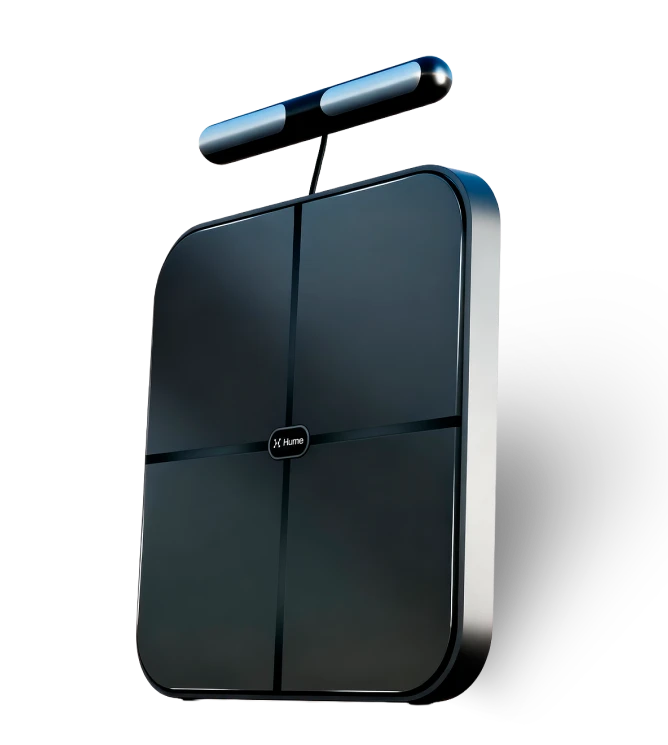
Hume Body Pod: our rating 4.2/5
The at-home way to see whether the training and eating you do after 40 is actually building muscle and shedding fat, instead of guessing from a weight number that barely moves. Rated 4.8/5 by more than 48,000 buyers.
- Reads body fat, skeletal muscle, visceral fat, and metabolic age in about 30 seconds each morning
- Hand-to-foot 8-frequency BIA, meaningfully more accurate than foot-only scales
- The app charts every reading, so you watch the trend and not just today’s number
- One-time purchase, no subscription. 45-day money-back guarantee, HSA/FSA eligible in the US, free shipping
Price at the time of writing: $229, down from $352, or about $13/month across 18 interest-free payments.
Check the current price and 45-day guarantee →
Germany / Switzerland / Austria (page in German) →
Table of Contents
- What the Hume Body Pod Measures
- How BIA Works — and How Good It Actually Is
- Device Specs and App
- Pricing and Guarantee
- Who It’s For — and Who Should Pass
- Pros and Cons
- Hume Body Pod vs a DEXA Scan
- Hume Body Pod vs Withings Body Scan 2 vs InBody
- Frequently Asked Questions
What the Hume Body Pod Measures
The Hume Body Pod measures body composition through bioelectrical impedance analysis (BIA). Unlike a standard bathroom scale, or a basic smart scale that reports total body weight and little else, the Hume Body Pod reports:
- Body fat percentage — total fat mass as a proportion of body weight
- Skeletal muscle mass — the lean muscle tissue directly responsible for strength, mobility, and metabolic rate (see our guide on protein intake after 40 to protect muscle mass)
- Visceral fat rating — an estimate of fat stored around the abdominal organs, which carries the greatest metabolic risk
- Basal metabolic rate (BMR) — calories the body burns at rest, which scales with muscle mass and is critical for understanding energy balance
- Hydration level — total body water as a percentage, which affects both performance and day-to-day BIA reading accuracy
- Metabolic age — a comparative metric estimating your metabolic profile relative to age norms based on the above data
- Bone mass estimate — estimated skeletal mineral density contribution to body weight
Rating: 4.2 / 5 — The Hume Body Pod delivers a genuinely useful multi-metric body composition snapshot in a compact home device. The eight-frequency segmental BIA approach is more accurate than single-frequency foot-only scales. The app converts the data into trend tracking and actionable benchmarks. Main limitation: BIA accuracy is sensitive to hydration timing, and no home BIA device replaces clinical DEXA for diagnostic precision — but for the purpose of tracking personal trends over time, it is a practical and accessible tool. For context on why these metrics matter after 40, see our guide on body composition after 40.
How BIA Works — and How Good It Actually Is
Bioelectrical impedance sends a small, imperceptible electrical current through the body. Different tissue types have different resistance to that current: muscle, which holds a large amount of water, is a good conductor; fat, which holds little water, resists the current more. The device measures this resistance across multiple frequencies and body segments, then applies validated equations to estimate tissue composition.
The key technical distinction in the Hume Body Pod is eight-frequency segmental BIA. Consumer scales that use only two foot electrodes measure total body impedance through the lower body only and extrapolate the rest — this introduces meaningful error, particularly for upper-body-dominant body types. The Hume Body Pod uses handle electrodes held during the measurement, which adds the arm and torso segments to the measurement circuit. Eight frequencies (rather than the single frequency used in basic devices) allows the device to distinguish between intracellular and extracellular water, which improves accuracy in estimating lean mass and fat.
In clinical validation studies, multi-frequency segmental BIA devices of this type achieve body fat percentage accuracy within 2–4% of DEXA when measurements are taken under consistent conditions (morning, same hydration state, same time of day). That is a meaningful improvement over single-frequency, foot-only scales, which can diverge from DEXA by 5–8% or more. A 2024 peer-reviewed study on the reliability and accuracy of multi-frequency bioelectrical impedance analysis found comparable agreement with DEXA under controlled measurement conditions. It is not clinical-grade precision — for that, DEXA scanning at a sports medicine facility is the reference standard — but for tracking personal trends over months and quarters, the precision is more than adequate.
Device Specs and App
| Specification | Detail |
|---|---|
| Measurement method | 8-frequency segmental BIA |
| Electrode configuration | Foot plates + hand-grip handles (4-point segmental) |
| Metrics reported | Weight, body fat %, muscle mass, visceral fat, BMR, hydration, bone mass, metabolic age |
| Connectivity | Bluetooth, syncs to companion app |
| App compatibility | iOS and Android |
| App features | Historical trend tracking, goal setting, composition benchmarks by age/sex |
| Max weight capacity | 180kg / 400lb |
| Display | LED readout with backlight |
| Power | AAA batteries |
| Guarantee | 45-day money-back |
| Markets | United States (English page); Germany, Switzerland, Austria (German-language offer page) |
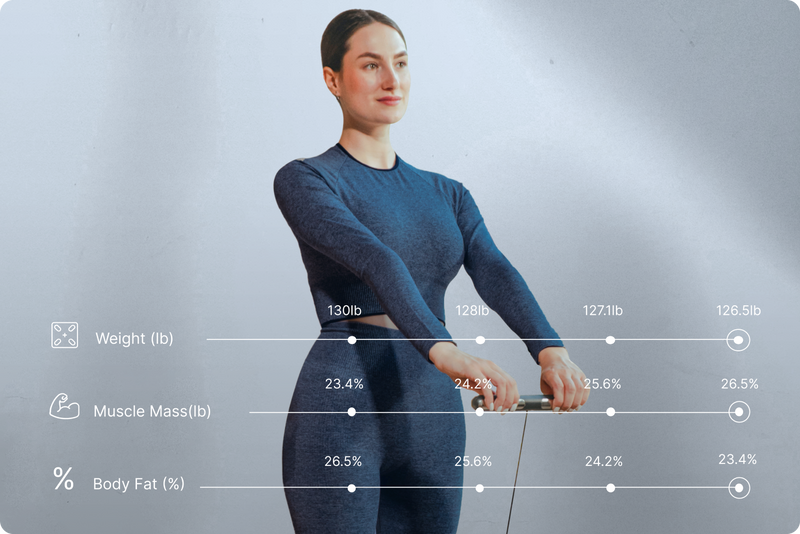
The companion app is where the Hume Body Pod data becomes most useful. The scale transmits via Bluetooth, and the app stores each measurement automatically — building a historical record that shows composition trends over time. The trend graph for muscle mass and body fat percentage, tracked monthly over 6–12 months, gives objective feedback on whether a training and nutrition approach is producing the intended change in body composition. This is the key value proposition: not precision at a single point in time, but sensitivity to change over time.
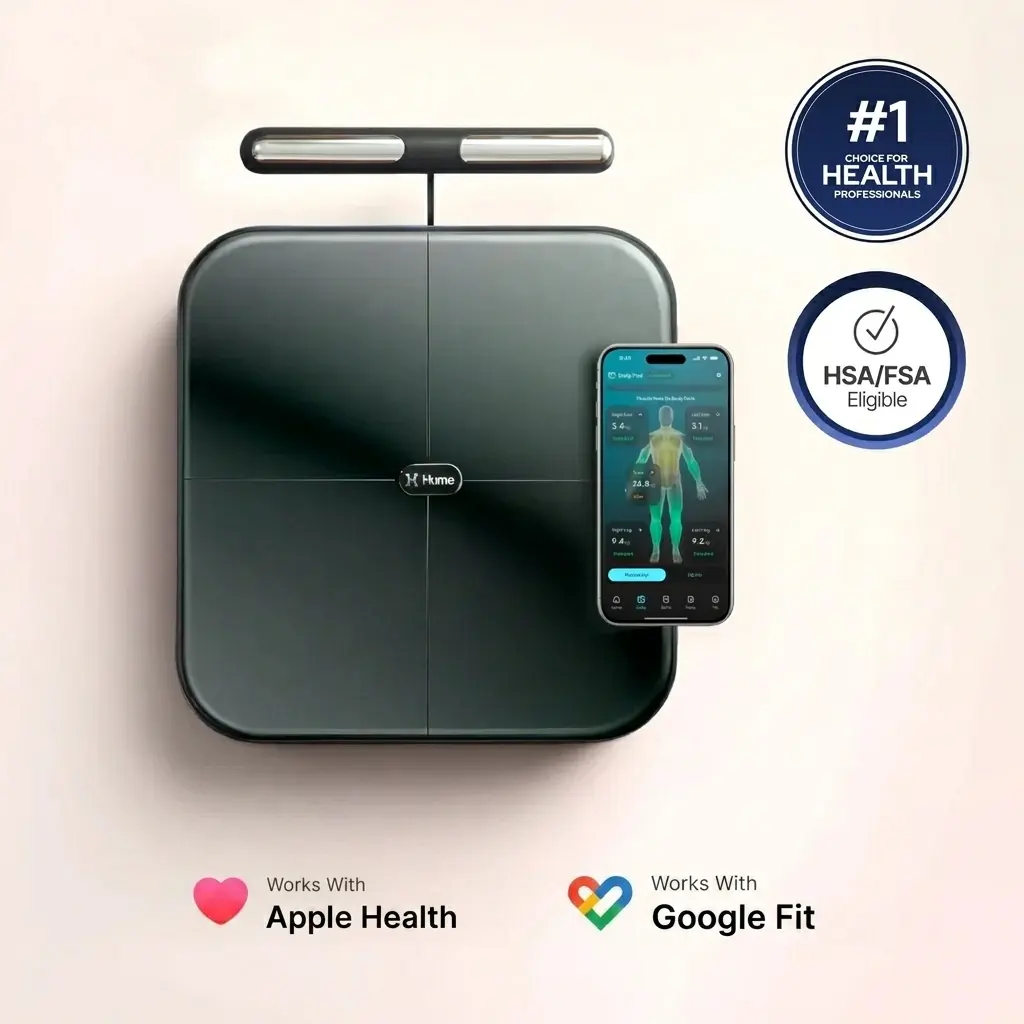
The app includes age- and sex-adjusted benchmarks for each metric, which contextualises where the user sits relative to population norms. This is more useful than raw numbers for most adults — knowing that skeletal muscle mass is in the bottom third for your age group is actionable information; knowing it has increased by 0.8kg over three months confirms that an intervention is working. If you are comparing the Hume Body Pod’s tracking approach to wearable options, see our roundup of the best fitness trackers for adults over 50.
Pricing and Guarantee
At the time of writing the Hume Body Pod is $229 in the US, down from a $352 list price. You can split it into 18 interest-free payments of about $13 a month if you would rather not pay it all at once. It is HSA/FSA eligible, so many US buyers can pay with pre-tax health dollars, and shipping is free. For Germany, Switzerland, and Austria the price shows in local currency on the separate German-language page. Check the links for the live figure, since the promotional price moves.
Put that next to the alternative. A single DEXA scan runs $40 to $150 and means booking a clinic visit; the three or four scans a year that real trend tracking would need cost about the same as the Pod and still give you far fewer data points. The Withings Body Scan 2 is $599.95. The Pod is the low-cost way to measure often, and measuring often is the whole point of tracking body composition.
The guarantee is 45 days. A full body-composition trend takes 8 to 12 weeks of consistent measuring to show clearly through the daily hydration noise, so 45 days is enough to confirm the device reads accurately for your body and that you will keep using it, though not enough to see a complete trend. Start measuring the morning it arrives.
See current price and availability (US) →
Pricing for Germany / Switzerland / Austria (German page) →
Who It’s For — and Who Should Pass
Good fit for:
- Adults over 40 tracking muscle mass alongside weight — the core use case where the Hume Body Pod provides information that a standard scale cannot
- Adults starting a resistance training program who want objective data on whether muscle mass is increasing, rather than relying on weight alone (which stays flat or declines during the early months of a simultaneous muscle-gain/fat-loss recomposition) — see our guide to setting up a joint-friendly home gym after 40
- Adults managing weight who want to distinguish between fat loss and muscle loss — a caloric deficit alone reduces total weight, but the composition of that weight loss matters significantly for long-term metabolic health (see how weight loss affects joint health)
- Adults with a history of weight cycling (repeated weight loss and regain) — body composition tracking often reveals the muscle mass cost of repeated cycles that total weight does not show
- Anyone who has been told their BMI is concerning but has significant muscle mass — the device provides objective data to contextualise BMI’s limitation
If you recognise yourself in that list, the Pod tells you something your current scale cannot, from the first morning you step on it.
Check the current price and 45-day guarantee →
Who should pass:
- Adults with pacemakers or other implanted electronic devices — BIA electrical current is contraindicated. Consult a physician before use
- Adults who want a single authoritative body composition measurement for clinical purposes — DEXA scanning at a sports medicine or radiology facility provides diagnostic-grade precision that home BIA cannot match
- Adults primarily motivated by weight loss who do not have an interest in muscle mass or metabolic health metrics — a standard scale is adequate for weight tracking alone
Pros and Cons
| Pros | Cons |
|---|---|
| 8-frequency segmental BIA — more accurate than foot-only consumer scales | 45-day guarantee ends before a full body-composition trend forms (8 to 12 weeks) |
| Bluetooth app tracks historical trends — the primary value over time | BIA accuracy degrades without consistent measurement conditions (same time, same hydration) |
| Reports visceral fat, muscle mass, and BMR — metrics weight cannot provide | Not a substitute for clinical DEXA for diagnostic use |
| Age/sex-adjusted benchmarks in app contextualise results | Requires consistent habit (same-day, same-conditions measurement) to unlock the trend value |
| Compact, standard scale form factor — no special installation required | Contraindicated for pacemaker users |
Hume Body Pod vs a DEXA Scan
A DEXA (DXA) scan is the reference standard for body composition. It uses a low-dose X-ray to measure fat, lean mass, and bone density with clinical precision, and it is the benchmark every home device is measured against. The trade-off is access and cost: a DEXA scan runs roughly $40 to $150 per session in the US, means a trip to a sports medicine clinic or imaging center, and involves a small radiation dose, so it is not something to repeat every week.
The Hume Body Pod is not trying to replace DEXA. It is trying to make frequent measurement practical. Under consistent conditions, its body fat readings land within about 2 to 4 percent of DEXA, close enough that a real change in body composition over two or three months shows up clearly even when the single-day number is not exact. A sensible pattern for many adults over 40: an occasional DEXA scan to set an accurate baseline, and the Hume Body Pod at home to track the direction of travel between scans.
| Hume Body Pod | DEXA scan | |
|---|---|---|
| Method | 8-frequency segmental BIA | Dual-energy X-ray absorptiometry |
| Typical cost | One-time device purchase, no subscription | About $40 to $150 per scan |
| Where | At home, any morning | Clinic or imaging center, by appointment |
| Body fat accuracy | Within about 2 to 4% of DEXA in controlled conditions | Reference standard |
| Best use | Frequent trend tracking | Accurate baseline and periodic checkpoints |
Hume Body Pod vs Withings Body Scan 2 vs InBody Dial H30
These are the three home devices adults over 40 most often compare when they want more than a weight reading. They sit at very different price points and are built for different jobs.
| Hume Body Pod | Withings Body Scan 2 | InBody Dial H30 | |
|---|---|---|---|
| US price | One-time purchase (see current offer) | $599.95 | About $340 ($280 refurbished) |
| Method | 8-frequency segmental BIA (hand-to-foot) | Segmental BIA, 12 electrodes, plus 6-lead ECG | Triple-frequency segmental BIA (hand-to-foot) |
| Composition metrics | Body fat, muscle mass, visceral fat, BMR, hydration, bone mass, metabolic age | Segmental fat and muscle, plus 60+ health biomarkers | Segmental fat and muscle, body water, visceral fat |
| Cardiovascular and other | None | ECG, hypertension risk alert, vascular age, early glycemic screening | None |
| Subscription | Not required | Not required for core metrics; optional Withings+ ($99/year) for advanced scores | Not required |
| Best known for | Simple, subscription-free composition trend tracking | Near-clinical multi-system health scan | Trusted BIA accuracy for composition specifically |
Choose the Hume Body Pod if…
You want to track body fat, muscle mass, and visceral fat trends over time at the lowest cost, with no subscription and no clinical extras you will not use. It covers the core job most people over 40 actually need.
Choose the InBody Dial H30 if…
Body composition accuracy is your priority and you are comfortable paying around $340 for it. InBody has a long track record in gym and clinical BIA, and the Dial H30 brings that lineage home. It does not add heart or nerve screening.
Choose the Withings Body Scan 2 if…
You want a single device that reads far more than body composition: a 6-lead ECG, a hypertension risk alert, vascular age, and early glycemic screening. At $599.95 it is the most expensive option by a wide margin, and it is aimed at people who want a near-clinical health scan at home rather than a simple composition tracker.
Bottom line: For most adults over 40 who simply want to see muscle and fat move in the right direction, the Hume Body Pod does that job for the least money and no subscription. Step up to InBody for stronger composition accuracy, or to the Withings Body Scan 2 if you want heart and metabolic screening built into the same device.
See the current Hume Body Pod offer (US) →
Is the Hume Body Pod Legit?
Yes. The Hume Body Pod comes from Hume Health, an established health technology company that also makes the Hume Band and ships directly to customers across the US and Europe. The device runs on bioelectrical impedance analysis (BIA), the same measurement approach used in gyms and clinical settings, and it arrives with a working iOS and Android app, customer support, free shipping, and a 45-day money-back guarantee.
The accuracy notes in this review are the normal, well-documented limits of home BIA as a technology, and they apply to every device in the category. On the questions people actually ask before buying: it is a real product from a real company, built on proven measurement technology, and rated 4.8 out of 5 across more than 48,000 customer reviews.
The verdict: Hume Body Pod, 4.2/5
If you are over 40 and serious about holding on to muscle and keeping visceral fat down, you need to see those numbers move, not hope they are moving. The Hume Body Pod measures them accurately enough at home, in about half a minute a day, for the lowest cost in its class and with no subscription. It will not replace a clinical DEXA scan, and the readings need consistent conditions to be reliable, but as the tool you actually use week after week it does the job. More than 48,000 buyers rate it 4.8/5.
$229 at the time of writing, down from $352. Installments available, HSA/FSA eligible, 45-day money-back guarantee, free shipping.
Check the current price (US) →
Germany / Switzerland / Austria (page in German) →
Frequently Asked Questions
Is the Hume Body Pod worth it?
For adults over 40 tracking muscle mass and visceral fat, yes. At $229 with no subscription it costs less than four DEXA scans and lets you measure as often as you like, which is what makes a trend visible in the first place. It is not worth it if total weight is all you care about, since a basic bathroom scale does that for a fraction of the price.
Is the Hume Pod the same as the Hume Body Pod?
Yes, both names refer to the same smart scale. Hume Health headlines the device as the Hume Pod on its own product page and then describes it as the Hume Body Pod in the same block, so a search for either name leads to this device. This review uses the fuller name throughout.
How accurate is the Hume Body Pod compared to a DEXA scan?
In controlled conditions (morning measurement, fasted, same hydration state each time), multi-frequency segmental BIA devices like the Hume Body Pod achieve body fat percentage accuracy within 2–4% of DEXA in research comparisons. That means a reading of 25% body fat could represent actual body fat anywhere from approximately 21–29%. This is not diagnostic precision, but it is adequate for tracking trends — if body fat reads 25% today and 22% in three months, that change is real and meaningful even if the absolute number is not DEXA-precise.
When is the best time to measure?
Morning, before eating or drinking, after using the bathroom, and before any exercise — consistently each time. Hydration state is the largest single variable affecting BIA readings. Measuring at the same time under the same conditions removes that source of noise and makes trend tracking reliable. Do not measure after intense exercise, after a large meal, or after alcohol consumption — all significantly shift hydration status and will distort the reading.
Why does my weight fluctuate so much day to day?
Normal body weight fluctuates 1–3kg daily due to food and fluid intake, glycogen stores, and digestive transit — none of which represents actual fat or muscle change. This is why body weight is a noisy short-term metric. Body composition (fat and muscle percentages) is more stable and changes slowly over weeks. The Hume Body Pod app’s trend view smooths out this daily noise and shows the meaningful longer-term direction.
Does the Hume Body Pod work for women going through menopause?
It measures body composition in the same way for all adults. However, hormonal changes during menopause affect fat distribution (particularly toward visceral fat) and muscle mass retention — making body composition tracking particularly relevant during this period. The device’s age- and sex-adjusted benchmarks account for these population differences in their reference norms.
Is Hume Health a real company?
Yes. Hume Health is a health technology company that makes body composition measurement devices and apps for adults tracking health metrics. They produce multiple products including the Hume Body Pod and Hume Band, sell through direct-to-consumer channels, and have a functional customer support operation.
Is the Hume Body Pod available in Germany, Switzerland, or Austria?
Yes. The Hume Body Pod is available in Germany, Switzerland, and Austria through a dedicated offer page in German, separate from the English-language ordering page used for the United States. Pricing for the DE/CH/AT market is shown in local currency on that page.
Is the Hume Body Pod or the Withings Body Scan 2 better for someone over 40?
It depends what you want to measure. The Hume Body Pod focuses on body composition trends (fat, muscle, visceral fat) at a lower one-time cost with no subscription. The Withings Body Scan 2 costs $599.95 and adds a 6-lead ECG, a hypertension risk alert, and early glycemic screening. If you mainly want to track muscle and fat over time, the Hume Body Pod covers it for far less; if you want heart and metabolic screening in the same device, the Withings is the more complete tool.
Hume Body Pod vs InBody Dial H30 — which is more accurate?
Both use multi-frequency segmental BIA with a hand-to-foot path, which is more accurate than foot-only scales. InBody has a longer validation record in clinical and gym settings and is generally regarded as the accuracy benchmark among home BIA devices, at a price of around $340. The Hume Body Pod is close in method and typically costs less, and for tracking your own trends over months the practical difference between the two is small as long as you measure under consistent conditions.
About the author: Richard Hale is an independent health writer focused on mobility, joint health, and active aging research. He is not a licensed medical professional. All content on VitalMove40 is for educational purposes only and is not a substitute for advice from a qualified healthcare provider.