
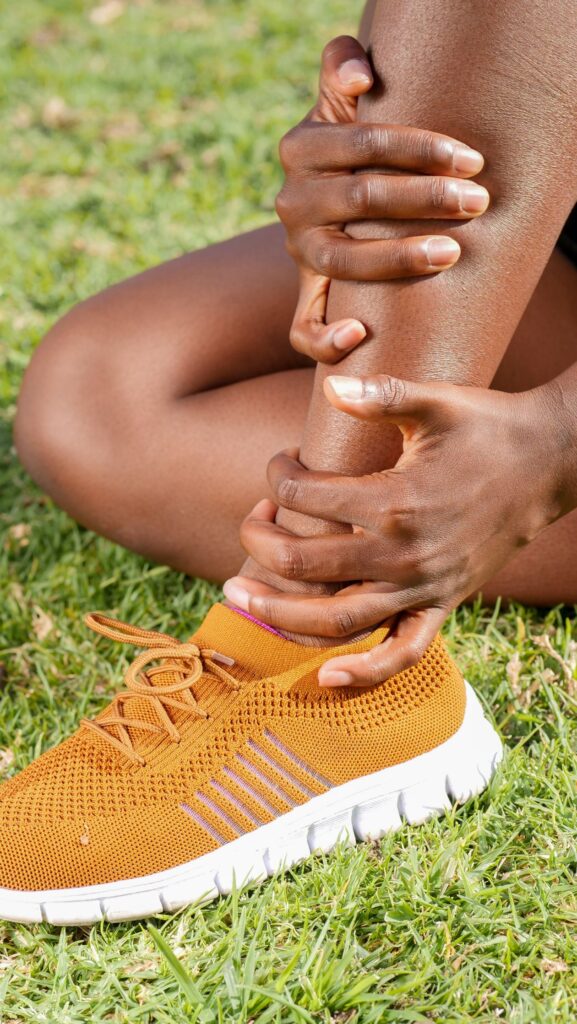
Ankle Pain and Instability After 40: Causes, Treatment and Support Options
Ankle pain and instability after 40 most commonly trace back to cumulative effects of old sprains, Achilles or peroneal tendinopathy, or early ankle osteoarthritis. The key to lasting improvement is proprioception training, not just support devices, though compression sleeves and proper footwear play a meaningful role during recovery and activity.
Few joint problems are as underestimated as chronic ankle issues. A bad ankle sprain in your 20s or 30s that “healed” may be the reason your ankle feels unstable and gives way during activity in your 40s. A decade of wearing unsupportive footwear adds to the picture. By midlife, the ankle complex often carries accumulated wear that begins to express itself as pain, stiffness, or that persistent sense of unreliability on uneven ground.
Anatomy: Why the Ankle Is Vulnerable
The ankle joint (talocrural joint) is formed by the tibia, fibula and talus. It is primarily a hinge joint allowing up-and-down motion (dorsiflexion and plantarflexion). The subtalar joint below it allows side-to-side motion (inversion and eversion).
The lateral (outer) side of the ankle is supported by three ligaments: the anterior talofibular ligament (ATFL), calcaneofibular ligament (CFL) and posterior talofibular ligament (PTFL). These are the ligaments torn in the classic “rolling” ankle sprain, and they are structurally weaker than the deltoid ligament complex on the medial (inner) side.
The tendons crossing the ankle include the Achilles posteriorly, the peroneal tendons laterally, the tibialis posterior medially, and the extensor tendons anteriorly. Each is a potential source of pain depending on the movement demands on that particular structure.
Common Causes After 40
| Condition | Location | Key Signs | Risk Factor |
|---|---|---|---|
| Chronic lateral instability | Outer ankle | Recurrent giving way, especially on uneven ground | Previous sprains |
| Achilles tendinopathy | Back of ankle, 2 to 6 cm above heel | Morning stiffness, pain with running or jumping | Increased activity, age, poor footwear |
| Peroneal tendinopathy | Behind outer ankle bone | Pain along outer ankle during walking or sport | Supinated foot type, previous sprains |
| Posterior tibial tendon dysfunction | Inner ankle, below medial malleolus | Flat arch collapse, inner ankle pain with walking | Obesity, flat feet, female sex, age |
| Ankle osteoarthritis | Front and sides of ankle joint | Deep joint pain, stiffness, grinding, swelling | Previous fracture, recurrent sprains |
| Ankle impingement | Front (soft tissue) or back (bone) | Pain at extremes of dorsiflexion or plantarflexion | Soccer players, dancers, runners |
| Plantar fasciitis | Heel to arch | Worst pain on first steps in morning | High impact activity, tight calves, poor footwear |
Chronic Ankle Instability: The Most Misunderstood Problem
Approximately 40% of people who sustain an ankle sprain develop chronic lateral ankle instability. The ligaments have healed, at least partially, but the proprioceptive nerve endings within the ligaments were damaged during the initial injury. These nerve endings normally provide continuous feedback to the brain about ankle position in space.
Without this feedback, the muscles responsible for ankle stabilization (primarily the peroneals) cannot react fast enough when the ankle begins to roll. The result: repeated near-sprains or actual re-sprains on any uneven terrain.
This is why compression sleeves help more than you might expect: they increase pressure on the skin over the ankle, activating skin-based proprioceptors (mechanoreceptors in the dermis) that partially compensate for the lost joint-based proprioception. They do not primarily work by “holding the ankle in place.”
The Best Exercises for Ankle Stability
Single-Leg Balance Progression
Start: stand on one foot on a flat surface for 30 seconds. Progress to: standing on a folded towel, then a foam pad, then a balance board. Eyes closed increases the difficulty significantly by removing visual compensation. 3 sets of 30 seconds per side, daily. This single exercise has the highest level of evidence for reducing re-sprain risk.
Star Excursion Balance Training
Stand on one foot. With your free foot, reach as far as possible in 8 different directions (imagine a star pattern on the floor) without touching down. Return to center between each reach. 3 rounds of the star pattern per side. This trains dynamic balance under load, closer to real-world conditions than static single-leg balance.
Peroneal Band Eversion
Sit with a resistance band looped around the foot. Anchor the other end and evert your foot outward against the resistance (sole faces outward). Slow and controlled. 3 sets of 15. Directly strengthens the peroneal tendons that protect against lateral ankle rolling.
Eccentric Calf Raises for Achilles
Stand on the edge of a step with heels off. Rise on both feet, then lower on the painful side only (single-leg eccentric). Perform slowly over 3 to 4 seconds on the way down. 3 sets of 15, twice daily. This is the Alfredson protocol and has 60 to 90% success rates in clinical trials for Achilles tendinopathy.
Calf and Achilles Flexibility
Against a wall, lean forward into a straight-leg calf stretch (gastrocnemius) then a bent-knee version (soleus). Hold 45 seconds each, 3 times per side. Tight calves increase Achilles loading and ankle stiffness. Essential for plantar fasciitis as well.
Ankle Sleeves and Braces: When They Help
The evidence for ankle support is strongest in specific contexts:
- During sport after a previous sprain: A 2018 meta-analysis found ankle bracing reduced re-sprain incidence by 69% in people with prior sprains. This is among the strongest effect sizes for any musculoskeletal support device.
- During prolonged standing or walking on uneven terrain
- Immediately after a sprain (first 3 to 5 days) to reduce swelling and allow weight-bearing
Ankle support is less useful (and potentially counterproductive) when worn all day on flat surfaces without any activity justification, as it reduces the proprioceptive training stimulus the ankle needs to rebuild stability.
We reviewed the Comprex Ankle Sleeves, which provide graduated compression and targeted lateral support without restricting the dorsiflexion needed for normal walking. The design is appropriate for daily use during activity without creating dependency in non-activity periods.
Footwear and Insoles
Ankle pain and shoe choice are closely related. Key shoe features for ankle health after 40:
- Wide toe box: Allows the forefoot to spread naturally, improving proprioception and balance
- Low heel-to-toe drop (under 8mm): Encourages better ankle mechanics and reduces Achilles loading
- Firm heel counter: Supports rearfoot stability without being rigid
- Lateral stability: A wider midsole base reduces inversion moments during walking
Insoles with arch support can reduce the load on the posterior tibial tendon in people with flat feet or progressive arch collapse. The Evostep Insoles provide graduated arch support that addresses the pronation-related ankle loading common in adults with flattened arches. For people with the opposite problem (high arch, supinated foot) and chronic lateral ankle instability, neutral or minimal-support insoles are more appropriate.
When to See a Doctor
Prompt medical evaluation is warranted if:
- You cannot bear weight after an ankle sprain (possible fracture, Ottawa Rules positive)
- There is significant swelling, bruising extending to the foot and heel, or deformity
- Pain is present at rest without recent injury
- You have deep joint pain with grinding and significant restriction (possible osteoarthritis needing imaging)
- Symptoms have not improved after 6 to 8 weeks of rehabilitation
Frequently Asked Questions
What causes ankle pain in adults over 40?
The most common causes are chronic ligament laxity from old sprains, peroneal or Achilles tendinopathy, ankle osteoarthritis, posterior tibial tendon dysfunction, and impingement syndromes from bony spurs. Previous ankle sprains are a major predisposing factor for most of these conditions.
Why does the ankle feel unstable after a sprain heals?
After an ankle sprain, the proprioceptive nerve endings in the ligaments are often damaged, reducing the ankle’s position sense. This proprioceptive deficit is the main driver of chronic instability and re-sprain risk, not the ligament laxity itself. Balance and proprioception exercises are the most effective rehabilitation approach.
What is the best exercise for ankle instability?
Balance and proprioception exercises are the most effective. Single-leg standing on an unstable surface, star excursion balance training, and lateral hops retrain the proprioceptive pathways damaged by previous sprains. Peroneal strengthening with resistance bands completes the rehabilitation protocol.
Do ankle sleeves actually help with instability?
Yes, during activity. Ankle sleeves reduce re-sprain risk by providing compression that enhances proprioception via skin receptors and some mechanical resistance to inversion movement. A 2018 meta-analysis found ankle bracing reduced re-sprain incidence by 69% in people with previous sprains.
What is Achilles tendinopathy and how is it treated?
Achilles tendinopathy is degeneration of the Achilles tendon causing pain and stiffness typically 2 to 6 cm above the heel. The most effective treatment is the Alfredson eccentric heel drop protocol: 3 sets of 15 eccentric heel drops on a step, twice daily for 12 weeks, with 60 to 90% success rates in clinical trials.
What type of shoe is best for ankle pain?
For chronic ankle instability, shoes with a wide base, good lateral stability and a firm heel counter provide the best support. A low heel-to-toe drop (under 8mm) encourages better ankle mechanics. Avoid overly cushioned, high-heeled shoes that reduce proprioceptive feedback from the foot.