Affiliate Disclosure: VitalMove40 earns a commission from purchases made through affiliate links on this page, at no extra cost to you. See our full Affiliate Disclosure Policy.
Last updated: August 12, 2026 | By Richard Hale
The Aptofit Smart Watch positions itself in the health monitoring segment of the consumer wearables market, with features that include continuous heart rate monitoring, blood oxygen tracking, sleep monitoring, and an ECG capability. This review covers what those features actually mean in practice, what the device is well-suited for, and what is important to understand about health monitoring claims in consumer wearables before making a purchase decision.
This content is for educational purposes only and is not medical advice. No consumer smartwatch replaces clinical monitoring or diagnosis. Any concerning health readings should be followed up with a qualified healthcare provider.

Table of Contents
- Who the Aptofit Is For
- Key Features
- Understanding the Health Monitoring Features
- What It Does Well
- Important Context on Health Claims
- Verdict
- Frequently Asked Questions
Who the Aptofit Is For
The Aptofit targets adults who want a consolidated health monitoring wearable, something that tracks daily activity, monitors heart rate continuously, checks blood oxygen, and provides ECG capability, in a single device. For adults over 40 who are motivated to be more aware of their health data and want a device that goes beyond simple step counting, the Aptofit covers the core health metrics that are actually useful for this demographic.
It is not a medical device, and should not be treated as one. See the full guide on activity tracking after 40 for context on how to use wearable health data appropriately.
Key Features
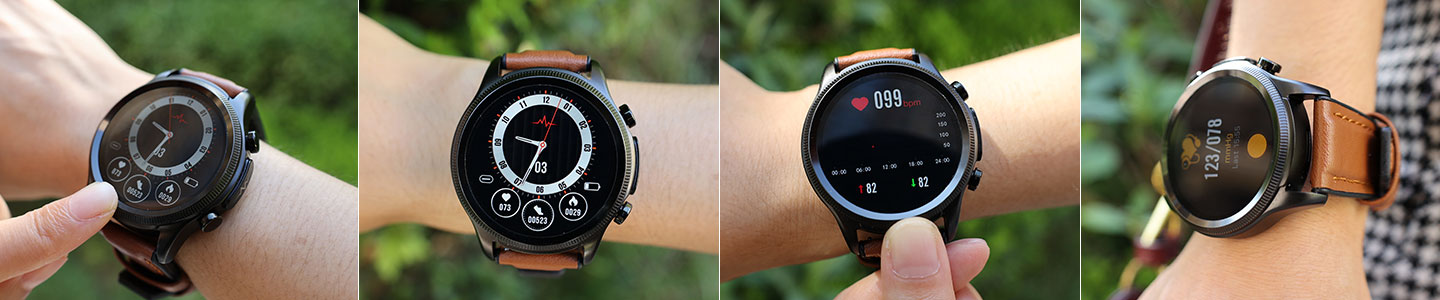
The Aptofit includes:
- Continuous heart rate monitoring: 24/7 optical wrist sensor
- Blood oxygen (SpO2) monitoring: spot checks and continuous tracking
- ECG capability: electrocardiogram function via electrical sensor
- Sleep monitoring: duration, sleep stages, sleep quality scoring
- Activity tracking: steps, distance, calories, active minutes
- Body temperature monitoring: skin surface temperature readings
Understanding the Health Monitoring Features
Continuous heart rate monitoring is a well-established consumer wearable feature with a solid evidence base at the population level. Optical wrist sensors have known accuracy limitations during vigorous exercise but are reliable for resting heart rate trends, which is the metric most useful for tracking fitness adaptation and recovery over time.
Blood oxygen (SpO2) monitoring via wrist-worn optical sensors provides estimated readings that are useful for identifying patterns but are less accurate than fingertip pulse oximeters, particularly in people with darker skin tones (where optical sensors can underread). For flagging potential desaturation episodes during sleep or trends over time, the data is informative. For any clinical decisions, a fingertip pulse oximeter is the appropriate tool.
ECG capability in consumer smartwatches typically detects atrial fibrillation with reasonable sensitivity. Several FDA-cleared consumer devices have been validated for this purpose. The value for adults over 40 is real, afib is significantly more common in this age group and often asymptomatic. An unexpected afib reading should be followed up with a clinical 12-lead ECG, not acted on directly.
What It Does Well
For the daily health awareness use case, tracking activity levels, monitoring resting heart rate trends, getting alerted to unusual patterns in sleep or heart rhythm, the Aptofit consolidates the relevant metrics in one device. The value of this consolidation is practical: most people are not going to wear multiple dedicated devices to track different metrics separately.
The sleep monitoring is particularly relevant for adults over 40, where sleep quality directly affects recovery, inflammation, joint health, and hormonal balance. Having consistent nightly data on sleep duration and disruption is useful behavioral feedback that most people do not otherwise have access to.
Important Context on Health Claims
Consumer wearables vary significantly in the accuracy and validation of their health monitoring claims. For any device claiming to monitor blood glucose non-invasively (without a skin prick), it is important to understand that continuous non-invasive glucose monitoring is an emerging technology that has not yet been validated to the standard of accuracy required for clinical or diabetes management use in any consumer wearable as of 2026. Estimates derived from optical or skin conductance sensors may provide trend data but should not be used for insulin dosing or clinical diabetes management decisions.
For adults using this category of device to be more aware of their general health patterns (not for medical management of diagnosed conditions) the distinction is less critical. But it is worth being clear-eyed about what consumer wearables can and cannot reliably measure.
Verdict
The Aptofit is a capable general-purpose health monitoring wearable for adults over 40 who want consolidated health data in one device. For daily activity awareness, resting heart rate trends, sleep monitoring, and basic cardiovascular pattern detection, it covers the core use cases. The ECG capability adds meaningful value for people in the age group where atrial fibrillation risk begins to rise.
Use it as a health awareness tool, not a medical monitoring device. The data it provides is most valuable for identifying patterns that warrant follow-up attention, not for self-diagnosing or self-managing specific health conditions.
Check current price and availability →
Pros and Cons at a Glance
| Pros | Cons |
|---|---|
| ECG + SpO2 + blood pressure estimation in one wearable, relevant metrics after 40 | Not a medical device, readings are screening indicators, not clinical diagnostics |
| HRV and sleep tracking provide recovery data useful for activity planning | Accuracy of optical wrist sensors decreases during high-intensity exercise |
| Activity monitoring builds movement habit awareness over time | Blood pressure estimation from wrist sensors is less accurate than brachial cuff measurement |
| Wide international availability across US, UK, Europe, and Australia | Requires smartphone for full feature access and data history |
| Triggers early attention to irregular heart rhythms worth clinical follow-up | Battery life varies with feature usage frequency |
Frequently Asked Questions
Is the Aptofit accurate for heart rate monitoring?
For resting heart rate and moderate-intensity activity, optical wrist sensors like the one in the Aptofit are typically within a few beats per minute of clinical reference measurements. Accuracy decreases during high-intensity exercise with significant wrist movement. For tracking resting heart rate trends over weeks (one of the most useful health metrics for fitness adaptation) the accuracy is adequate for that purpose.
Can the Aptofit detect atrial fibrillation?
The ECG function is designed to detect irregular rhythms including atrial fibrillation. Consumer ECG features cannot diagnose afib with certainty, but they can flag patterns that warrant clinical follow-up. Any reading that suggests an irregular rhythm should be followed up with a 12-lead ECG from a healthcare provider rather than acted on directly.
How does the Aptofit compare to the Apple Watch or Fitbit?
The Aptofit offers similar core health monitoring features (heart rate, SpO2, ECG, sleep) at a different price point. Established brands like Apple Watch have more extensive regulatory clearances and larger validation study databases. For the general health awareness use case, tracking activity, monitoring resting heart rate, sleep quality, the feature set is comparable across this category of devices.
Is the Aptofit suitable for someone with diabetes?
The Aptofit is suitable as a general activity and health monitoring device for people with diabetes, as it is for any adult. No consumer smartwatch as of 2026 provides clinically validated continuous glucose monitoring that should be used for insulin dosing or clinical diabetes management. If the device includes glucose estimation features, treat these as general trend indicators, not clinical readings, and continue using the monitoring approach prescribed by your healthcare provider.
About the author: Richard Hale is an independent health writer focused on mobility, joint health, and active aging research. He is not a licensed medical professional. All content on VitalMove40 is for educational purposes only and is not a substitute for advice from a qualified healthcare provider.