Affiliate disclosure: This article contains affiliate links. If you purchase through our links, we may earn a commission at no extra cost to you. We only cover products we think are worth your consideration. Full disclosure here.
Last updated: September 5, 2026 | By Richard Hale
Hume Body Pod available in: United States. Also Germany, Switzerland, and Austria (offer page in German).
If you are over 40 and you want a home device that measures more than body weight, three names dominate the shortlist: the Hume Body Pod, the Withings Body Scan 2, and the InBody Dial H30. They look similar on a product page. In practice they are built for three different jobs and sit at three very different prices.
This comparison lays out what each device measures, how accurate the readings are, what you pay once versus every year, and which one makes sense depending on whether you want body composition tracking, a near-clinical health scan, or the most trusted impedance accuracy for the money.
The Short Answer
Hume Body Pod is the best pick for most adults over 40: it tracks body fat, muscle mass, and visceral fat trends over time, it is a one-time purchase, and there is no subscription. Lowest cost to own, and it covers the job most people actually need.
Withings Body Scan 2 is for people who want a home health scan rather than a composition tracker: a 6-lead ECG, a hypertension risk alert, vascular age, and early metabolic screening, all in one device. At $599.95 it is the most expensive by a wide margin.
InBody Dial H30 is for people who want the strongest impedance accuracy for body composition specifically, from a brand with a long clinical and gym track record, and who are comfortable paying around $340 for it.
Hume Body Pod vs Withings Body Scan 2 vs InBody Dial H30
| Hume Body Pod | Withings Body Scan 2 | InBody Dial H30 | |
|---|---|---|---|
| US price | One-time purchase (check current offer) | $599.95 | About $340 ($280 refurbished) |
| Measurement method | 8-frequency segmental BIA, hand-to-foot | Segmental BIA, 12 electrodes, plus 6-lead ECG | Triple-frequency segmental BIA, hand-to-foot |
| Composition metrics | Body fat, skeletal muscle mass, visceral fat, BMR, hydration, bone mass, metabolic age | Segmental fat and muscle, body water, visceral fat, plus 60+ health biomarkers | Segmental fat and muscle, body water, visceral fat |
| Heart and metabolic | None | 6-lead ECG, hypertension risk alert, vascular age, early glycemic screening | None |
| Subscription | Not required | Not required for core metrics; optional Withings+ ($99/year) for advanced scores | Not required |
| App | Hume Health app, iOS and Android, trend history and age/sex benchmarks | Withings app, large ecosystem, syncs with Apple Health and Google | InBody app, composition-focused, minimal extras |
| Best known for | Simple, subscription-free composition trend tracking | Near-clinical multi-system health scan at home | Trusted impedance accuracy for composition |
Prices are US figures at the time of writing and change often. Check each brand’s own page for current pricing before buying.
Hume Body Pod: Best for Body Composition Trends and Lowest Cost
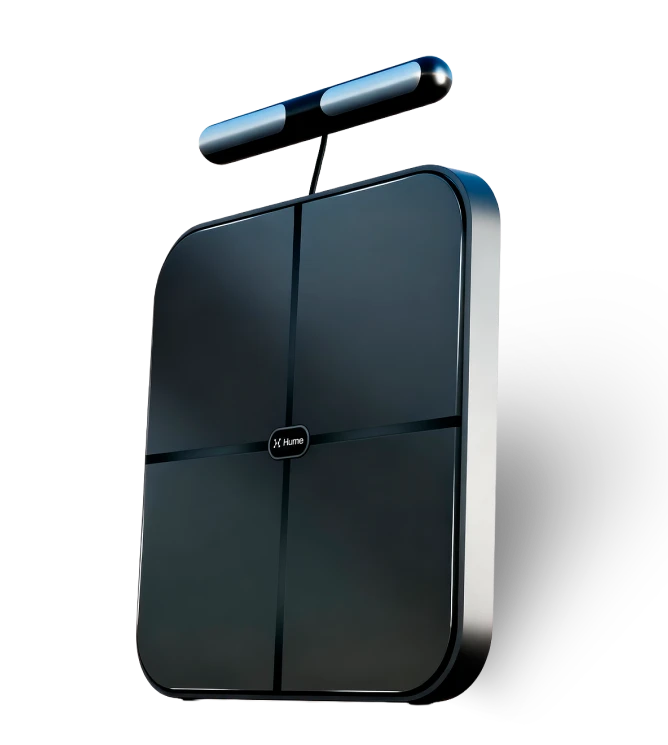
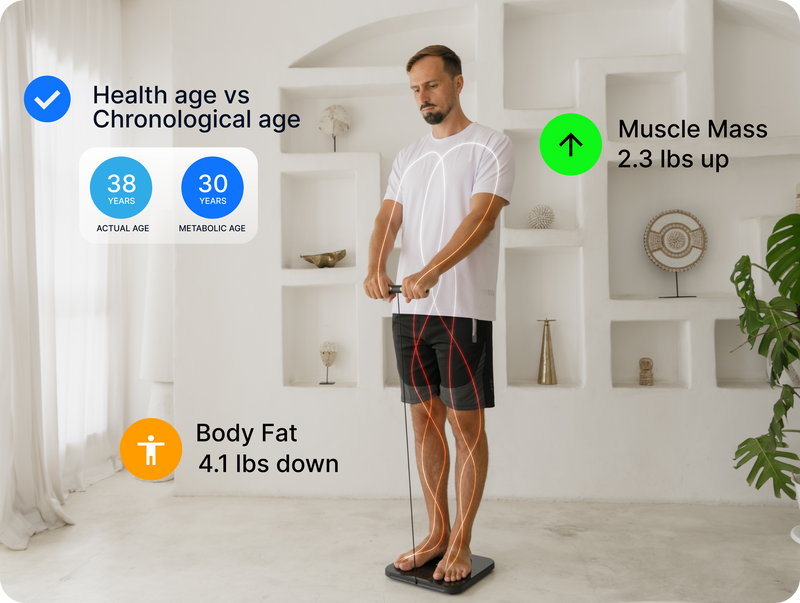
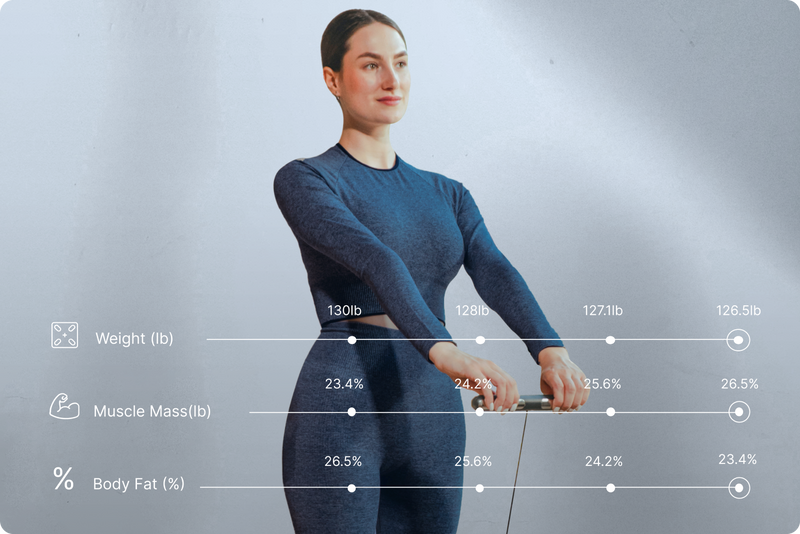
The Hume Body Pod measures body composition through 8-frequency segmental bioelectrical impedance analysis (BIA). You stand on the foot plates and hold the hand-grip handles, which adds the arms and torso to the measurement circuit rather than reading through the lower body alone. It reports body fat percentage, skeletal muscle mass, visceral fat, basal metabolic rate, hydration, bone mass, and metabolic age, and the Hume Health app stores every reading so you can watch the trend line over months.
Its main advantage over the other two is cost and focus. It is a one-time purchase with no subscription, and it does exactly one job: it tells you whether fat and muscle are moving in the direction you want. For an adult over 40 who has started resistance training, is managing weight, or simply wants to protect muscle mass with age, that is usually the whole brief. For the full breakdown of the device on its own, see our Hume Body Pod review, and for why these numbers matter after 40, see our guide to body composition after 40.
Where it gives ground: it has no heart or metabolic screening at all, and the 45-day money-back window is short for a device whose value only shows up after 8 to 12 weeks of consistent measurement. The app ecosystem is also newer and smaller than Withings’.
Choose the Hume Body Pod if…
You want to track body fat, muscle mass, and visceral fat trends over time at the lowest cost, with no subscription and no clinical features you will not use. It covers the core job most people over 40 actually need.
Hume Body Pod — one-time purchase, no subscription, 45-day money-back
Withings Body Scan 2: Best for a Near-Clinical Home Health Scan
The Withings Body Scan 2 is a different category of device. Alongside segmental fat and muscle readings from a 12-electrode BIA system, it runs a 6-lead ECG from the handle, flags hypertension risk, estimates vascular age, and includes early glycemic screening. Withings quotes more than 60 health biomarkers in total. It launched in mid-2026 at $599.95.
Core measurements do not require a subscription, but the more advanced interpretive scores sit behind Withings+ at $99 per year. The Withings app is mature, syncs cleanly with Apple Health and Google, and is the most polished ecosystem of the three.
The trade-off is obvious: you are paying four to six times the price of the alternatives for features that overlap with a blood pressure cuff, a smartwatch ECG, and routine bloodwork. If you already have those covered, most of the extra spend is redundant.
Choose the Withings Body Scan 2 if…
You want one device that reads far more than body composition, you do not already track heart rhythm or blood pressure at home, and the $599.95 price is acceptable for consolidating several health checks into a single 30-second stand.
InBody Dial H30: Best for Trusted Impedance Accuracy
InBody is the name gyms and clinics use for impedance-based body composition, and the Dial H30 brings that lineage into a home device. It uses triple-frequency segmental BIA with a hand-to-foot path, and it reports segmental fat and muscle, body water, and visceral fat. It has no ECG, no blood pressure alert, and a deliberately plain app. It sells for around $340, with refurbished units near $280.
What you are paying for is validation history. InBody’s measurement approach has the longest track record against reference methods among consumer-accessible BIA, so if the single most important thing to you is that the composition number is as trustworthy as home impedance gets, this is the pick. It does not try to be anything else.
Choose the InBody Dial H30 if…
Body composition accuracy is your top priority, you want a brand with a clinical and gym track record behind the reading, and you are fine paying around $340 for a device that adds no heart or metabolic features.
How Accurate Are These Devices?
All three estimate composition from bioelectrical impedance, not direct measurement. Impedance sends a small, imperceptible current through the body; muscle holds more water and conducts it well, fat resists it, and validated equations convert the resistance into tissue estimates. Hand-to-foot and multi-electrode designs like these three are more accurate than foot-only bathroom scales because they include the upper body in the circuit instead of extrapolating it.
Under consistent conditions, multi-frequency segmental BIA lands within roughly 2 to 4 percent of a DEXA scan for body fat percentage, compared with 5 to 8 percent or more for single-frequency foot-only scales. A 2024 peer-reviewed analysis of the reliability and accuracy of multi-frequency bioelectrical impedance analysis found comparable agreement with DEXA when measurements were taken under controlled conditions.
None of these is diagnostic-grade. DEXA at a sports medicine or radiology facility remains the reference standard, at roughly $40 to $150 per scan. A practical pattern for many adults over 40: an occasional DEXA scan to set an accurate baseline, then one of these devices at home to track the direction of travel between scans. The single most important accuracy factor for all three is measuring at the same time of day, in the same hydration state, every time.
Which Should You Buy After 40?
- You want body composition trends for the least money, no subscription: Hume Body Pod.
- You want the reading backed by the longest validation record and will pay ~$340 for it: InBody Dial H30.
- You want ECG, blood pressure risk, and metabolic screening in the same device: Withings Body Scan 2.
- You already have a blood pressure cuff and a smartwatch ECG: skip the Withings premium; Hume Body Pod or InBody covers the composition gap for far less.
- You are starting resistance training and want to confirm muscle is increasing: any of the three works; the Hume Body Pod does it at the lowest cost.
Bottom line: For most adults over 40 who simply want to see muscle and fat move in the right direction, the Hume Body Pod does that job for the least money and no subscription. Step up to the InBody Dial H30 for a stronger accuracy pedigree, or to the Withings Body Scan 2 if you want heart and metabolic screening built into the same device. A scale is one input, not the whole picture — see our guide to protein intake after 40 to protect muscle mass and our roundup of the best fitness trackers for adults over 50 for the habits and tools that move those numbers in the first place.
See the current Hume Body Pod offer (US) →
This article is educational and not medical advice. Body composition and health-scan devices are wellness tools, not diagnostic equipment. Talk to a qualified healthcare provider about individual health concerns, and before using any impedance device if you have a pacemaker or other implanted electronic device.
Frequently Asked Questions
Is the Hume Body Pod or the Withings Body Scan 2 better for someone over 40?
It depends what you want to measure. The Hume Body Pod focuses on body composition trends — body fat, muscle mass, visceral fat — at a lower one-time cost with no subscription. The Withings Body Scan 2 costs $599.95 and adds a 6-lead ECG, a hypertension risk alert, vascular age, and early glycemic screening. If you mainly want to track muscle and fat over time, the Hume Body Pod covers it for far less. If you want a near-clinical health scan in one device, the Withings is the more complete tool.
Is the Hume Body Pod or the InBody Dial H30 more accurate?
Both use multi-frequency segmental BIA with a hand-to-foot path, which is more accurate than foot-only scales. InBody has the longer validation record in clinical and gym settings and is generally treated as the accuracy benchmark among home BIA devices, at around $340. The Hume Body Pod is close in method and typically costs less. For tracking your own trends over months, the practical difference is small as long as you measure under consistent conditions.
Do I need the Withings+ subscription?
No, not for the core measurements. The Withings Body Scan 2 reports weight, segmental body composition, and the ECG without a subscription. Withings+ at $99 per year unlocks the more advanced interpretive scores. Many owners use the device without ever subscribing.
Can any of these replace a DEXA scan?
No. DEXA is the reference standard for body composition and costs roughly $40 to $150 per scan. Home impedance devices land within about 2 to 4 percent of DEXA for body fat under consistent conditions, which is adequate for tracking change over time but not for a single diagnostic-grade measurement. A common approach is an occasional DEXA baseline plus a home device for the months in between.
Which one measures blood pressure?
Only the Withings Body Scan 2, which provides a hypertension risk alert rather than a cuff-style reading. Neither the Hume Body Pod nor the InBody Dial H30 measures blood pressure or heart rhythm; both are body composition devices only.
Are these available outside the United States?
Availability varies by brand. The Hume Body Pod is sold in the United States, and in Germany, Switzerland, and Austria through a separate German-language offer page. Withings and InBody both distribute across North America, Europe, and Australia, but pricing and model availability differ by region — check the local storefront for each.
About the Author
Richard Hale writes about mobility, recovery, and evidence-based wellness strategies for adults over 40 at VitalMove40. He is an independent health writer, not a licensed medical professional. Content is educational and not a substitute for advice from a qualified healthcare provider.