

Last updated: August 19, 2026 | By Richard Hale
Creatine has spent three decades tagged as a bodybuilding powder, something for 22 year olds chasing bigger lifts. That reputation is outdated. A growing body of research now points to creatine as one of the more useful, well studied supplements for adults over 40, specifically for preserving muscle, supporting strength, and even backing up the joints that muscle protects. This guide walks through what creatine actually does, what the evidence says for adults in this age range, how to take it, and who should check with a doctor first.
This content is for educational purposes only and is not medical advice. Creatine is generally well tolerated, but anyone with existing kidney disease, liver disease, or another condition affecting these organs should talk to a healthcare provider before starting any supplement, including creatine.

Table of Contents
- What Is Creatine and How Does It Work
- Why Muscle and Strength Decline After 40
- What the Research Shows for Adults Over 40
- The Muscle-Joint Connection: Can Creatine Help Joint Health
- Does Creatine Help Bone Density Too
- Is Creatine Safe? Kidney, Liver, and Other Myths
- How to Take Creatine After 40: Dose and Timing
- Who Should Be Cautious With Creatine
- Frequently Asked Questions
What Is Creatine and How Does It Work
Creatine is a naturally occurring compound made from three amino acids, stored mostly in skeletal muscle, where it helps regenerate the fast energy your muscles use during effort. Your body makes some on its own and gets more from meat and fish, but supplementing raises muscle creatine stores well above what diet alone typically achieves. Higher stores mean more available fuel for the short, intense bursts of effort involved in lifting weights, climbing stairs, or getting up quickly from a chair.
The mechanism is straightforward. Inside muscle cells, creatine is stored mostly as phosphocreatine, a rapid-reserve fuel source that helps regenerate ATP, the molecule muscles burn for energy. During resistance exercise, having more phosphocreatine on hand lets you push out an extra rep, recover faster between sets, and train at a slightly higher intensity over time. That small edge, repeated across months of workouts, adds up to more muscle and strength than training alone tends to produce.
Of the many forms sold, creatine monohydrate is the one with by far the most research behind it. Newer forms marketed as more “advanced” (buffered, hydrochloride, or liquid versions) have not shown a meaningful advantage over plain monohydrate in head-to-head studies, despite often costing more.
Why Muscle and Strength Decline After 40
Muscle mass and strength both decline with age, and the decline accelerates noticeably after 40. Research tracking this process, sometimes called sarcopenia, estimates that adults lose roughly 3 to 5 percent of muscle mass per decade through their 30s, with that rate climbing to around 8 percent per decade after 40 and increasing further after 60.
Strength drops even faster than muscle size, since aging also affects how efficiently nerves recruit muscle fibers. Depending on the muscle group and how it is measured, studies have recorded strength losses in the range of 16 to 40 percent from midlife onward if nothing is done to counteract it. This is exactly why grip strength and leg strength are now used as predictors of long-term health, independent of body weight or muscle size alone.
The practical consequence is not just about looking or feeling less strong. Weaker muscles mean less shock absorption and support around the knees, hips, and spine, slower recovery from minor injuries, and a higher fall risk as balance-related muscle groups weaken along with everything else. Resistance training is the single most effective countermeasure, and this is the context where creatine earns its place: it is not a replacement for strength training, it is a way to get more out of it.

What the Research Shows for Adults Over 40
Multiple systematic reviews find that adding creatine to a resistance training program produces greater gains in muscle strength and lean muscle mass in older adults than resistance training alone. The additive effect tends to become clearest with training programs that run 12 weeks or longer, which lines up with how long it takes to build meaningful strength through any protocol.
A 2025 systematic review and meta-analysis focused specifically on older adults found that creatine combined with structured exercise significantly improved measures of strength and lean tissue mass compared with exercise alone, with a good safety record across the pooled studies (European Review of Aging and Physical Activity, 2025). Other meta-analyses looking specifically at older women found creatine most reliably boosted upper-body strength, with more mixed results for lower-body strength when creatine was used without resistance training, which underscores that the two work best as a pair, not as substitutes for each other.
The takeaway from the current evidence is measured rather than dramatic: creatine will not turn back the clock on its own, and it will not replace the basic requirement of progressive resistance exercise. What it reliably does, according to the pooled trial data, is help you get more strength and lean mass out of the training you are already doing.
The Muscle-Joint Connection: Can Creatine Help Joint Health
Creatine does not act on cartilage or joint tissue directly. Its connection to joint health is indirect but well documented: stronger muscles around a joint absorb more load and stress, which reduces the strain the joint itself has to handle. This is the same logic behind why physical therapists prescribe quad-strengthening exercises for knee pain rather than resting the joint.
The clearest evidence for this comes from studies in people with knee osteoarthritis specifically. A randomized, placebo-controlled trial in postmenopausal women with knee osteoarthritis gave one group creatine (a short loading period followed by 5 grams a day) alongside a lower-body resistance training program, while the other group did the same training with a placebo. The creatine group showed significantly greater improvements in physical function and stiffness, along with gains in lower-limb lean mass that the placebo group did not match (Neves et al., published in Medicine & Science in Sports & Exercise).
A more recent randomized controlled trial published in late 2025 built on this by pairing creatine with a full physical therapy program (heat therapy, electrotherapy, joint mobilization, and supervised resistance work) for adults aged 40 to 70 with knee osteoarthritis. Over four weeks, the creatine group had significantly greater reductions in pain scores, better fall-risk scores, and larger gains in isometric muscle strength and skeletal muscle mass compared with the group doing physical therapy alone (Journal of Clinical Medicine, 2025). Neither study found creatine changes cartilage or reverses joint damage. What both found is that creatine amplified the benefit of the exercise program itself, in people who already had joint problems.
For anyone managing knee or hip discomfort, that is a meaningful distinction. Creatine is not a joint pain treatment on its own. Paired with the kind of resistance work covered in our guide to strengthening exercises for arthritic knees, it appears to help that work do more.
Does Creatine Help Bone Density Too
The evidence here is genuinely mixed, and it is worth being upfront about that rather than overselling it. Some individual trials in older adults have found small increases in bone mineral density with creatine plus resistance training compared with resistance training alone, particularly at the hip and in the legs. But pooled meta-analyses combining multiple trials have generally not found a statistically significant effect on whole-body bone density (meta-analysis in the Journal of Clinical Densitometry).
The more consistent, better-supported benefit is indirect: by helping preserve muscle mass and strength, creatine may reduce fall risk, and fewer falls means fewer fractures. That is a real and useful outcome even without a direct effect on bone mineral density itself. If bone health specifically is a priority, our article on vitamin D and joint health covers a supplement with more consistent bone-related evidence.

Is Creatine Safe? Kidney, Liver, and Other Myths
For healthy adults taking standard doses, creatine has one of the strongest safety records of any supplement on the market, including for kidney and liver function. The kidney-damage concern traces back mostly to a small number of individual case reports, several involving people who already had a pre-existing kidney condition or were taking very high doses far beyond what is typically recommended, not to controlled studies in healthy people.
The 2017 position stand from the International Society of Sports Nutrition, reviewing the accumulated research literature, concluded that creatine supplementation at recommended doses does not adversely affect kidney or liver function in healthy individuals, even over years of continuous use (Kreider et al., Journal of the International Society of Sports Nutrition, 2017). A more recent review of common safety concerns reached the same conclusion, noting that temporary rises in blood creatinine after starting creatine reflect normal creatine metabolism, not organ damage, and are frequently mistaken for a kidney problem by people unfamiliar with how creatinine is measured (PMC, 2025).
Other common concerns do not hold up well either. Creatine does not cause significant hair loss based on current evidence, does not dehydrate you, and the “bloating” some people notice is mild water retention inside the muscle cells themselves, which is part of how it works, not a warning sign. That water weight is not the same as fat gain and typically levels off after the first couple of weeks.
How to Take Creatine After 40: Dose and Timing
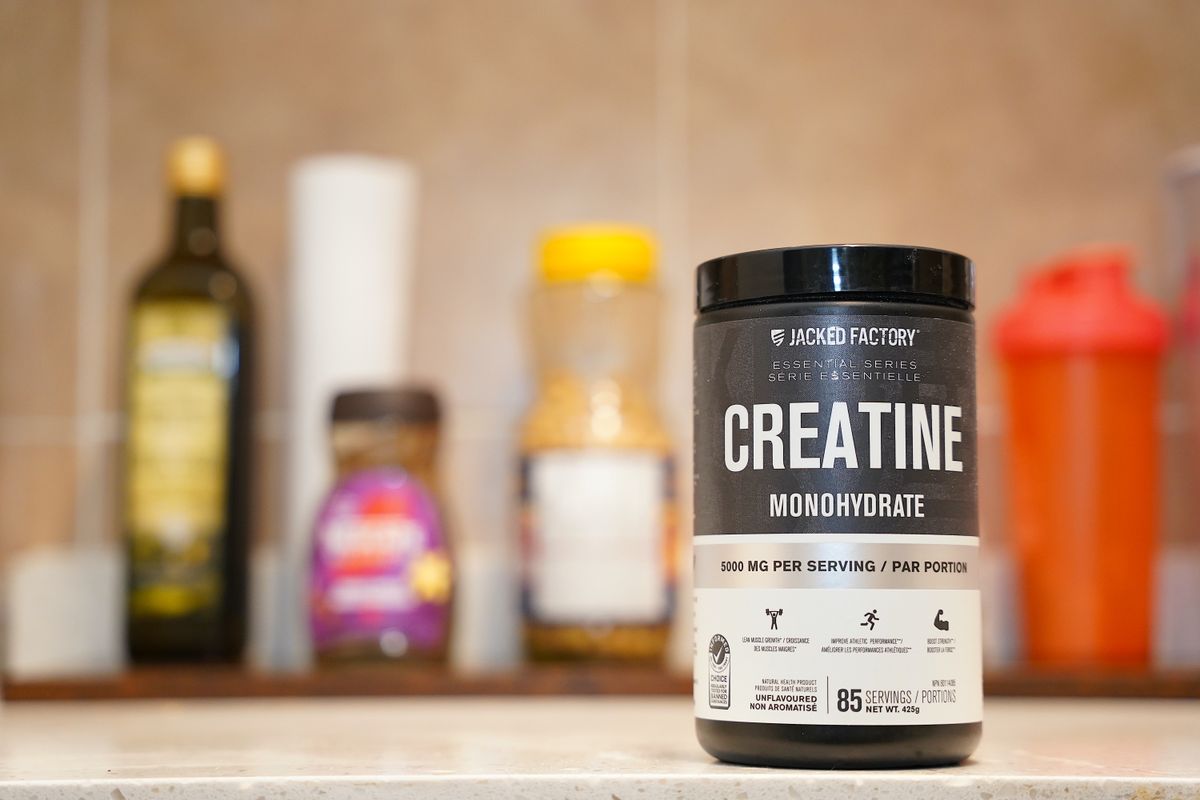
The standard maintenance dose used across most research is 3 to 5 grams of creatine monohydrate per day, taken consistently. Consistency matters more than timing. Whether you take it with breakfast, before a workout, or after one, the research does not show one timing strategy is meaningfully better than another for daily use.
- Loading vs. no loading: some protocols start with a short “loading phase” of around 20 grams a day, split into smaller doses, for 5 to 7 days before dropping to the 3 to 5 gram maintenance dose. This raises muscle creatine stores faster, over about a week instead of about a month. Skipping the loading phase and simply taking 3 to 5 grams a day from the start gets you to the same saturated muscle creatine level, it just takes roughly three to four weeks longer to get there.
- Which form: creatine monohydrate remains the best-studied and most cost-effective option. It is what nearly every trial referenced in this article used.
- Mixing it in: plain creatine monohydrate dissolves easily in water, coffee, or a protein shake and has little taste. There is no need for specialty “transport” formulas.
- Pairing with training: the research is consistent that creatine’s benefits for strength and lean mass show up alongside resistance training, not as a substitute for it. If you are building a training routine at home, our guide to a joint-friendly home gym after 40 covers equipment that pairs well with this kind of supplementation.
Who Should Be Cautious With Creatine
Most healthy adults over 40 can take standard doses of creatine without issue, but a few groups should check with a doctor first rather than starting on their own. Anyone with existing kidney disease, liver disease, or a condition that already affects how these organs function should get individual guidance before adding creatine, since the safety research is specifically about people with normal organ function.
The same caution applies to anyone taking medications that affect kidney function, such as certain blood pressure medications or NSAIDs used regularly for pain, since a doctor can advise on any interaction relevant to your specific case. People managing other chronic conditions, or anyone unsure whether a supplement fits into their current medication routine, should also raise it at their next appointment rather than guessing. This is general education, not a substitute for a conversation with your own healthcare provider about your specific health history.
Frequently Asked Questions
Does creatine actually help with joint pain?
Not directly. Creatine does not act on cartilage or joint tissue itself. What the research shows is that creatine strengthens the muscles supporting a joint when combined with resistance training, and in people with knee osteoarthritis, that combination produced better pain and function scores than resistance training alone. Think of it as amplifying the benefit of the exercise, not treating the joint directly.
How much creatine should someone over 40 take?
The standard, well-researched dose is 3 to 5 grams of creatine monohydrate per day, taken consistently. This is the same range used across most of the studies covering older adults, and higher doses have not been shown to produce meaningfully better results for general use.
Do I need to do a loading phase, or can I just take 5 grams a day?
A loading phase is optional, not necessary. Taking 20 grams a day for about a week saturates your muscle creatine stores faster. Skipping straight to 3 to 5 grams a day gets you to the same saturation point, it just takes roughly three to four weeks instead of one.
Is creatine safe for kidneys after 40?
For adults with normal kidney function, yes. Multiple reviews of the research literature, including a formal position stand from the International Society of Sports Nutrition, have found no evidence that standard creatine doses harm kidney function in healthy people, even with years of continuous use. Anyone with existing kidney disease should still check with their doctor first.
What is the best time of day to take creatine?
Timing does not appear to matter much for daily use. What matters is taking it consistently every day, since creatine works by gradually saturating muscle stores over time rather than through an acute, single-dose effect. Pick a time that is easy to remember and stick with it, whether that is with breakfast or alongside a workout.
Can women over 40 take creatine, or is it just for bodybuilders?
Creatine is not sex specific, and several of the key studies on creatine and joint health, including the postmenopausal knee osteoarthritis research referenced above, were conducted specifically in women. The strength and lean mass benefits documented in resistance-training research apply to women as well as men.
Does creatine cause bloating or weight gain?
Creatine draws a small amount of extra water into muscle cells, which can add a small amount of scale weight and a feeling of fullness in the first week or two. This is water inside the muscle, not fat, and it typically levels off rather than continuing to climb. It is not the same as bloating from digestive causes.
How long does it take to notice results from creatine?
Most people notice little on day one, since creatine works by gradually filling muscle stores rather than acting immediately. Strength and performance benefits from creatine paired with resistance training typically become measurable within 4 to 12 weeks of consistent use, and the research showing the clearest strength and lean-mass gains generally comes from programs lasting 12 weeks or longer.
Where to Go From Here
Creatine is one of the more evidence-backed, low-cost additions available for adults focused on preserving muscle and supporting the joints that muscle protects, provided it is paired with actual resistance training and taken at standard doses. If you already deal with joint discomfort, pairing this with targeted strength work matters more than the supplement itself. Our guide to exercises to strengthen knees with arthritis is a good next stop, as is our breakdown of protein intake for muscle and joint health after 40, since creatine and adequate protein tend to work together rather than as competing strategies. For anyone still recovering from a hard training session, our guide to muscle recovery after 40 covers the other side of the equation.
As always, this article is educational, not a personal recommendation. Anyone with kidney disease, liver disease, or a relevant chronic condition should loop in their doctor before adding creatine or any new supplement to their routine.
About the author: Richard Hale is an independent health writer focused on mobility, joint health, and active aging research. He is not a licensed medical professional. All content on VitalMove40 is for educational purposes only and is not a substitute for advice from a qualified healthcare provider.