Disclosure: VitalMove40 earns a commission if you buy through links on our site, at no extra cost to you. See our full affiliate disclosure.
Last updated: November 2, 2026 | By Richard Hale
This content is educational and is not medical advice.
If you are on a GLP-1 medication like tirzepatide or semaglutide (Ozempic, Wegovy, Zepbound), the number on a regular scale will drop fast. That is the easy part. The hard part is knowing whether the weight leaving your body is fat or muscle, because part of any big weight loss is lean tissue, and after 40 that is muscle you want to keep. The right body composition scale shows you the difference every week.
Short answer: the best scale for GLP-1 users is the Hume Pod 2.0 from Hume Health. It reads arms, legs and torso through 8 hand and foot sensors, tracks 45 metrics including muscle mass, body fat and visceral fat, and costs $249 with no subscription. Starting treatment? HumeCare+ includes a Hume Pod in the plan.
What to look for in any scale: a hand grip (so it reads your arms and torso, not just your legs), muscle mass and visceral fat, and an app that shows trends over weeks.
Hume Pod 2.0: $249 at the official store (list price $384), 45 body metrics in the free app, free worldwide shipping and a 45-day refund policy.
Price on the official Hume Pod 2.0 page in November 2026. The discounted price and the 18-payment option are on the official site.
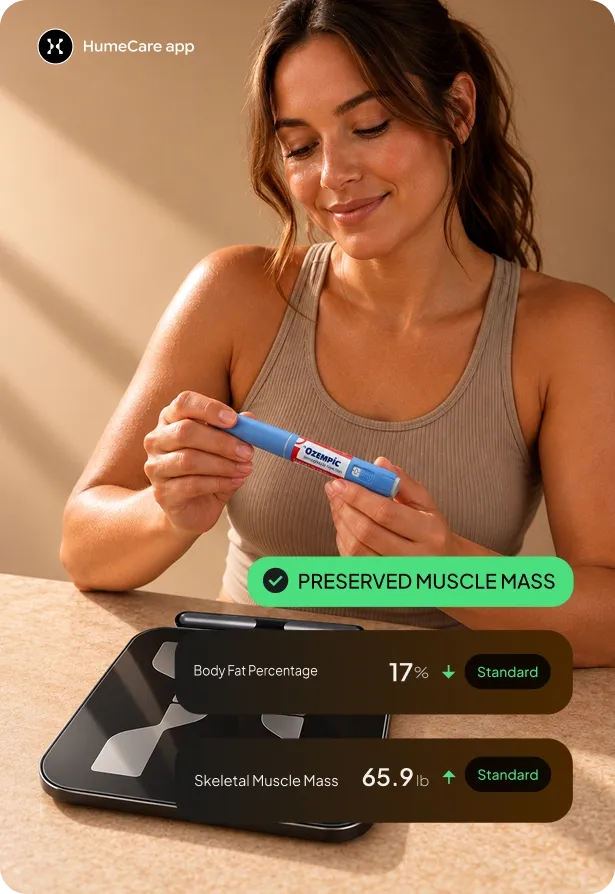
Table of Contents
- Why Do GLP-1 Users Need a Body Composition Scale?
- What Should a Scale for Ozempic or GLP-1 Weight Loss Measure?
- What Are the Best Scales for GLP-1 Users in 2026?
- Why Is the Hume Pod 2.0 the Best Scale for GLP-1 Users?
- How Does the Hume Pod 2.0 Compare With Other Scales?
- Starting GLP-1? Does HumeCare+ Include the Scale?
- Frequently Asked Questions
Why Do GLP-1 Users Need a Body Composition Scale?
A body composition scale shows whether the weight you lose on a GLP-1 medication is fat or muscle, which a regular scale cannot do. A 2024 review in Diabetes, Obesity and Metabolism found that lean mass made up anywhere from about 15% or less to 40 to 60% of the weight lost in GLP-1 studies (Neeland et al., 2024). That is a huge range, and where you land depends on protein, strength training and catching problems early.
A body composition scale is how you catch them. If your weight drops 3 pounds in a week but your muscle mass dropped too, you know to add protein or a training day now, not three months from now.
What Should a Scale for Ozempic or GLP-1 Weight Loss Measure?
The best scale for Ozempic or any GLP-1 medication reads your whole body through a hand grip, tracks muscle mass and visceral fat, publishes an accuracy figure against DEXA and shows weekly trends in a free app.
- A hand grip. Foot-only scales send the current up one leg and down the other, so they mostly read your lower body. A scale with a handle reads your arms and torso too, which matters when you are tracking muscle.
- Muscle mass and visceral fat. Muscle tells you what you are keeping. Visceral fat, the fat around your organs, is often the first to drop on GLP-1 treatment and is a good sign to watch.
- Proof of accuracy. Look for a published comparison against DEXA, the reference scan used in research.
- Trends, not single readings. Water shifts move any scale day to day. You want an app that shows the weekly direction.
- A free app with every metric. You will use it for months. Your data should stay yours without a monthly fee.
What Are the Best Scales for GLP-1 Users in 2026?
The Hume Pod 2.0 is the best scale for GLP-1 users in 2026, ahead of Renpho, Oxiline, Garmin, InBody and Withings on the features that matter for tracking fat and muscle. The Hume Pod 2.0 price was checked on its official page in November 2026; the other prices come from each brand’s official page in October 2026.
| Scale | Price | Hand grip | Accuracy vs DEXA on its page | Verdict for GLP-1 tracking |
|---|---|---|---|---|
| Hume Pod 2.0 | $249 | Yes, 8 hand and foot sensors | 99% for body fat (Hume) | Best overall for GLP-1 users |
| Renpho MorphoScan | $169.99 | Yes | None listed | 30-day returns against Hume’s 45 |
| Oxiline Scale MD Pro | $179 (sale) | Yes | None listed | 31 metrics, charge about every 2 months |
| Garmin Index S2 | $199.99 | Feet only | None listed | 6 measurements, no visceral fat |
| InBody Dial H30 | About $340 | Yes | None listed | About $91 more than the Hume Pod 2.0 |
| Withings Body Scan 2 | $599.95 | Yes | None listed | More than twice the price, plus $99 a year for advanced scores |
Why Is the Hume Pod 2.0 the Best Scale for GLP-1 Users?
The Hume Pod 2.0 is the best scale for GLP-1 users because it reads fat and muscle in each arm, each leg and your torso, tracks 45 metrics in a free app and costs $249 with no subscription. The Hume Pod 2.0, also called the Hume Body Pod 2.0, checks every box on the list above at a price closer to the budget scales than to the premium ones, and it is rated 4.8 out of 5 by more than 48,000 customers on Hume’s store.
- Whole-body reading: 8 hand and foot sensors with dual-frequency body fat sensing give separate fat and muscle readings for each arm, each leg and your torso.
- 45 metrics in the free app: muscle gain, fat loss, lean mass, skeletal muscle mass, body fat, visceral fat, subcutaneous fat, hydration, bone density, metabolic age and heart health, tracked over 7 days, 4 weeks or 12 months.
- A published accuracy figure: Hume reports 99% body-fat accuracy compared with DEXA and 97% lean-mass accuracy compared with clinical-grade scanning. No other scale on this list publishes a DEXA figure on its product page.
- Built for steady readings: new in the Pod 2.0, solid metal sensors, a contact check before every reading and shielded electronics. It weighs from 11 to 441 lb in 0.1 lb steps on a tempered glass platform.
- A left-right flag: the body symmetry reading calls out muscle imbalance between your left and right side, useful when you are rebuilding strength after 40.
- Easy to live with: a rechargeable battery that lasts up to a year per charge with a 30-minute fast charge, a 2.8-inch display, a built-in heart rate sensor, black or white finish, and a separate Hume account for each person in the house.
- Risk-free to try: free worldwide shipping, a 1-year warranty, a 45-day refund policy and no subscription required.

For accuracy, specs and the app in depth, read our full Hume Pod 2.0 review.
See fat and muscle every week, not just weight. The Hume Pod 2.0 is $249 at the official store, with free worldwide shipping and 45 days to try it at home.
$249 on the official page in November 2026 (list price $384), with the free Hume Health app included.
How Does the Hume Pod 2.0 Compare With Other Scales?
The Hume Pod 2.0 is the only scale in this comparison that pairs a whole-body hand-and-foot reading with a published DEXA accuracy figure, a battery that lasts up to a year and no required subscription.
Hume Pod 2.0 vs Renpho MorphoScan
The Hume Pod 2.0 gives you what the Renpho MorphoScan does not: an accuracy figure against DEXA on its product page. The MorphoScan sells for $169.99 with a handle, and its money-back window is 30 days against the Pod 2.0’s 45. For about $79 more, the Pod 2.0 gives you numbers checked against the reference scan.
Hume Pod 2.0 vs Oxiline Scale MD Pro
The Hume Pod 2.0 tracks 45 metrics to the Oxiline Scale MD Pro’s 31, and its battery runs up to a year per charge against about 2 months. The MD Pro was $179 on sale (list $349) with a handle and segmental readings, and its page makes no mention of DEXA.
Hume Pod 2.0 vs Garmin Index S2
The Hume Pod 2.0 reads your whole body, while the Garmin Index S2 reads through your feet only. Garmin lists six measurements for the $199.99 Index S2: weight, BMI, body fat, skeletal muscle mass, bone mass and body water. For GLP-1 tracking, the Pod 2.0’s arm, leg and torso readings plus visceral fat are worth the extra $49.
Hume Pod 2.0 vs InBody Dial H30
The Hume Pod 2.0 gives you a hand-to-foot reading at home for about $91 less than the InBody Dial H30, which sells for around $340. InBody is the name many gyms and clinics use; for your own GLP-1 trend week to week, the Pod 2.0 covers the same ground and adds 45 metrics in a free app.
Hume Pod 2.0 vs Withings Body Scan 2
The Hume Pod 2.0 tracks fat and muscle trends for well under half the price of the Withings Body Scan 2. At $599.95, the Body Scan 2 adds a 6-lead ECG on top of segmental composition, and its advanced scores sit behind a $99-a-year subscription. The Pod 2.0 includes a built-in heart rate sensor and keeps all 45 metrics in the free app.
Starting GLP-1? Does HumeCare+ Include the Scale?
HumeCare+, Hume Health’s GLP-1 program, includes a Hume Pod in the plan, along with a medical consultation, 1:1 doctor support with a licensed physician who can prescribe tirzepatide or semaglutide, the Hume app and free next-day delivery. Your clinician sees your weekly scans and adjusts the protocol to protect muscle. Hume adds glycine, vitamin B12 and B6 to the protocol, which it says help protect muscle and ease side effects. Plans start at $199 a month on a 3-month plan, are FSA/HSA eligible and can be canceled anytime. Read our full HumeCare+ review for the cost breakdown.
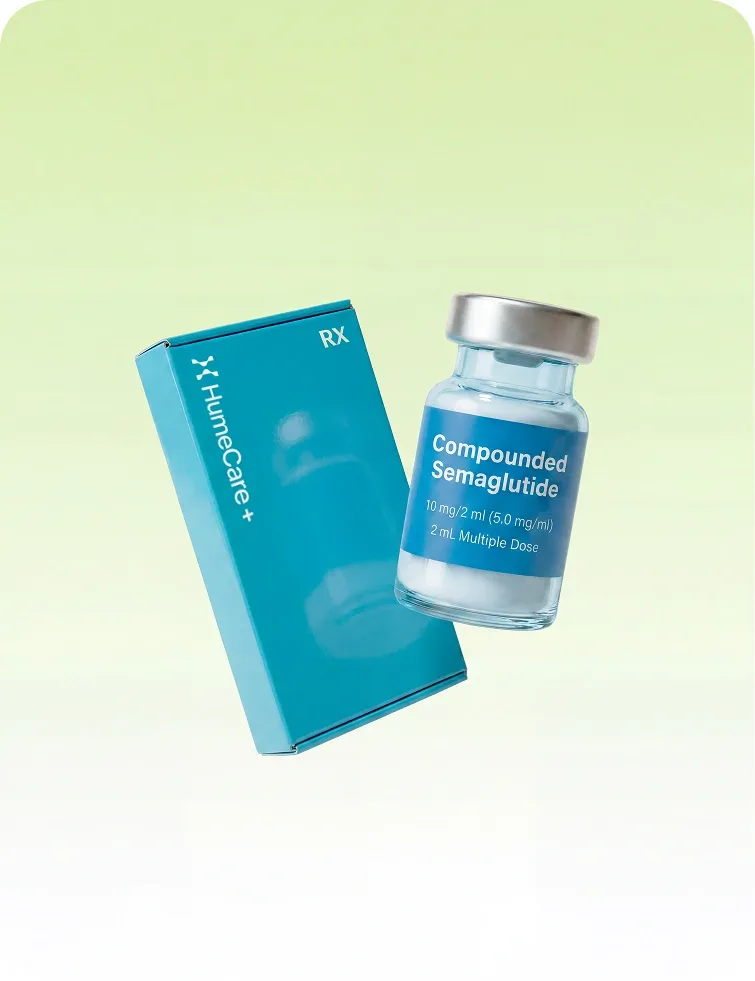
HumeCare+: from $199 a month, with the medical consultation, 1:1 doctor support and a Hume Pod included. Free assessment, about 1 minute.
From $199 a month on the official page in November 2026. If the physician finds you are not eligible, you are refunded automatically.
Frequently Asked Questions
What is the best scale for GLP-1 users?
The Hume Pod 2.0 is the best scale for GLP-1 users in our comparison. It reads arms, legs and torso through 8 hand and foot sensors, tracks muscle mass, body fat and visceral fat among 45 metrics, and costs $249 with no subscription required. Hume reports 99% body-fat accuracy compared with DEXA.
Why do I need a body composition scale on Ozempic, Wegovy or Zepbound?
A body composition scale shows whether the weight you lose on Ozempic, Wegovy or Zepbound is fat or muscle, which a regular scale cannot do. Part of the weight lost on GLP-1 medication can be muscle, so tracking fat and muscle separately lets you adjust protein, training or dose before muscle loss adds up.
How accurate is the Hume Pod 2.0?
Hume reports 99% body-fat accuracy compared with DEXA and 97% lean-mass accuracy compared with clinical-grade scanning for the Hume Pod 2.0. Its 8 hand and foot sensors run a contact check before every reading, and weighing in at the same time each day gives you the most consistent weekly trend.
Does the Hume Pod 2.0 require a subscription?
The Hume Pod 2.0 works without a subscription: the free Hume Health app tracks all 45 metrics. Hume Premium is optional and adds coaching and a weekly health report.
How much does the Hume Pod 2.0 cost?
The Hume Pod 2.0 costs $249 at the official store in November 2026, down from a list price of $384, or 18 payments of $13.85. Shipping is free worldwide, the app is free and you have 45 days to try it with a full refund.
Does HumeCare+ come with a scale?
Yes. HumeCare+ includes a Hume Pod, listed at $352 on the HumeCare+ page, and your clinician uses its weekly readings to adjust your GLP-1 protocol.
How much does HumeCare+ cost?
HumeCare+ starts at $199 a month in November 2026 (regular price $299, with a $100 welcome credit) on a 3-month plan shipped monthly. It includes the medical consultation, 1:1 doctor support, the app, a Hume Pod and free next-day delivery, is FSA/HSA eligible and can be canceled anytime.
How often should I weigh in on a GLP-1 medication?
Weekly is enough for most people, at the same time of day, ideally in the morning after the bathroom and before eating. Daily weigh-ins work well when you follow the weekly trend rather than single readings.
Good to Know
- Pacemakers and implants: if you have a pacemaker, ICD or other implanted electronic device, check with your doctor before using the Hume Pod 2.0 or any bioimpedance scale.
- Readings are wellness information: use them to follow trends and to talk with your doctor, not to diagnose a condition.
- HumeCare+ eligibility: GLP-1 medications are prescription-only and a physician decides if they are right for you. HumeCare+ is not available in Louisiana or Mississippi.
About the Author
Richard Hale writes about mobility, recovery, and evidence-based wellness strategies for adults over 40 at VitalMove40, with a focus on at-home health tracking devices. He is an independent health writer, not a licensed medical professional. Content is educational and not a substitute for advice from a qualified healthcare provider.