
Last updated: July 14, 2026 | By Richard Hale
Cycling is one of the most joint-friendly aerobic activities available to adults over 40. The non-weight-bearing nature of riding removes the impact load that makes activities like running problematic for people with hip and knee arthritis, while still providing cardiovascular and muscular benefits. Properly set up and progressively introduced, cycling is both therapeutic and highly sustainable long-term.
This content is for educational purposes only and is not medical advice. If you have significant hip or knee OA, or have had recent joint replacement surgery, consult your surgeon or physiotherapist before beginning a cycling program.

Table of Contents
- Why Cycling Is Joint-Friendly
- Evidence in Joint Conditions
- Bike Setup: The Critical Variables
- Outdoor Cycling vs. Stationary Bike
- E-Bikes as an Accessible Option
- How to Get Started After 40
- Frequently Asked Questions
Why Cycling Is Joint-Friendly
During walking, the knee joint absorbs forces approximately 2-3 times body weight with each step. During running, this rises to 7-12 times body weight. During cycling, the knee bears significantly lower compressive forces because the body weight is supported by the saddle rather than the joint, the knee primarily resists the rotational load of the pedaling action rather than vertical impact. This makes cycling appropriate for people who cannot tolerate the repetitive impact of walking for extended periods.
Cycling also provides the “pumping” effect that joint health requires. Synovial joints depend on movement to circulate synovial fluid, the nutrient and lubricant medium that the cartilage absorbs like a sponge. Sedentary behavior starves the cartilage of this circulation. The repetitive, low-load movement of cycling promotes synovial fluid distribution across the joint surfaces without the impact stress that accelerates cartilage wear.
The muscular demand of cycling strengthens the quadriceps, hamstrings, and gluteal muscles that support and stabilize the knee and hip joints. Muscle strength is one of the most modifiable factors in OA progression and pain, particularly quadriceps weakness, which is strongly associated with knee OA severity.
Evidence in Joint Conditions
Knee OA: cycling is well-supported for knee OA management. A 2019 RCT in the Journal of Rheumatology compared cycling to walking in adults with knee OA, both groups improved pain and function, but cycling produced equal or greater improvements with less discomfort during the exercise sessions. A 2021 systematic review in the British Journal of Sports Medicine confirmed that stationary cycling is an effective, low-risk intervention for knee OA pain and function.
Hip OA: the non-weight-bearing nature is similarly beneficial for hip OA. The cyclic hip flexion-extension of pedaling maintains range of motion in the hip joint, which is a common secondary casualty of hip OA progression. Range of motion maintenance is particularly important for preventing the functional decline that accelerates disability.
After knee replacement: cycling on a stationary bike is typically one of the first exercises introduced in rehabilitation after total knee replacement, usually within 2-3 weeks post-surgery. The range of motion required for cycling (approximately 110 degrees of knee flexion) is a rehabilitation milestone, and the low joint load makes it safe during the healing period.
Bike Setup: The Critical Variables
Saddle height (most important): when the pedal is at its lowest point, the knee should be at 25-35 degrees of flexion, not fully extended (which overstresses the knee in extension) and not deeply bent (which increases patellofemoral joint pressure). The hip should not rock side to side when pedaling, which indicates the saddle is too high. A common starting point: saddle height set so the heel can touch the pedal at the bottom of the stroke, with the leg nearly straight, then place the ball of the foot on the pedal, which produces the correct flexion angle.
Saddle fore-aft position: when the pedal is at the 3 o’clock position (horizontal forward position), the front of the kneecap should be directly above the pedal axle. Too far forward increases patellofemoral joint load; too far back stresses the posterior knee structures.
Handlebar height: for joint health (rather than performance), an upright position with handlebars close to saddle height or slightly higher is preferable to aggressive forward-leaning positions. An upright posture reduces neck, shoulder, and lower back strain and allows the hip to move through a comfortable range of flexion during the pedaling stroke.
Cadence: higher cadence (pedaling faster in an easier gear, 80-90 RPM) reduces the force per pedal stroke compared to lower cadence (50-60 RPM in a harder gear). For joint health, a lighter gear with higher cadence is consistently recommended. The “grinding” sensation from too hard a gear means higher joint load per stroke.
Outdoor Cycling vs. Stationary Bike
Both are beneficial, with different advantages. Stationary bikes provide a controlled environment with no falls risk, consistent workload, and the ability to stop immediately, which makes them safer for people with significant balance issues or severe joint pain during the initial return-to-exercise period. They allow precise cadence and resistance monitoring.
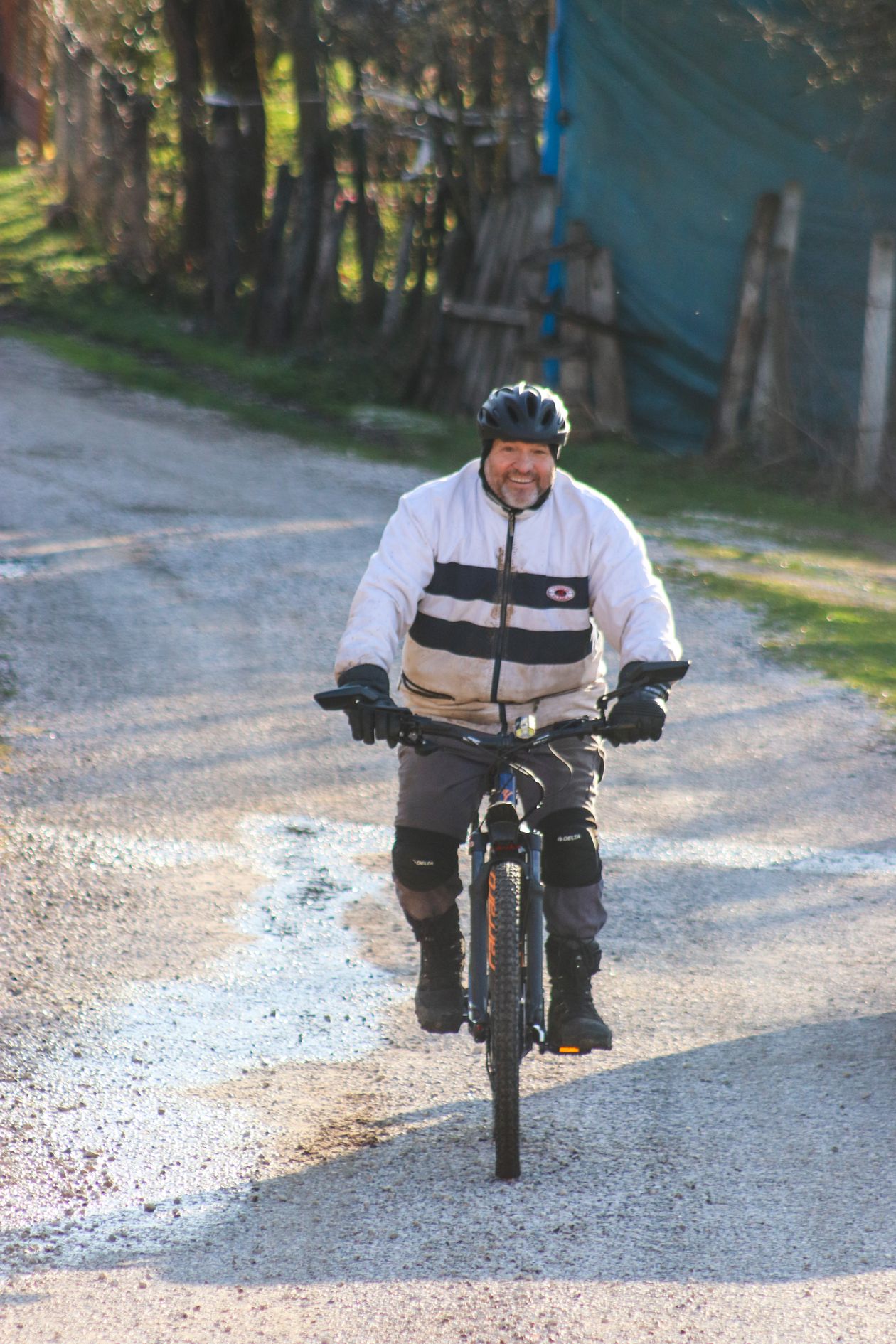
Outdoor cycling adds balance demands, proprioceptive challenge, and the psychological benefit of environmental engagement, factors that are genuinely positive for active aging. The uncontrolled terrain of outdoor cycling can introduce jarring and impact that a stationary bike eliminates, but this is minimal on paved surfaces and cycle paths.
Recumbent bikes (whether stationary or outdoor) are an excellent option for adults with significant lower back pain or hip OA. The semi-reclined position reduces hip flexion demands and lower back strain, making them accessible to people who cannot tolerate an upright cycling position.
E-Bikes as an Accessible Option
Electric-assisted bikes (e-bikes) provide pedal assistance that reduces the cardiovascular and muscular demand of cycling without eliminating it. For adults returning to cycling after a long period of inactivity, managing a cardiac condition, or coping with significant joint pain that makes unassisted cycling impractical, e-bikes provide a genuine solution.
Research on e-bike use in older adults confirms that riders do still engage in meaningful moderate-intensity exercise, the assistance enables longer rides and routes with hills that would otherwise be prohibitive, while the pedaling action maintains the joint health benefits. Heart rate data from e-bike studies shows consistent moderate-intensity cardiovascular engagement despite the assistance.
E-bikes have become increasingly mainstream and affordable. For adults who would otherwise not cycle due to cardiovascular limitations or significant joint pain, they are a clinically sensible option that enables an activity with significant documented joint and cardiovascular benefits.

How to Get Started After 40
For sedentary adults or those returning to cycling after a significant gap:
- Weeks 1-2: 15-20 minute sessions, 3x/week, easy resistance, focus on smooth pedaling action at 80+ RPM cadence
- Weeks 3-4: extend to 25-30 minutes, same frequency and low intensity
- Month 2: add a fourth session, begin introducing one moderate-effort session per week where breathing becomes noticeable but conversation is still possible
- Month 3+: progressively extend duration and vary intensity as tolerated
Joint pain during cycling that is above a 3/10 and does not settle within 24 hours suggests too much load, reduce duration or resistance. Mild muscle soreness (DOMS) is expected and appropriate. Joint pain that is sharp, swelling-producing, or persists more than 24-48 hours warrants a reassessment of saddle height and intensity before continuing.
Frequently Asked Questions
Is cycling good for knee arthritis?
Yes, consistently. Multiple RCTs and systematic reviews confirm that cycling (both stationary and outdoor) reduces pain and improves physical function in knee OA. The non-weight-bearing nature of cycling makes it tolerable when walking is painful, and the muscle strengthening effect on the quadriceps provides significant long-term joint stabilization benefit. It is one of the most commonly recommended exercises by rheumatologists and orthopedic surgeons for knee OA.
What is the best bike for someone with knee pain?
A bike that can be fit properly to your body dimensions is more important than the type. For people with significant knee pain, a stationary upright or recumbent bike allows the most precise setup and the safest environment to start. For outdoor cycling, a hybrid or city bike with an upright handlebar position is preferable to a road bike with aggressive forward geometry. The saddle height adjustment is the most critical variable regardless of bike type.
Is cycling good for knee arthritis?
Yes, cycling is one of the most recommended exercise modalities for knee osteoarthritis. The circular pedalling motion loads the knee without the impact of walking or running, and the seated position reduces axial load. Studies consistently show cycling reduces knee pain and improves function in adults with knee OA. Correct bike fit is essential: seat height should allow the knee to be at 25 to 30 degrees of flexion at the bottom of the pedal stroke. Low resistance and higher cadence are preferable to high resistance and slow cadence for adults with joint concerns.
Does cycling help with hip pain?
Cycling can be beneficial for hip pain related to weak hip abductors and external rotators. However, cycling primarily trains the hip in flexion and extension, which may not adequately address abductor and external rotator weakness that underlies much adult hip pain. Hip impingement can be aggravated by cycling if the seat is too low, forcing the hip into end-range flexion at the top of each pedal stroke, raising the seat resolves this in most cases. For hip osteoarthritis, cycling is generally appropriate and less provocative than weight-bearing exercise.
How long should I cycle for joint health after 40?
For cardiovascular and joint health benefits, 150 minutes of moderate-intensity cycling per week is the evidence-supported target. For adults new to cycling or returning after a break, 15 to 20 minute sessions at comfortable resistance initially, increasing by 10 to 15 minutes per week, allows joints and tendons to adapt at the rate the cardiovascular system typically gets credit for. Consistency at a manageable volume is more beneficial than occasional high-intensity sessions, joint cartilage is nourished by regular movement, not by the intensity of any single session.
About the author: Richard Hale is an independent health writer focused on mobility, joint health, and active aging research. He is not a licensed medical professional. All content on VitalMove40 is for educational purposes only and is not a substitute for advice from a qualified healthcare provider.