Disclosure: VitalMove40 earns a commission if you buy through links on our site, at no extra cost to you. See our full affiliate disclosure.
Last updated: November 3, 2026 | By Richard Hale
This content is educational and is not medical advice.
Metabolic age is the Hume Pod 2.0 reading that turns your whole body composition into one easy number: an age you can set next to your real one. Seeing “35” when you are 45 feels great. Seeing a number above your birthday is the push many people over 40 need to start lifting. This guide explains what the number means, how the Hume Pod calculates it, how accurate it is and how to move it down.
Quick answer: The Hume Pod 2.0 calculates metabolic age from a full body composition scan. Its 8 hand and foot sensors measure fat mass and lean mass in your arms, legs and torso, and Hume’s algorithm compares that profile with your actual age. More muscle and less fat bring the number down.
How to use it: follow the weekly trend in the free Hume Health app. The Pod 2.0 is a one-time purchase, and metabolic age is included with every scan.
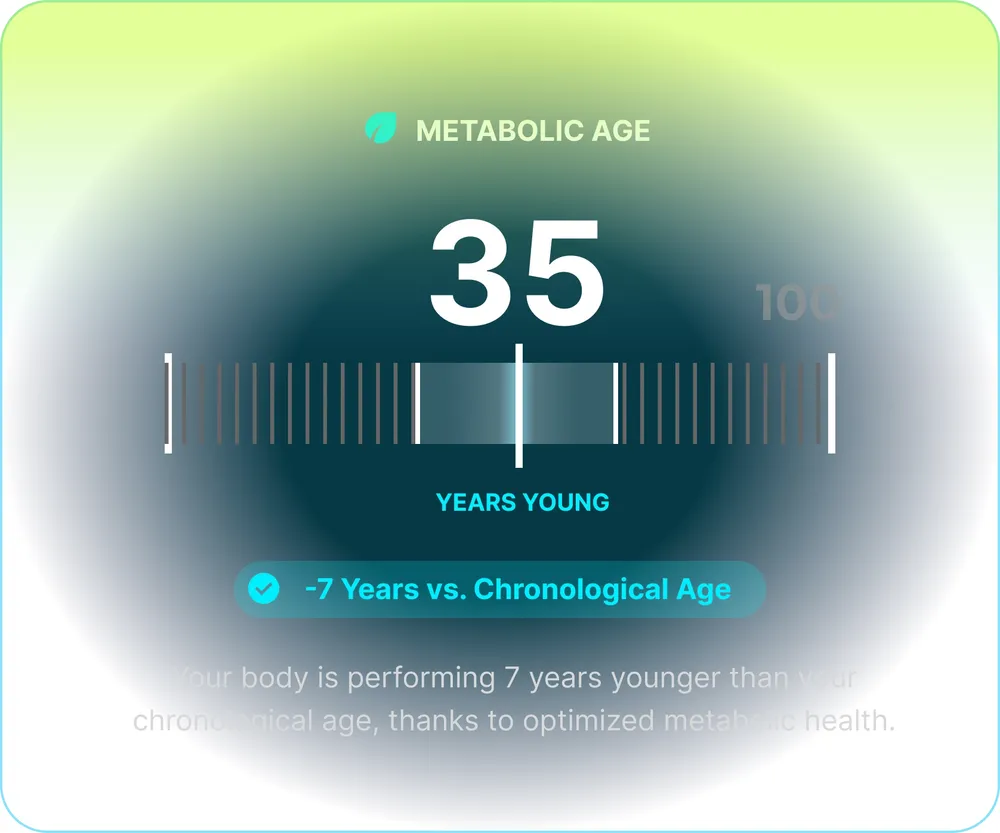
Table of Contents
- What Is Metabolic Age on the Hume Pod 2.0?
- How Does the Hume Pod Calculate Metabolic Age?
- How Accurate Is the Hume Pod 2.0 for Metabolic Age?
- What Does Your Hume Pod Metabolic Age Mean?
- How Can You Lower Your Metabolic Age After 40?
- Hume Pod Metabolic Age FAQ
What Is Metabolic Age on the Hume Pod 2.0?
Metabolic age is a comparison of your body’s condition with your actual age, shown as a number of years. Hume Health defines it as “a comparison of your body’s biological condition relative to your actual age, reflecting how efficiently your body is functioning.” A metabolic age below your real age means your body profile matches that of a younger person. A metabolic age above it means your profile matches an older one.
On the Hume Pod 2.0, metabolic age is one of 45 metrics, alongside body fat, lean mass, skeletal muscle mass, visceral fat, subcutaneous fat, hydration, bone density and heart health. Its strength is simplicity: it rolls all of those readings into one number you want to see going down.
How Does the Hume Pod Calculate Metabolic Age?
The Hume Pod calculates metabolic age in three steps: a body composition scan, an estimate of your resting metabolism, and a comparison of that profile with your actual age.
Step 1, the scan. When you stand on the Pod 2.0 and hold the handle, its 8 hand and foot sensors send a small dual-frequency current through your arms, torso and legs. Lean tissue, which holds a lot of water, conducts it easily; fat resists it. From that, the Pod estimates your fat mass and lean mass for each arm, each leg and your torso. The 2.0 runs a contact check before every reading, so each scan starts from solid contact.
Step 2, your resting metabolism. How many calories you burn at rest depends mostly on your lean mass. A classic review of the research found that fat-free mass is the main predictor of resting energy expenditure in adults (Cunningham, 1991). The more muscle the scan finds, the higher your estimated resting metabolism.
Step 3, the age comparison. Your composition and resting metabolism are set against what is typical for people of different ages, together with the height, age and sex you enter in the app. The age your profile matches is your metabolic age. The exact weighting is Hume’s own Pod 2.0 algorithm, which Hume says was put through independent clinical testing.

How Accurate Is the Hume Pod 2.0 for Metabolic Age?
The Hume Pod 2.0’s metabolic age is as accurate as the body composition reading underneath it, and Hume reports 99% body-fat accuracy compared with DEXA and 97% lean-mass accuracy compared with clinical-grade scanning. Metabolic age is built from fat mass and lean mass, so a strong reading of those two numbers is what makes it meaningful.
For the 2.0, Hume moved to solid metal sensors, added the contact check before each reading and shielded the electronics. The way to get the most from the number is to read it as a trend: weigh in at the same time each morning and watch the direction over two to four weeks. For the full breakdown of how accurate the Hume Pod is, metric by metric, see is the Hume Body Pod accurate.
What Does Your Hume Pod Metabolic Age Mean?
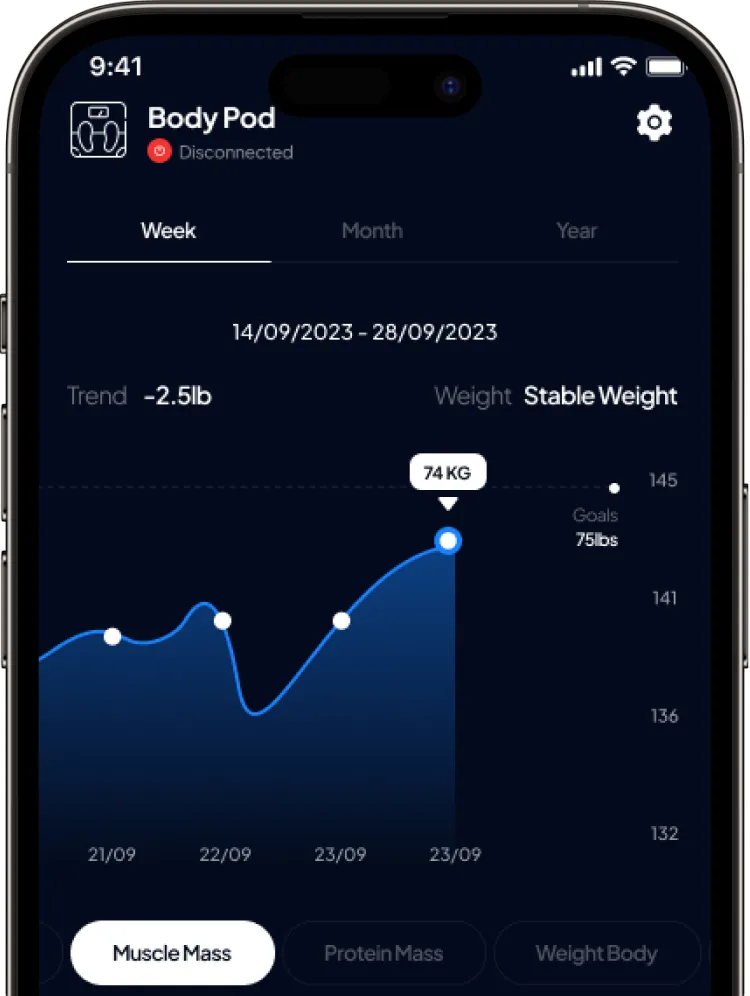
A Hume Pod metabolic age below your real age means your muscle-to-fat profile looks younger than your years, and a number above it shows exactly where to work: more muscle, less fat.
- Lower than your real age: your muscle-to-fat profile is in good shape. Your goal is to keep it there as the years pass.
- About the same as your real age: you are typical for your age. Adding muscle is the fastest way to pull it lower.
- Higher than your real age: your profile has more fat and less muscle than is typical for your age. This is common after 40 and very responsive to change, which is the encouraging part.
Hume says its Pod 2.0 algorithm was put through independent clinical testing and that “73% saw a measured improvement on metabolic age.” It is a number that moves when your habits move.
How Can You Lower Your Metabolic Age After 40?
You lower your metabolic age by building muscle and losing fat, because those are the two inputs the number rests on. These are the habits that change your composition:
- Strength train two or three times a week. In a trial of dieting adults over 65, those who did resistance training lost far less lean mass than those who only did aerobic exercise (Villareal et al., 2017).
- Eat enough protein, spread across your meals, so your body has what it needs to keep and build muscle.
- Lose fat steadily. Gradual fat loss protects your muscle, which keeps metabolic age heading down.
- Sleep and move every day. Daily walking and steady sleep support the whole picture.
- Measure the same way each time: in the morning, after the bathroom, before eating or drinking a lot.
Track your metabolic age at home. The Hume Pod 2.0 is $249 at the official store (list price $384), with all 45 metrics in the free app, free shipping and a 45-day full refund.
Price on the official Hume Pod 2.0 page at the time of writing, November 2026. The discounted price is on the official site.
Hume Pod Metabolic Age FAQ
How does the Hume Pod calculate metabolic age?
The Hume Pod 2.0 measures your fat mass and lean mass through 8 hand and foot sensors, estimates your resting metabolism from your lean mass, and compares that profile with what is typical for your age. The exact weighting is Hume’s own algorithm, which Hume says went through independent clinical testing.
What is metabolic age?
Metabolic age is a comparison of your body’s condition with your actual age. Hume Health describes it as reflecting how efficiently your body is functioning. A metabolic age lower than your real age means your body composition looks like that of a younger person.
What is a good metabolic age?
Anything at or below your real age is a good sign. Lower is better, because it means your muscle-to-fat profile looks like that of a younger person.
Why is my metabolic age higher than my real age?
Usually because your body has more fat and less muscle than is typical for your age. It is common after 40 and responds well to strength training, enough protein and gradual fat loss.
How accurate is the Hume Pod 2.0?
Hume reports 99% body-fat accuracy compared with DEXA and 97% lean-mass accuracy compared with clinical-grade scanning for the Pod 2.0. Metabolic age is built on those fat and lean readings, and it is most useful as a trend over weeks.
How fast can metabolic age change?
Body composition shifts over weeks, so check the trend every two to four weeks of steady strength training and better eating. Hume says that in independent clinical testing of its Pod 2.0 algorithm, “73% saw a measured improvement on metabolic age.”
Does the Hume Pod 2.0 need a subscription to show metabolic age?
Metabolic age comes free with every scan. The Hume Pod 2.0 is a one-time purchase, and the free Hume Health app is included and shows all 45 metrics, metabolic age among them.
What does the Hume Pod 2.0 measure besides metabolic age?
The Pod 2.0 tracks 45 metrics, including body fat, lean mass, skeletal muscle mass, visceral fat, subcutaneous fat, hydration, bone density, body symmetry and heart health. It has 8 hand and foot sensors for arm, leg and torso readings, 4 weight sensors with a range of 11 to 441 lb in 0.1 lb steps, a built-in heart rate sensor, a 2.8 inch display and a rechargeable battery that lasts up to a year per charge.
Is the Hume Pod 2.0 worth it for tracking metabolic age?
Yes. The short Hume Pod 2.0 review for metabolic age tracking: one scan at home gives you metabolic age plus 44 other metrics, with separate readings for your arms, legs and torso. It is $249 at the time of writing (November 2026), with free shipping, a 1-year warranty and a 45-day full refund.
Watch your metabolic age go down, week by week. The Hume Pod 2.0 is $249 (list price $384), a one-time purchase with the free app included and a 45-day full refund.
$249 on the official Hume Pod 2.0 page at the time of writing, November 2026.
Good to Know: Hume Pod 2.0 Safety Notes
- Pacemakers and implants: if you have a pacemaker, ICD or other implanted electronic device, check with your doctor before using the Pod 2.0, as with any bioimpedance scale.
- Readings are wellness information: body composition scales are wellness tools, not diagnostic equipment. Use the readings to follow trends and to talk with your doctor.
About the Author
Richard Hale writes about mobility, recovery, and evidence-based wellness strategies for adults over 40 at VitalMove40, with a focus on at-home health tracking devices. He is an independent health writer, not a licensed medical professional. Content is educational and not a substitute for advice from a qualified healthcare provider.